The big picture


Warning: Undefined variable $num in /home/shroutdo/public_html/courses/wp-content/plugins/single-categories/single_categories.php on line 126

Warning: Undefined variable $posts_num in /home/shroutdo/public_html/courses/wp-content/plugins/single-categories/single_categories.php on line 127

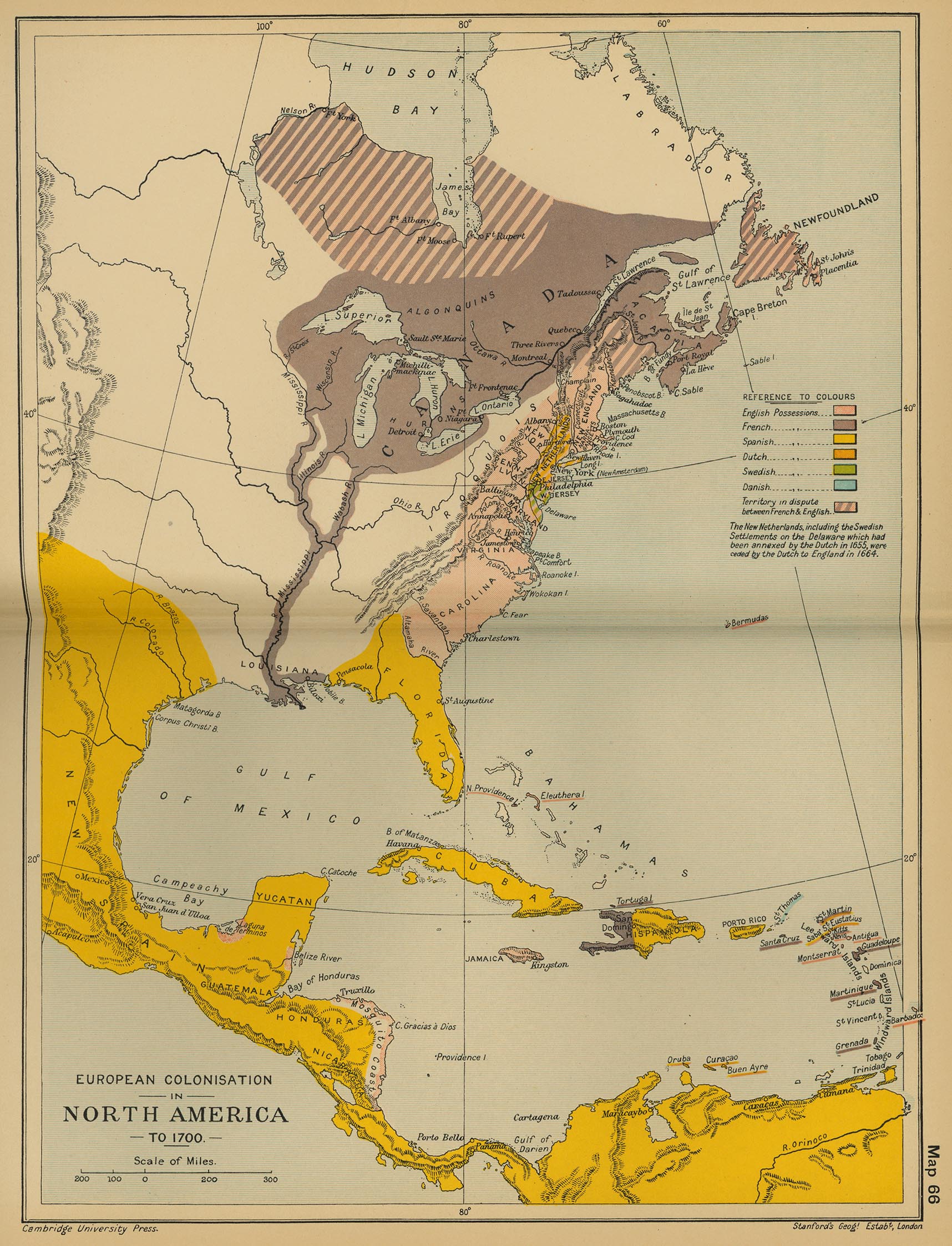
We, like Taylor, have been approaching colonial American history in a regional manner – jumping from North to South to Middle colonies as they developed.  This has been largely because these regions developed separately from one another – in any given year, someone in Plymouth mightn’t know what someone in Jamestown was up to.  This week, that begins to change, as the British colonies in North America begin to cohere.  In the spirit of that cohesion, I thought it might be worthwhile to give you all a “big picture” view of what we’ve been studying – so here are two visualizations.  The first is a timeline of European colonialism in North America from 1492 to the American Revolution.  The different colors represent different imperial powers – Red is Spain, Purple is Dutch, Blue is England, Maroon is Sweden and Green is French:

Big picture colonial timeline

The second is a map of North America circa 1700, which shows all of the different areas claimed (as distinct from actually settled) by different European powers.  Hopefully, together these two documents will give you a sense of what’s been happening across colonial North America, rather than just in each separate region.

Puritans and Indians reading


Warning: Undefined variable $num in /home/shroutdo/public_html/courses/wp-content/plugins/single-categories/single_categories.php on line 126

Warning: Undefined variable $posts_num in /home/shroutdo/public_html/courses/wp-content/plugins/single-categories/single_categories.php on line 127

What I found most interesting in reading this chapter was that the Puritans had trouble getting their vision of a “city on a hill” to come to fruition, and Taylor references how the American Indians had a much healthier communal society that took care of everyone in the community. It is extremely ironic that many European immigrants saw these people as Barbarians when the native people had what the Puritans were searching for (aside from the absence of Christianity in the native people’s communities). Taylor Simmons does point out that not everyone saw these ‘Barbarians’ as savage, sub-human people groups, but the large majority of the settlers did not care enough to consider the American Indians’ life style, so most people did not have the same revelation as Roger Williams. I think that overall (Alan) Taylor does a good job of portraying the colonial Indian wars, and I understand that covering an entire war in two to three pages is extremely difficult, but I wish he would have spent more time covering the Pequot War because I feel like the colonists’ attitudes to the Indians is portrayed very clearly. He could have built on Governor William Bradford’s view that “God had found them worthy” (196) to take over the land. Also, many religious leaders’ responses to the war contradicted what Williams thought, including Reverend John Robinson of the Plymouth Colony who said, “how happy a thing it had been, if you had converted some before you had killed any…” (197). Religion continued to play a key roll in the settlers’ attitude to the Indians, and Taylor could have devoted more time to this topic. I like Taylor’s use of primary sources in the chapter, and the quotes he uses prove how much religion dictated confrontation with the Indians. I just wish he would have built on these sources more. Taylor supports his argument of colonists changing the environment (and, therefore, the lives) of the American Indians and how they dwindled into a small minority because of the effect of European settlement.

Davis, Chapter 4: The Origins of Race-Based Slavery


Warning: Undefined variable $num in /home/shroutdo/public_html/courses/wp-content/plugins/single-categories/single_categories.php on line 126

Warning: Undefined variable $posts_num in /home/shroutdo/public_html/courses/wp-content/plugins/single-categories/single_categories.php on line 127

Sherwood Callaway
HIS 141, Blog Post 3

The institution of slavery as it existed in the American south would have been wholly unfamiliar to someone living in the 15th century. In the early modern world, Europeans abstained from slavery entirely, celebrating the ““non-enslavability” of Christian whites.” Africans only enslaved prisoners of war and debtors. Islamic states throughout the Mediterranean traded captives from the Black Sea area. The ancient Romans had operated similarly, refusing to make distinctions based on race, religion, etc.

 
In chapter 4 of Inhuman Bondage, author Davis investigates the origins of race-based slavery, a comparatively peculiar phenomenon. Jacob Newton suggested in his blog post that “a revival in classical learning” was responsible for rationalizing this kind of servitude. I would argue that there exists no classical precept that supports such a claim. Even the Gallic tribes, who were considered barbarians and defeated by Caesar, we’re only enslaved as prisoners of war. Rather, it is the Christian tradition, which dominated early modern Europe, that established the ideological foundation for race-based slavery. For example, the biblical “Curse of Ham” set a precedent for racial distinctions. The ancient Hebrewes enslaved their Canaanite enemies, and Europeans felt a similar “need to enslave “outsiders”.” Because of the darkness of their skin, Africans appeared dirty, uncivilized, and foreign. For the Portuguese in Brazil especially, the process of Christianizing these people became a particularly popular justification.

 
In the same chapter, Davis also supports the ideas of historian David Eltis, who argued that plantation slavery was an economic inevitability: a natural “next step” for the European economy, and a predecessor of “the efficiency, organization, and global interconnectedness of industrial capitalism.” The political and commercial environment of the early modern period made African slave labor a particularly appealing concept. Ironically, if not for religion and morality, the institution of slavery could have expanded infinitely for the want of profit.


Some additional thoughts on trade, race and terminology.


Warning: Undefined variable $num in /home/shroutdo/public_html/courses/wp-content/plugins/single-categories/single_categories.php on line 126

Warning: Undefined variable $posts_num in /home/shroutdo/public_html/courses/wp-content/plugins/single-categories/single_categories.php on line 127

Wells helpfully pointed the class to this article from NPR’s Codeswitch Blog, which tackles the history of the phrase “Indian Giver.”  While Wells rightfully brought this up in terms of the ways in which terminology can be (knowingly or unknowingly) insulting, I’d also encourage all of you to think about it in terms of the trade practices we spoke about on Tuesday.  In the context of cementing relationships through trade, civility and exchange, the expectation that gifts be reciprocated begins to look less like rudeness, and more like a part of commercial negotiations.

For more on mutual misunderstandings in French-Indian trade, see Nancy Shoemaker’s article “Body Language: The Body as a Source of Sameness and Difference in Eighteenth-Century American Indian Diplomacy East of the Mississippi.” in Janet Moore Lindman and Michele Lise Tarter’s edited volume A Centre of Wonders: The Body in Early America.

American Colonies, Chapter 3: “Conquest and Race in New Spain”


Warning: Undefined variable $num in /home/shroutdo/public_html/courses/wp-content/plugins/single-categories/single_categories.php on line 126

Warning: Undefined variable $posts_num in /home/shroutdo/public_html/courses/wp-content/plugins/single-categories/single_categories.php on line 127

In Chapter 3, Taylor demystifies the “Black Legend” of Spanish cruelty by highlighting both the atrocities and developments of Spanish conquest—a lucrative venture for bullish entrepreneurs and an onerous governance for the Spanish crown. Continuing his comparative perspective, Taylor examines the Spanish conquest through lens of the Native peoples as well as the Spanish. I, however, found his description of the Spanish motives especially interesting. He notes that while Spanish colonization was “a private enterprise . . . in the pursuit of profit,” it also served to extend the control of the Spanish crown and Catholic church by means of the requerimento (57). Though driven by seemingly disparate interests, the Spanish conquerers—in the Taylor’s presentation, at least—used their separate interests as motives and justifications for the atrocities of their conquests, particularly at Tenochtitlán. Describing Cortes’ visit to the enchanting city—I say “enchanting” because of Bernal Diaz’s description of it—Taylor writes that the Spanish explorers were “inflamed [with] desire to conquer, plunder” (53). Yet, they abhorred the gruesome rituals and idolatry of the Aztecs. So they employed their religious duty ‘to give light to those . . . in darkness’ as justification to eclipse the Aztec culture and society with their own customs (58). Perhaps no event described in Chapter 3 better reflects the Spanish cultural conquest than the construction of the cathedral in Mexico City. Tenochtitlán’s ruins became the cornerstones of a Christian temple, born on the backs of its own people.

I find it interesting that among the list of Spanish motives for conquest Taylor excludes racial prejudice. Granted, Taylor states in Chapter 5 that Europeans perceived the Native peoples as “socially and culturally inferior” rather than racially unequal (107). But I find it hard to believe that the confrontation of two foreign, ethnically homogenous groups would not provoke racial prejudice, although admittedly my this assertion is influenced by modern instances of racism.

Regardless, I think there is a better explanation for Taylor’s exclusion of racism in his list of Spanish motives. In her post last week, Caitlin noted Taylor’s argument for colonial social-hierarchy as the origin of racism in America. Racial oppression, she stated, was “created through the colonial process,” not pre-meditated. With this view in mind, Taylor’s description makes sense. As the Native peoples were assimilated—or coerced, depending on your view—into the Spanish colonies, they were exploited and worked on haciendas as sharecroppers. And as Taylor’s argument would suggest, a racial hierarchy (castas) evolved from the social hierarchy, with Natives and African slaves at the bottom and whiter peoples towards the top. So, whether an omission for the sake of his argument or a fine example of racism evolving out of classism, the absence of racial qualifications for the Spanish conquest seems best explained by Taylor’s previous argument. I think Caitlin would agree, but I look forward to hearing her response.

On a different note, we spent much of class last Thursday discussing common words and phrases used when describing the history of the American Native peoples. Many words—like “village,” as opposed to “city”—we concluded, fail to accurately convey the complexity and sophistication of Native civilization and culture. In fact, some words reflect cultural ignorance more than just historical inaccuracy. I think this recent blog is especially relevant to that conversation:

http://www.npr.org/blogs/codeswitch/2013/09/02/217295339/the-history-behind-the-phrase-dont-be-an-indian-giver

Taylor, Chapter 2: An Environmental Perspective


Warning: Undefined variable $num in /home/shroutdo/public_html/courses/wp-content/plugins/single-categories/single_categories.php on line 126

Warning: Undefined variable $posts_num in /home/shroutdo/public_html/courses/wp-content/plugins/single-categories/single_categories.php on line 127

Sherwood Callaway

HIS 141, Blog Post 2

For context, my post today has mostly to do with the environmental history Taylor presents in chapter 2.

Generally speaking, chapter 2 was concerned with three things: thee driving forces behind European exploration, the decimation of local inhabitants upon European contact, and the environmental ramifications of European-American interaction. The Europeans pursued exploration because it offered new opportunities for commercial exploitation and religious conversion. Their experiences in the western Atlantic –where they subdued the Guanche through “just” warfare, manipulation of local politics, and by unintentionally introducing of foreign diseases, plants and animals – demonstrated these benefits, and prepared the Europeans for their “new world.”  Finally, the breadth and variety of economical implications resulting from making contact was astounding; rampant disease destroyed whole Indian nations, crops were exchanged and food supplies significantly altered, livestock introduced, deforestation dramatically increased, etc.

Simply, the Europeans threw America’s natural balance completely out of whack.

Taylor deserves credit for giving sufficient attention to the role of the environment in this period. In his post last week, Wells was first to recognize the way Taylor weaves anthropological and environmental histories together. Certainly, one cannot be separated from the other, but less mindful historians often diminish the weightof the latter. Taylor has proven himself otherwise; for example, he quotes Thomas Malthas’ principle of population, acknowledging man’s environmental dependency.

After reading the first chapter, I assumed Taylor’s interest in environmental history was conditioned by his subject material— the Indians. Wells may have felt the same, since in his blog post he employed the examples of the Anasazi and the Hohokam. Under this impression, I considered Taylor backward and hypocritical, since much of his introduction was spent condemning historical inaccuracies like that of the nature-loving Indian. However, this reading has clearly proven that Taylor’s interest in environmental history is simply part of a well-rounded modus operandi. The environment pertains equally to all three parties this time; the Europeans gained more efficient crops like maize and potatoes; the Indians suffered from alien disease, flora and fauna; the Africans benefit from the introduction of cassava, and enjoyed some protection from slavers, thanks to the harshness of their environment.

I applaud Taylor for his including this historical dimension, and am excited to experience other aspects of American history through it.

American Colonies: “Introduction” & “Natives”


Warning: Undefined variable $num in /home/shroutdo/public_html/courses/wp-content/plugins/single-categories/single_categories.php on line 126

Warning: Undefined variable $posts_num in /home/shroutdo/public_html/courses/wp-content/plugins/single-categories/single_categories.php on line 127

I appreciated the balanced historical approach laid out in Taylor’s introduction. While noting the over-simplification of the conventional histories, he suggests in his introduction that a “comparative perspective” including the Natives, Africans, and non-British colonialists better explains the dynamic cultures and events of the American colonies (xv). Even so, he does not neglect the British colonialists. Rather, he notes their significance and frames their history within a greater geographical and cultural context. America, after all, was not confined to the Atlantic coast. Nor were its customs restricted to those of the British. Such an approach, I think, appropriately treats the British colonies while justly advocating for those often overlooked.

In his account of the Native Americans, I was particularly struck by Taylor’s incorporation of American environmental history. He lists environmental history in the introduction as a “line. . . of scholarship” American Colonies employs, but I didn’t think that he would weave both the cultural and environmental history together so seamlessly (xiv). Presented together, the two—the Native Americans and the American landscape –seem inseparable. As when drought forced the Anasazi and the Hohokam to relocate or extinction led the Peleo-Indians to invent the atlatyl, the Natives’ dynamic history resulted from the responses of the environment. Considering the active role the land played in the Natives’ history, I wonder to what extent their past experiences shaped their religious beliefs and vice-versa.

Reading Taylor, I was surprised by his style. His prose reads smoothly, and though he structures the chapter like a narrative, he still seamlessly incorporates facts and figures without much digression. Although I enjoyed the lucidity of his narrative style, I wish he had listed further explanations or evidence for certain claims—perhaps via footnote. Granted, Taylor admitted that his claims were “highly speculative” and the evidence “fragmentary and limited,” but further explanation about the speculation of, or evidence for, certain claims would have been helpful (4). Nevertheless, Taylor presented what I believe to be a prudent historical approach and an informative narrative history. I look forward to reading his interpretation of the early European colonies.

Taylor, Chapter 1: A Diversity-Continuity Contradiction


Warning: Undefined variable $num in /home/shroutdo/public_html/courses/wp-content/plugins/single-categories/single_categories.php on line 126

Warning: Undefined variable $posts_num in /home/shroutdo/public_html/courses/wp-content/plugins/single-categories/single_categories.php on line 127

Sherwood Callaway

HIS 141, Blog Post 1

In his introduction, Taylor describes colonial America as a melting pot of diversity, in which the three distinct cultures – European, Indian and African – each with its own subdivisions, were thrust together in a manner of unprecedented speed and force. Driven by “profit-seeking and soul-seeking,” the Europeans facilitated this gathering with their comparatively advanced navigational abilities, shipping entrepreneurial colonists and African laborers alike. British America emerged as the dominant cultural entity in the so-called New World, imposing itself upon Indian and African cohabitants. These less powerful cultures were certainly not less prominent, however; they held equal influence in the cultural mix. Taylor writes profoundly of colonial society, saying “in such exchanges and composites, we find the true measure of American distinctiveness, the true foundation for the diverse American of our time.” That particular statement struck me as Americentric (if that is even a word), and I was surprised to hear such a thing from Taylor, who makes such a point of debunking the “traditional story of American uplift” that is associated with the colonies.

Additionally, in chapter one, Taylor seems to contradict his description of colonial America – which I previously summarized in brief – by suggesting cultural continuity between pre-Columbian Indians and Europeans. Their violent tendencies, for one:

“the chiefdoms conducted chronic warfare. Burials reveal skeletons scarred with battle wounds; many towns were fortified with wooden palisades, and their art often celebrated warriors displaying the skulls, scalps, and corpses of their victims. Of course, none of this rendered them more warlike than their contemporaries elsewhere in the world; European graves, cities, and art of the same period (“the Middle Ages”) also displayed the prominence of war and the honors bestowed upon victors.”

Their metropolitan and technological advancements, for another: The Hohokam used a massive and complex system of irrigation canals for farming, which “demanded extensive, coordinated labor to build and maintain.” And near the Mississippi River, the Mound Builder city of Cahokia once sprawled – the notable home of an impressive calendrical device and the largest earthen pyramid in North America. Taylor seems to legitimize Indian civilization in the face of Eurocentrism by describing in detail these accomplishments.

In summary, Taylor seemed to contradict himself by first championing the diversity of colonial America, but then spending the entire first chapter writing an indigenous history in the way we usually write European history.