Warning: Undefined variable $num in /home/shroutdo/public_html/courses/wp-content/plugins/single-categories/single_categories.php on line 126
Warning: Undefined variable $posts_num in /home/shroutdo/public_html/courses/wp-content/plugins/single-categories/single_categories.php on line 127
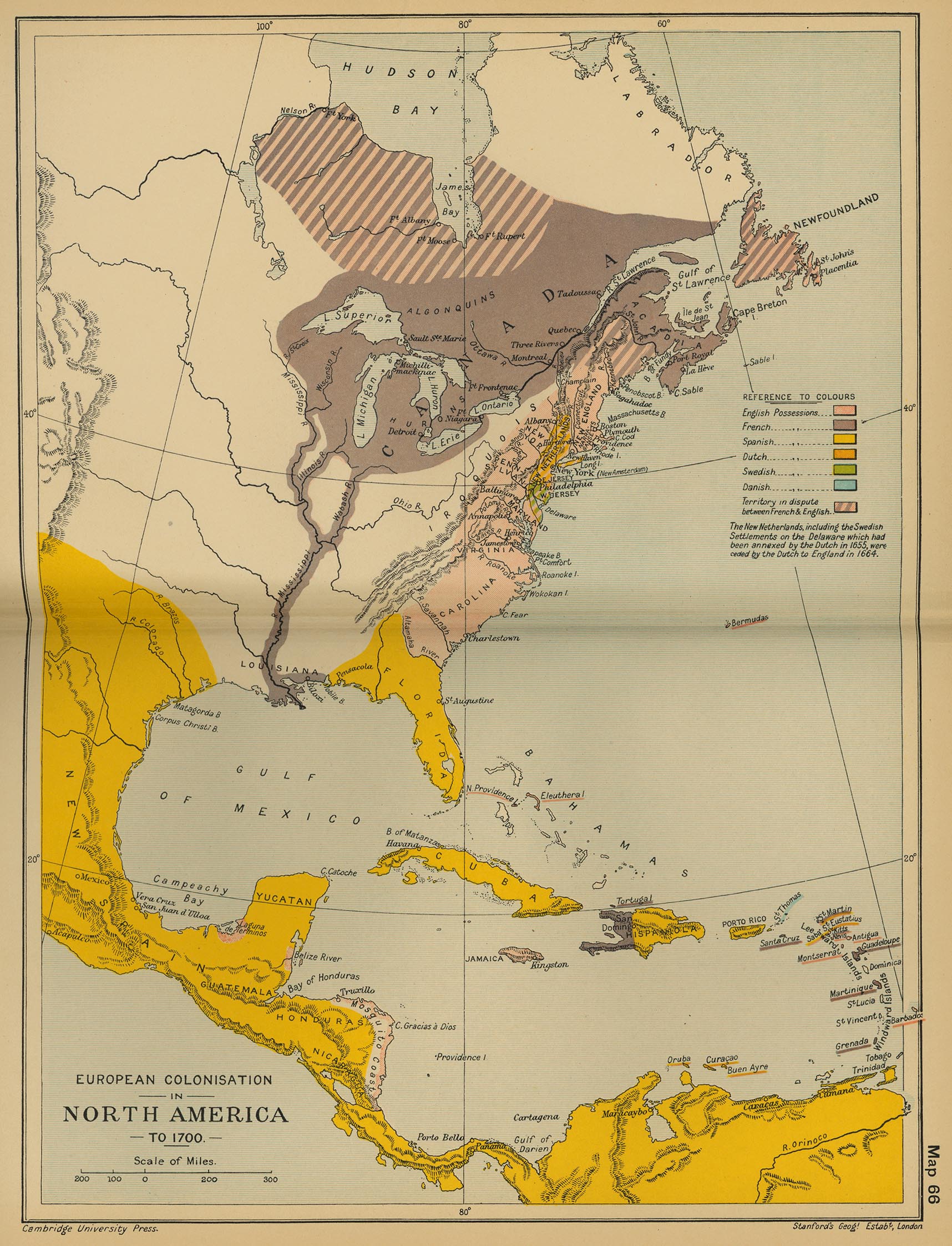
A major theme in American Colonies in this week’s reading is England’s emergence as a major imperial power in the mid-17th century. Two of England’s earliest attempts at colonizing the “New World”, Jamestown and Roanoke, were relatively low risk endeavors and went widely unnoticed by the French, the Spanish, and the Dutch. Although Roanoke failed miserably, Jamestown’s survival followed by moderate success and establishment of additional settlements in Virginia officially marked England’s entrance into the “New World”. When compared to the empire the Spanish had forged in present day Mexico and Florida, England’s territory in Virginia and Massachusetts was diminutive. However, England’s confidence grew significantly as the 17th century drew onward and in 1670 they founded Charles Town on the mouth of the Ashley River in present day South Carolina. This was a bold statement by the English because it defied Spanish claims to the coast and was much closer to the major Spanish city of San Agustin than the English settlement of Jamestown.
As Taylor describes the Lords Proprietor that controlled the Carolina territory and their methods of attracting settlers and actually settling the massive amount of land they impulsively “claimed”, he portrays the English as these daring up-starts who are directly challenging the Spanish for superiority in the Americas. Taylor also depicts the English as a country determined to thrive in the Americas and through their relentless recruitment of Englishmen to the Carolina territory, they were able to construct a colony formidable enough to prevent the Spanish from continuing their attacks. I consider Taylor’s representation of the English’s sharp rise in aggressiveness toward claiming and settling land in the Americas relatively easy to comprehend and overall quite effective. However, I found Taylor’s section regarding the establishment of Georgia less than adequate.
I understand there is tremendous skill required to write concisely but I found Taylor’s section on the colony of Georgia to be lacking significant depth. Despite providing a history (even a brief one) of Native people and their experiences prior to European arrival in previous areas of focus, Taylor offered no information about Native people and their existence in Georgia before it became a British colony. Despite Taylor’s decision to leave Natives out, I did not find his section on Georgia completely distasteful. I appreciate the distinctions he made between Georgia and the rest of the British colonies. For example, he discussed the trustees’ decision to forbid the importation or possession of slaves until 1751. He also described the difference in crop cultivation, most colonies grew tobacco, indigo, or rice but Georgia produced hemp, flax, mulberry, and grapes during the early years of the colony. Perhaps the most noticeable difference he described was the colony of Georgia’s attempt to prohibit rum consumption on the grounds that it “deterred hard work and moral uplift”.
Lastly, I would like to comment on a Georgia’s role as a British colony in the 17th century. As my classmate Evan Farese mentioned, Carolina was initially intended as a buffer zone between Virginia and Florida. Following the economic success in the Carolinas, the crowned deemed it necessary to create Georgia as a buffer zone between the Carolinas and Spanish Florida. Although it was not a glamorous one at the start, Georgia did play a very important role in the English expansion in the Americas.