Slavery in the North, Virginia, and South Carolina


Warning: Undefined variable $num in /home/shroutdo/public_html/courses/wp-content/plugins/single-categories/single_categories.php on line 126

Warning: Undefined variable $posts_num in /home/shroutdo/public_html/courses/wp-content/plugins/single-categories/single_categories.php on line 127

Slavery took on distinct forms in the various regions of America. In the North slavery was not as commonplace as in the South, but slavery in some areas was still the primary backbone of physical labor, and unlike the South, Northern slaves were more directly in competition with working class whites, but at the same time had more elements of their own autonomy and were often quite close to their white owners. In Virginia slavery underwent several transformations. Slavery saw its roots initially in Virginia as very similar to indentured servitude, with some slaves finding freedom after working for a master for a set number of years. The beginning years of slavery in Virginia showed a surprising degree of egalitarianism between freed blacks and whites, with some blacks becoming planters and slave owners themselves. As time went on however, and more slaves entered Virginia, the elites among the society grew upset at the idea of this near racial equality and worked to enshrine black inferiority into the laws, resulting in a vast removal of the rights of freed blacks and of those of slaves.  In South Carolina, a interesting dichotomy emerged, slaves were crucial to almost every aspect of South Carolina life, from working the fields to fighting Indians, and the slave owners profited greatly from the slaves’ skills and  labor, but the slave owners were greatly fearful of the possibility of a slave uprising, as they were outnumbered by their slaves and instituted harsh slave codes to attempt to prevent it. But in spite of this slaves had  a greater degree of cultural autonomy than within other portions of the American colonies.


Warning: Undefined variable $num in /home/shroutdo/public_html/courses/wp-content/plugins/single-categories/single_categories.php on line 126

Warning: Undefined variable $posts_num in /home/shroutdo/public_html/courses/wp-content/plugins/single-categories/single_categories.php on line 127

In this week’s reading, chapters 7 and 11, Taylor discussed the colonial practices of Georgia, the Carolinas, and the Chesapeake. To start, I disliked the lack of information the author gave about Georgia. Granted, as mentioned in class, Georgia history is boring. But I am from Atlanta, and I am biased. I want my state to be represented as much as the others. My suggestion to the author, without any credibility of course, would be to include more detail about the issues in Georgia and the native peoples involved. However, I was born in Greenville and also lived 9 years in York, SC so I was moderately pleased with the history of the Carolinas. One of the main arguments Taylor presents includes the white sense of solidarity versus the fractioned Indian identities. I found this particularly interesting and wondered the outcome had the Native peoples banded together and fought as an American nation. Would we all still be in Europe? Would it have taken decades or centuries more to conquer the “New World”? In just about all of the cases on the eastern coast of the North American mainland, Indians fought side by side with colonists against rival tribes. The Europeans would play the nations against each other and take advantage of the rivalries. Later, when convenient, the colonists would find an excuse to massacre the former partners. One of the very few chiefs to promote a nation combining tribes was executed for his ideas, not by a European, but by a fellow native. A few differences between the colonies include the attempt by Georgians to create a colony without slave while the Chesapeake and Carolinas relied heavily on slave trade and labor to prosper. The explanation about trying to keep whites motivated to work by avoiding slave labor rang bells in my head because I have taken AP US history but this idea was never addresses in the textbook I read before. It makes sense that whites would find physical labor degrading because it made them feel like slaves and that was definitely depressing in the time period.

Carolina (Chapters 7 and 11)


Warning: Undefined variable $num in /home/shroutdo/public_html/courses/wp-content/plugins/single-categories/single_categories.php on line 126

Warning: Undefined variable $posts_num in /home/shroutdo/public_html/courses/wp-content/plugins/single-categories/single_categories.php on line 127

In Chapters 7 and 11 of American Colonies a major theme is the idea that the land in the New World is land that is not owned by anyone and therefore it can be given away by the British. The British landed in South Carolina for the first time in 1670. Three ships carrying 200 colonists had sailed from Barbados to the mouth of the Ashley River, where they would found Charles Town, named for King Charles II. This represented the founding of Carolina, a land further south than Virginia. This meant even hotter summers and more miserable humidity. For a group sailing from the crowded heat of the small island of Barbados though, the wide open empty space and less intense climate of Carolina was inviting. The space was given by the King to a council called the Lords Proprietor which was a member of 8 Lords who were to govern over the new space. Essentially, this made sure that the King would not have to be bothered by the trivial matters of starting a colony, but ensured that people he trusted would take care of it. And so Carolina was formed as the newest British colony in the new world.

The location of Carolina was very helpful from the King’s perspective. Charles II’s main interest in the New World was the tobacco output that Virginia was supplying and until Carolina was founded, there was essentially nothing between Jamestown and San Agustin, the Spanish colony. Carolina acted as a buffer between the two colonies as it was in fact much closer to San Augustin than Jamestown. The location of Charles Town was also a bold statement by the British who essentially said that they weren’t scared to claim any land they wanted in the New World, no matter how close it was to Spanish colonies. This claim was challenged by the Spanish who attacked up the coast and eventually destroyed Port Royal, a town even further south than Charles Town. The amount of British colonists coming into Carolina was far to great, especially in comparison the amount going into San Agustin. The Spanish quickly became far outnumbered and stopped attacking. The population of South Carolina grew up to 6,600 by 1700.

How did they get all these settlers to go to South Carolina and increase the population so much? They incentivized. They were prepared to offer each colonist 150 acres for each member of his family if he would make the voyage over to Carolina. Even if you couldn’t afford to make the journey yourself, you could become an indentured servant, where you would pledge to serve someone for four to seven years if they payed your way across the Atlantic. After a servant was freed, they were given land and tools and became a member of the New World. Many young men found their way across the ocean in that way. The British justified giving away all the land they wanted to, not realizing that some of it may belong to Natives who were already there. What shocks me as a reader is how Indians did not revolt as the British forged further and further in to their land. While the land that the British were giving away seemed to have no owner, I’m sure it had some very important meaning to Indians of the area.

I think that the founding of the Carolinas was important for the British because it sent a message to the Spanish and it allowed British yet another place to populate in the New World. The New World was also a place in which many enslaved people found a home. By 1700, out of the 6,600 people living in South Carolina, 2,800 were black. I think that my classmate Funderburg raises a good point about how eventually the white’s goal became to make the African slaves angry at the Indians as the British feared that one day the enslaved people would join forces with the Natives and overthrow the whites.

The big picture


Warning: Undefined variable $num in /home/shroutdo/public_html/courses/wp-content/plugins/single-categories/single_categories.php on line 126

Warning: Undefined variable $posts_num in /home/shroutdo/public_html/courses/wp-content/plugins/single-categories/single_categories.php on line 127

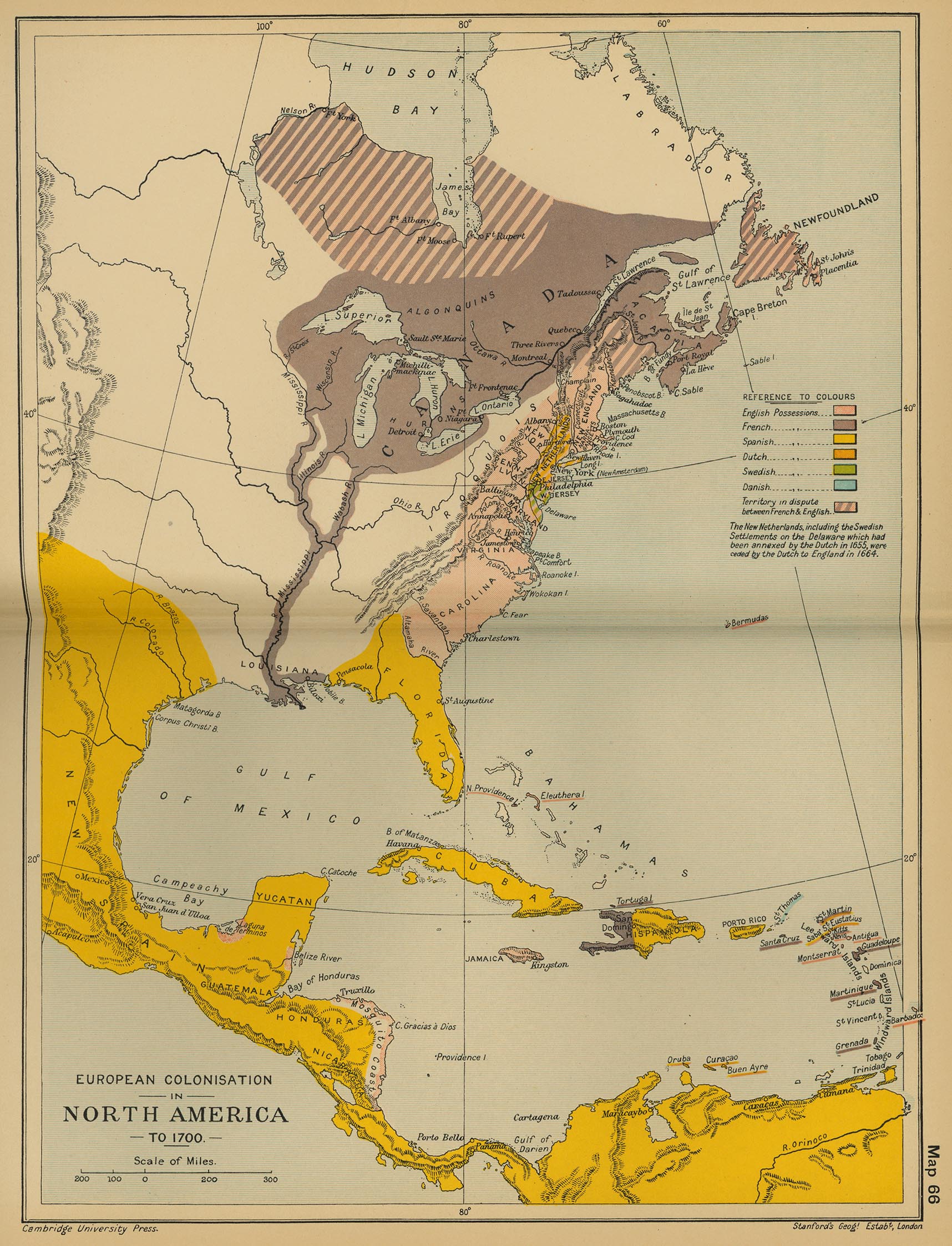
We, like Taylor, have been approaching colonial American history in a regional manner – jumping from North to South to Middle colonies as they developed.  This has been largely because these regions developed separately from one another – in any given year, someone in Plymouth mightn’t know what someone in Jamestown was up to.  This week, that begins to change, as the British colonies in North America begin to cohere.  In the spirit of that cohesion, I thought it might be worthwhile to give you all a “big picture” view of what we’ve been studying – so here are two visualizations.  The first is a timeline of European colonialism in North America from 1492 to the American Revolution.  The different colors represent different imperial powers – Red is Spain, Purple is Dutch, Blue is England, Maroon is Sweden and Green is French:

Big picture colonial timeline

The second is a map of North America circa 1700, which shows all of the different areas claimed (as distinct from actually settled) by different European powers.  Hopefully, together these two documents will give you a sense of what’s been happening across colonial North America, rather than just in each separate region.

Week 3 Chapter 4 and 5


Warning: Undefined variable $num in /home/shroutdo/public_html/courses/wp-content/plugins/single-categories/single_categories.php on line 126

Warning: Undefined variable $posts_num in /home/shroutdo/public_html/courses/wp-content/plugins/single-categories/single_categories.php on line 127

This being the first non-American Colonies reading assigned, I found the change in perspective extremely refreshing. The author brought the issue of slavery in the American colonies to a much more grandiose scale, comparing it with instances of human domination which occurred in Europe’s past and describing how these instances created the social climate  which allowed for the mass trafficking of African Slaves. One unique argument made by Davis in chapter 4 was that if it could have ever become culturally Legitimate, Europeans colonizers would have enslaved the vagabonds and criminals within Europe and avoided the expense of Trafficking from Africa all together.

Although I’m sure that all of us have have heard a description of the conditions which slaves were shipped to America in, the one put forth in Inhuman Bondage resonated with me and projected a lasting image by prefacing the few details put forth with a sentence stating that no human words can describe the horror of the transport vessels, and that only the Holocaust and Roman Slavery were even on par.

Davis also does an excellent job of outlining the details of the trade, such as the route which slaves were taken and their various stops which connect to create an extremely complex mass transit system developed by the Europeans, especially in the New World, where control was constantly being lost and gained. The nature of these two chapters show a complexity and denseness which is not found in American Colonies, but does an effective job of describing a horrific system which played an incredibly significant role in the development of the colonies.

Davis also makes MUCH more effective use of maps.

Taylor, Chapter 2: An Environmental Perspective


Warning: Undefined variable $num in /home/shroutdo/public_html/courses/wp-content/plugins/single-categories/single_categories.php on line 126

Warning: Undefined variable $posts_num in /home/shroutdo/public_html/courses/wp-content/plugins/single-categories/single_categories.php on line 127

Sherwood Callaway

HIS 141, Blog Post 2

For context, my post today has mostly to do with the environmental history Taylor presents in chapter 2.

Generally speaking, chapter 2 was concerned with three things: thee driving forces behind European exploration, the decimation of local inhabitants upon European contact, and the environmental ramifications of European-American interaction. The Europeans pursued exploration because it offered new opportunities for commercial exploitation and religious conversion. Their experiences in the western Atlantic –where they subdued the Guanche through “just” warfare, manipulation of local politics, and by unintentionally introducing of foreign diseases, plants and animals – demonstrated these benefits, and prepared the Europeans for their “new world.”  Finally, the breadth and variety of economical implications resulting from making contact was astounding; rampant disease destroyed whole Indian nations, crops were exchanged and food supplies significantly altered, livestock introduced, deforestation dramatically increased, etc.

Simply, the Europeans threw America’s natural balance completely out of whack.

Taylor deserves credit for giving sufficient attention to the role of the environment in this period. In his post last week, Wells was first to recognize the way Taylor weaves anthropological and environmental histories together. Certainly, one cannot be separated from the other, but less mindful historians often diminish the weightof the latter. Taylor has proven himself otherwise; for example, he quotes Thomas Malthas’ principle of population, acknowledging man’s environmental dependency.

After reading the first chapter, I assumed Taylor’s interest in environmental history was conditioned by his subject material— the Indians. Wells may have felt the same, since in his blog post he employed the examples of the Anasazi and the Hohokam. Under this impression, I considered Taylor backward and hypocritical, since much of his introduction was spent condemning historical inaccuracies like that of the nature-loving Indian. However, this reading has clearly proven that Taylor’s interest in environmental history is simply part of a well-rounded modus operandi. The environment pertains equally to all three parties this time; the Europeans gained more efficient crops like maize and potatoes; the Indians suffered from alien disease, flora and fauna; the Africans benefit from the introduction of cassava, and enjoyed some protection from slavers, thanks to the harshness of their environment.

I applaud Taylor for his including this historical dimension, and am excited to experience other aspects of American history through it.

Taylor, Chapter 1: A Diversity-Continuity Contradiction


Warning: Undefined variable $num in /home/shroutdo/public_html/courses/wp-content/plugins/single-categories/single_categories.php on line 126

Warning: Undefined variable $posts_num in /home/shroutdo/public_html/courses/wp-content/plugins/single-categories/single_categories.php on line 127

Sherwood Callaway

HIS 141, Blog Post 1

In his introduction, Taylor describes colonial America as a melting pot of diversity, in which the three distinct cultures – European, Indian and African – each with its own subdivisions, were thrust together in a manner of unprecedented speed and force. Driven by “profit-seeking and soul-seeking,” the Europeans facilitated this gathering with their comparatively advanced navigational abilities, shipping entrepreneurial colonists and African laborers alike. British America emerged as the dominant cultural entity in the so-called New World, imposing itself upon Indian and African cohabitants. These less powerful cultures were certainly not less prominent, however; they held equal influence in the cultural mix. Taylor writes profoundly of colonial society, saying “in such exchanges and composites, we find the true measure of American distinctiveness, the true foundation for the diverse American of our time.” That particular statement struck me as Americentric (if that is even a word), and I was surprised to hear such a thing from Taylor, who makes such a point of debunking the “traditional story of American uplift” that is associated with the colonies.

Additionally, in chapter one, Taylor seems to contradict his description of colonial America – which I previously summarized in brief – by suggesting cultural continuity between pre-Columbian Indians and Europeans. Their violent tendencies, for one:

“the chiefdoms conducted chronic warfare. Burials reveal skeletons scarred with battle wounds; many towns were fortified with wooden palisades, and their art often celebrated warriors displaying the skulls, scalps, and corpses of their victims. Of course, none of this rendered them more warlike than their contemporaries elsewhere in the world; European graves, cities, and art of the same period (“the Middle Ages”) also displayed the prominence of war and the honors bestowed upon victors.”

Their metropolitan and technological advancements, for another: The Hohokam used a massive and complex system of irrigation canals for farming, which “demanded extensive, coordinated labor to build and maintain.” And near the Mississippi River, the Mound Builder city of Cahokia once sprawled – the notable home of an impressive calendrical device and the largest earthen pyramid in North America. Taylor seems to legitimize Indian civilization in the face of Eurocentrism by describing in detail these accomplishments.

In summary, Taylor seemed to contradict himself by first championing the diversity of colonial America, but then spending the entire first chapter writing an indigenous history in the way we usually write European history.