You Can’t Take It With You


Warning: Undefined variable $num in /home/shroutdo/public_html/courses/wp-content/plugins/single-categories/single_categories.php on line 126

Warning: Undefined variable $posts_num in /home/shroutdo/public_html/courses/wp-content/plugins/single-categories/single_categories.php on line 127

I found Wolfe’s article intriguing but not entirely convincing. I did not necessarily agree with his assessment of native lands as their lives. While an integral part of where a person comes from is where they are from, this does not die with removal. Rather, when a person or group of people leaves their home, they take that with them. The Native Americans that were removed from their land were not stripped of their heritage. They were robbed of the land that they grew up on, the land that raised them, but not of the heritage that was their tribe. The natives, at this point in history, would not grow up, go off to college, and then go get a job. However, that is the twenty first century lens with which I glance at this. We, in today’s culture, move around a lot. From college to jobs to traveling, we are constantly on the move. While this was not the case for them, my perspective says that you are how you were raised and you take that with you no matter where you go.

NAKINDIG mentions in his blog post that Wolfe “explains how the views of the Europeans towards the American Indians included a nomadic, landless view of the native peoples.” My belief may stem from that belief. While it is true that some natives were nomadic, the vast majority was not and settled in specific locations based on their needs. While I do not agree with the Indian removals of years past, I do not see the argument for a cultural loss. Slaves were brought in from Africa, and while they did not necessarily flaunt their African culture to their owners, it was definitely present. Eastman Johnson’s painting, My Old Kentucky Home or Negro Life at the South, shows this African culture hidden behind the walls of the slave quarters. To that same end, the natives had a culture that whether enslaved or moved or not, should have been able to continue on.

While I disagree with Wolfe on movement, I appreciate his distinction between genocide and a disruption and thieving of lands. While a vast number of natives were killed as a direct product of Europeans weapons, diseases, etc. A good number were indirectly killed by a forced relocation of sorts. This was not an intentional annihilation, but rather an opening up of the frontier will consequences that went south. I am in no way defending the Indian removal, but I do see in a difference in genocide and an indirect annihilation.

Settler Colonialism vs Genocide


Warning: Undefined variable $num in /home/shroutdo/public_html/courses/wp-content/plugins/single-categories/single_categories.php on line 126

Warning: Undefined variable $posts_num in /home/shroutdo/public_html/courses/wp-content/plugins/single-categories/single_categories.php on line 127

I definitely liked Patrick Wolfe’s topic on “Settler colonialism and the elimination of the native”. He enters academic debate very well in his article, and I think I agree with him after reading the article. Although almost all of the native peoples ended up dying because of European colonization, they Europeans did not actively practice killing the race (in a loosely used form of the word), so they did not practice genocide. He brought in outside examples to explain the difference between genocide, and taking land.

I definitely liked his conjecture of land being life, and how the settlers were taking land, and the byproduct of taking land was taking the lives of the Natives. He even explains how the views of the Europeans towards the American Indians included a nomadic, landless view of the native peoples. Therefore, they did not have a homeland, and if they did not have a homeland, the land was not theirs to be taken from. Although the native peoples actually did have a homeland, the interpretation of the settlers was different from that which was actually accurate, so their mindset did not actually involve killing people in order to take their land; it involved moving people from one place to another (worst case scenario being by force), so that they could settle the land and start the process of modernity. The settlers were killing the natives so passively, that, in the minds of the settlers, they were only taking land that no one owned and not taking lives of the native peoples.

Short end of the stick


Warning: Undefined variable $num in /home/shroutdo/public_html/courses/wp-content/plugins/single-categories/single_categories.php on line 126

Warning: Undefined variable $posts_num in /home/shroutdo/public_html/courses/wp-content/plugins/single-categories/single_categories.php on line 127

A reoccurring theme in American history is the poor treatment of the natives. I found this last chapter of American Colonies to be really interesting because I had never known of the Russian involvement in the continent or the Spanish taking of California. However, the Indians were cruelly treated and forced out of the land that was rightfully theirs, just as the Spanish and English had done on the east coast.

To begin Taylor goes into the Russians and their takeover in Siberia and Alaska. The Russians may have been the most ruthless of all ethnic groups as they forced the natives to provide them with furs in order to make a profit. The Russians didn’t use trade as they easily could have. Instead they chose the route of holding woman and children at gunpoint and coercing the Aleut men to bring furs back as ransom (451). Obviously, this aggravated the Aleuts and they rebelled, and the Russians quickly countered by burning villages and murdering the natives by the hundreds (452)

The Spanish were very similar with their treatment of the Indians in California. The Spanish showed no equality to the natives as they came in and just took land that they wanted with no remorse. Their move caused Russians to prepare defense in case of a Spanish attack on their new claimed lands, but Taylor states that the Spanish was “preoccupied with trying to control the immense native population” and they did so through “plundering, beating, and raping Indians.” (458) I noticed that my classmate Jake Newton spoke on how the Spanish was going to colonize in the west because of the other countries involvement in the west (http://sites.davidson.edu/his141/spanish-brutality-in-the-west/). I definitely agree with that reason, but I also feel that a big influence on the Spanish colonization in California was the need to protect their settlements in Mexico (454).

One thing I disagree with from Taylors writings is the way he makes the levels or harshness vary from ethnic groups. Although there does have to be some group that it the worst in their actions towards the natives, Taylor makes it seem like the French were good guys, English were bad at times and good at times, and the Spanish and Russians just ran over natives at all times. In reality all of these groups used natives to their own advantage and none are innocent when the history is actually analyzed.

The big picture


Warning: Undefined variable $num in /home/shroutdo/public_html/courses/wp-content/plugins/single-categories/single_categories.php on line 126

Warning: Undefined variable $posts_num in /home/shroutdo/public_html/courses/wp-content/plugins/single-categories/single_categories.php on line 127

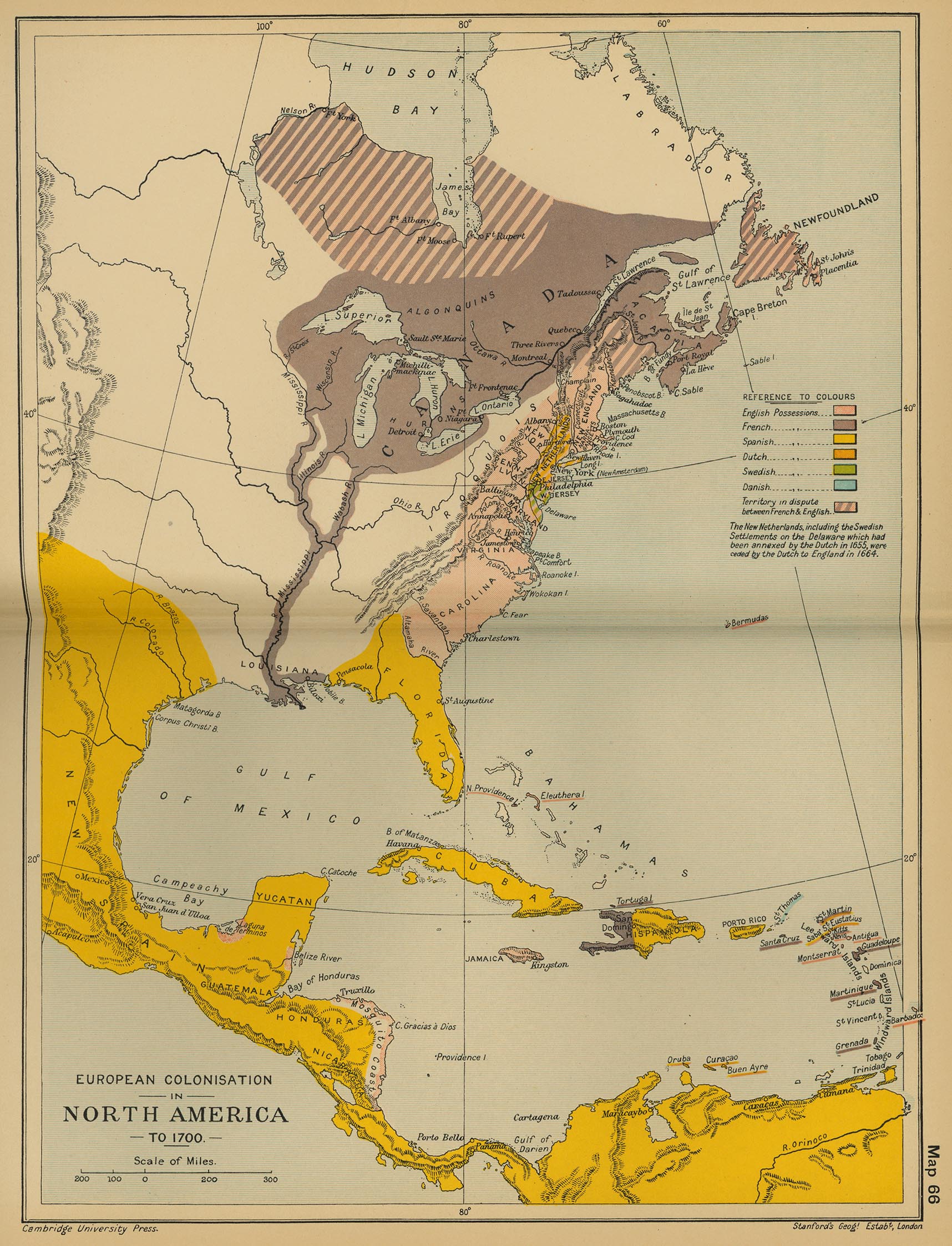
We, like Taylor, have been approaching colonial American history in a regional manner – jumping from North to South to Middle colonies as they developed.  This has been largely because these regions developed separately from one another – in any given year, someone in Plymouth mightn’t know what someone in Jamestown was up to.  This week, that begins to change, as the British colonies in North America begin to cohere.  In the spirit of that cohesion, I thought it might be worthwhile to give you all a “big picture” view of what we’ve been studying – so here are two visualizations.  The first is a timeline of European colonialism in North America from 1492 to the American Revolution.  The different colors represent different imperial powers – Red is Spain, Purple is Dutch, Blue is England, Maroon is Sweden and Green is French:

Big picture colonial timeline

The second is a map of North America circa 1700, which shows all of the different areas claimed (as distinct from actually settled) by different European powers.  Hopefully, together these two documents will give you a sense of what’s been happening across colonial North America, rather than just in each separate region.

History trumps childhood- Chapters 3 & 5


Warning: Undefined variable $num in /home/shroutdo/public_html/courses/wp-content/plugins/single-categories/single_categories.php on line 126

Warning: Undefined variable $posts_num in /home/shroutdo/public_html/courses/wp-content/plugins/single-categories/single_categories.php on line 127

Alas, yet another childhood story is ruined by the fierce truth of history. First, I found out the Pocahontas movie is not historically accurate. Then, it was unveiled that Columbus treated the natives with harsh brutality. Now, my world centered on the English being the main explorers to the “New World” is historically skewed. Taylor, altering my preconceptions on colonization, offers up a history, thus far, that centers on many other cultures.

Chapter three targets the Spanish explorers and their fierce conquest in the “Americas.” Taylor takes a relatively harsh approach in presenting the Spanish. The Spanish were vicious in their takeover of their so-called new land. Cortés and his army demonstrate the Spanish desire for conquest by taking over Tenochtitlán. What was once a booming metropolis of native wealth and civilization was “reduced… to a bloody rubble” (53). To make matters worse, the area they took over was littered with gold and silver. Yet, the new gold over powered the Spanish economy causing a rough period of inflation for those at the bottom of the economic pyramid. For me, the Spanish represent the normal colonist that came over seas and soon showed dominance over the native peoples in an attempt to become rich.

However, chapter five showed a different relationship between the native peoples and the European explorers. The French explorers to the north had a contrasting association with the natives than that of the Spanish. The French were in North America to acquire furs and dominate the fur market. The native peoples knew the French were so far inland for the furs and soon took advantage of this fact. The native peoples were bringing in such large quantities of fur that the French were in an interesting position socially and economically. If they attacked the natives, they could take them over and the area. However, that would remove their supplier of fur, so they were trapped in a period of peace. Normally peace would be the ideal, but in a culture where the native peoples were originally though of as beasts, the French were not ecstatic to be equals. Taylor does give the French a certain amount of praise for being so peaceful, and they were nicer than the Spanish. Yet, they still had their fighting and were only peaceful for economic reasons.

The Europeans saw themselves as greater beings than the native peoples. With superior technology, I could see how the Europeans thought of themselves as higher powers. So since the Europeans “discovered” the “New World,” colonization history has been presented in that light. Taylor, however, is fighting the norm by presenting his thoughts differently. I admire his prowess for attempting to change a more than five hundred-year-old practice.

Introduction-Chapter 1 Post (#1)


Warning: Undefined variable $num in /home/shroutdo/public_html/courses/wp-content/plugins/single-categories/single_categories.php on line 126

Warning: Undefined variable $posts_num in /home/shroutdo/public_html/courses/wp-content/plugins/single-categories/single_categories.php on line 127

Author Alan Taylor has a very interesting line on the first page of the Introduction that, in my opinion, gives early insight into what this book will discuss. After shortly describing white Europeans’ motivation for immigrating to what is the present day United States, Taylor opens his fourth paragraph with a captivating person opinion- “But the traditional story of American uplift excludes too many people” (Taylor, Introduction) To me, this line immediately informs the reader that the purpose of this book is to give a more complete description of American History, one that fills in the holes and gives credit to those often forgotten in less “detailed” accounts of American History. The first chapter in the book immediately shows that Taylor does indeed intend to fill in those blanks. In it he gives brief overviews of the history of a number of Native American tribes who called the lands home way before Christopher Columbus or any other Europeans set foot in the “new world”.

Personally, I thoroughly enjoyed the first chapter as it informed me about much I had never even heard regarding early life in the Americas. I had known that Christopher Columbus did not in fact “discover” these lands but I was unaware of the deep history that so many different native tribes had on the land. Taylor also gives a description of the natives that does not mesh with the way they are often portrayed today. Modern day filmmakers have painted an image of these early natives in moves (which is admittedly the extent of my previous study on this topic) as a supremely spiritual and peaceful people who were unjustifiably taken advantage of by the Europeans. While Taylor does not defend the Europeans, he makes sure to inform the reader that the Natives were not completely innocent, peaceful tribes who wished only to be left alone. They were just as violent and war-prone as the people they fought, they simply did not have the technology and weaponry to seriously compete. I appreciated Taylor giving this perspective here. It assures me that he did his best to stay completely objective. I can only assume that the rest of the book is written in the same manor.