What In The World Is Russia Doing Here?


Warning: Undefined variable $num in /home/shroutdo/public_html/courses/wp-content/plugins/single-categories/single_categories.php on line 126

Warning: Undefined variable $posts_num in /home/shroutdo/public_html/courses/wp-content/plugins/single-categories/single_categories.php on line 127

Up to this point, the entire focus of this class has been on the colonization of America. That is logical considering that this is American history, but the history thus far has not really been American. Rather, it has been a conglomerate of European explorations, European politics, and European settlement. Chapter 19 was no different, but this final chapter ended the colonial period in an intriguing way.

Spain had played a role in the colonies up to this point, but they started to get worried. Spain “owned” a lot of land towards the west coast. I say “owned” because technically they claimed the land and it was theirs, but the Spanish really had no idea how much land was actually their. So when rumors spread that Russia and Britain were coming after their landed, they assumed that “the Russians and British were closing in on California and would soon outflank New Mexico and attack precious Mexico” (Taylor 445). First off, what in the world is Russia doing in this book? Russia was definitely not a country I expected to hear, or had ever heard, in connection to colonial history. Also, it always amazes me how little they knew about the layout of the country, as seen by the map of the island of California (http://en.wikipedia.org/wiki/File:California_island_Vinckeboons5.jpg). However, the Spanish did expand with their missionaries up the coast of California. They claimed the land by establishing little missionaries scattered up the coast of a vast territory.

Somehow Russia decides to rear its ugly head in the colonies. Now considering I had never heard of Russia being in America this early, I was intrigued to see what they brought to the table. I very quickly learned two major themes. The first is that the Russians are just like every other country that settled near natives. They were brutal, cruel, and effective in dealing with natives. They used natives to get the goods they needed and took advantage of them, just like every other society we have studied thus far. Secondly, Russia created a sense of urgency for the Spanish. Sarah Funderburg puts it eloquently in her most recent post, “the rumor that the Russians were rapidly expanding their land-holdings (or establishing them at all) motivated the Spanish to increase their aggressive expansion.” The Russians, to me, did not add much to the conversation about colonization. It seems as if they were another card in the deck.

Russia, Spain, Britain, France, etc. all seem to go the same way about colonization. As our talk of American colonization comes to end it is very clear. Now, just as Taylor does I will conclude with a brief mention of Revolution. Now, it is time to revolt against the British crown and become the United States of America.

The Other Cold War: Imperial Paranoia in Pacific North America


Warning: Undefined variable $num in /home/shroutdo/public_html/courses/wp-content/plugins/single-categories/single_categories.php on line 126

Warning: Undefined variable $posts_num in /home/shroutdo/public_html/courses/wp-content/plugins/single-categories/single_categories.php on line 127

We spent last Thursday’s class discussing the imperial wars in North America and how—in many ways—the French, British, and Spanish colonies functioned as a microcosm of the imperial conflicts in Europe. I think we see some continuities of this theme in our latest reading.

In Chapter 19, Taylor directs our focus westward to the Pacific, detailing the Russsian and Spanish colonization efforts along the west coast of North America. Eager to reap the commercial rewards of colonization, Russian explorers ventured east through Siberia into present-day Alaska; meanwhile, their Spanish counterparts crept northwest from Mexico into Alta California. Though separated by thousands of miles, the Pacific colonies shared some interesting similarities with those of the British and Spanish in the East. Taylor notes that in their treatment of the Siberians—and later the Aleut—Russian promyshlenniki resembled the Spanish conquistadors, intimidating Native peoples into hunting furs later to be traded with Chinese and Russian merchants (447). I, however, found even more striking similarities in Taylor’s description of the Spanish missions in Alta California that I’d like to share:

  1. Intimidation Tactics – To suppress Native insurrection, the Spanish employed a number of intimidation tactics against the Native peoples. Exercising their technological supremacy, Spanish colonists stifled periodic Native uprisings with their impressive array of horses and guns. Much less organized and more poorly equipped, the Natives stood little chance against the Spanish invaders. In the greatest demonstration of power and intimidation, the commander at Mission San Gabriel decapitated a local chief and displayed his head on a stake just outside the mission. Though the chief had retaliated—and justly so—against the Spanish for having recently raped his wife, the Spanish commander felt that his excessive retribution was necessary, “lest the Indians ‘come to know their power'” (458). This tragic story immediately reminded me of Taylor’s account of King Phillip’s War, in which the the New English and their “praying town” allies executed Metacom and displayed his head atop a watchtower (201-2). Both accounts serve as fine examples of Native suppression at the hands of European colonists. Depending on how they perceived the Native peoples—as a tool to be used or animals to be broken—Europeans altered their treatment of the Native peoples.
  2. Forced Assimilation – In an effort to Christianize the Native peoples, Spanish missions adopted a methods of forced assimilation to Spanish culture and Catholic religion. Taylor notes that by keeping their recents converts under close scrutiny within the confines of the mission, Spanish franciscans, led by Fray Serra, required Native peoples to forsake their animism and adopt Spanish customs. They required them wear Spanish clothing, recite the Catechism, and learn the Castilian language. Most disturbingly, Spanish monks confined young, unwed girls to barracks at night, where, as one California governor noted, ‘[it] was not possible for [him] to endure them, even for a minute” (463). Such horrifying treatment of the Natives, reminded me of the Puritan “praying towns,” in which Puritans confined converted Native peoples for the sake of evangelism. Anglicizing the Natives, the Puritans missionaries forced those living within the praying towns to adopt English names, cut their hair, change their clothes, and abandon hunting and fishing (200). Such horrifying accounts of Native suppress reveal that while each colony differe

Though there were certainly many continuities in the colonies from the Atlantic to the Pacific, I found the most interesting example in the European motivation to colonize. In his blog last week,  A.J. described how North America served as the stage for European power struggles (http://sites.davidson.edu/his141/old-world-competition-comes-to-the-new-world/). As he aptly noted, “now battles would take place on New World land which would greatly affect the people living there.” I think the same occurred on the Pacific coast. This war, however, was much unlike the war to the East, where geopolitical struggles culminated in numerous violent conflicts. Rather than engaging in a violent conflict, the Russia and Spain entered a cold war. Though Russian colonial efforts in Alaska remained small and insignificant—only 400 settlers by 1800—in the scheme of geopolitics, the Spanish saw them as a threat to Spanish supremacy in America (454). Paranoid that Russia settlers or British fur-traders might assume control of the resource-rich North American West, Spanish ordered the colonization of Alta California, a project rife with economic, domestic, and environmental trouble. Though they never engaged in full-scale war, the colony of Alta California was born out of imperial paranoia and geopolitical conflict. Indeed, the Spain and Russia did engage in a political struggle for power in North America, characterized by unwarranted fear. So, one could say that Spain and Russia engaged in a cold war in the Pacific.

Southern History Ain’t Pretty


Warning: Undefined variable $num in /home/shroutdo/public_html/courses/wp-content/plugins/single-categories/single_categories.php on line 126

Warning: Undefined variable $posts_num in /home/shroutdo/public_html/courses/wp-content/plugins/single-categories/single_categories.php on line 127

Finally, we reached the South. We piddled around the area for a little while with Virginia and shortly after went North. But now we can talk about some good ole southern tales of rice, raiders, terror, and for brief moment, Georgia. Those short headers from Taylor’s  Chapter 11 on the Carolinas show us just how great colonial times were in the Carolinas. It is safe to say that they showed up a little late to the party. The “new world” was no longer a disease ridden mystery but rather a disease filled reality. People had been in America long before the Lords Proprietor were set govern the large state of everything above Florida and below Virginia. But quickly, as Taylor points out and we might expect, that large land mass split into North Carolina, South Carolina, and eventually Georgia.

However, for the Carolinas showing up late to the party might not have been a bad thing. Just as Virginians figured out their crop was tobacco, so did South Carolinians figured out that rice could be their fortune. So the South Carolinians did as all respectable rich white men did back then, they bought slaves. The slave trade was not a new entity, but rather a practiced trade. And these were not any slaves. They were specialists in their fields, literally. However, being so southern the slaves could easily run south away from the slaveholders and into free territory. So, to prevent them for running away they armed themselves at all times, scared them, and armed the Native Americans around them to help if any slaves were to run in their direction. The whites were scared up an uprising in a society where blacks were a large part of the population. As history tells us, South Carolina becomes a slave state and remains that way for a long, long time.

Now, as Taylor did with Georgia, I will briefly speak of the Chesapeake colonies. Taylor presents a lot of information here. Yet, while I was reading, I felt as if I was reading a book of fun facts. He spats off numbers about how much it cost to cross the ocean and then mentions the story of Elizabeth Abbot and her master. Which leads him to wealth, successful planters, which in turn lead to Bacon’s Rebellion, and so on. Taylor then ends the chapter with slavery. He acknowledges a successful freed black man, Anthony Johnson, but then speaks his final words on the demise of the status of freed black men. One colonist even said that Negro and Slave had become homogenous (157).

I’ve always had a passion for studying southern history because it is where I am from. But it has never been nor will it ever be pretty. Taylor does what should be done. He speaks of truths, horrible, horrible truths, but truths that should be acknowledged and learned from.

The big picture


Warning: Undefined variable $num in /home/shroutdo/public_html/courses/wp-content/plugins/single-categories/single_categories.php on line 126

Warning: Undefined variable $posts_num in /home/shroutdo/public_html/courses/wp-content/plugins/single-categories/single_categories.php on line 127

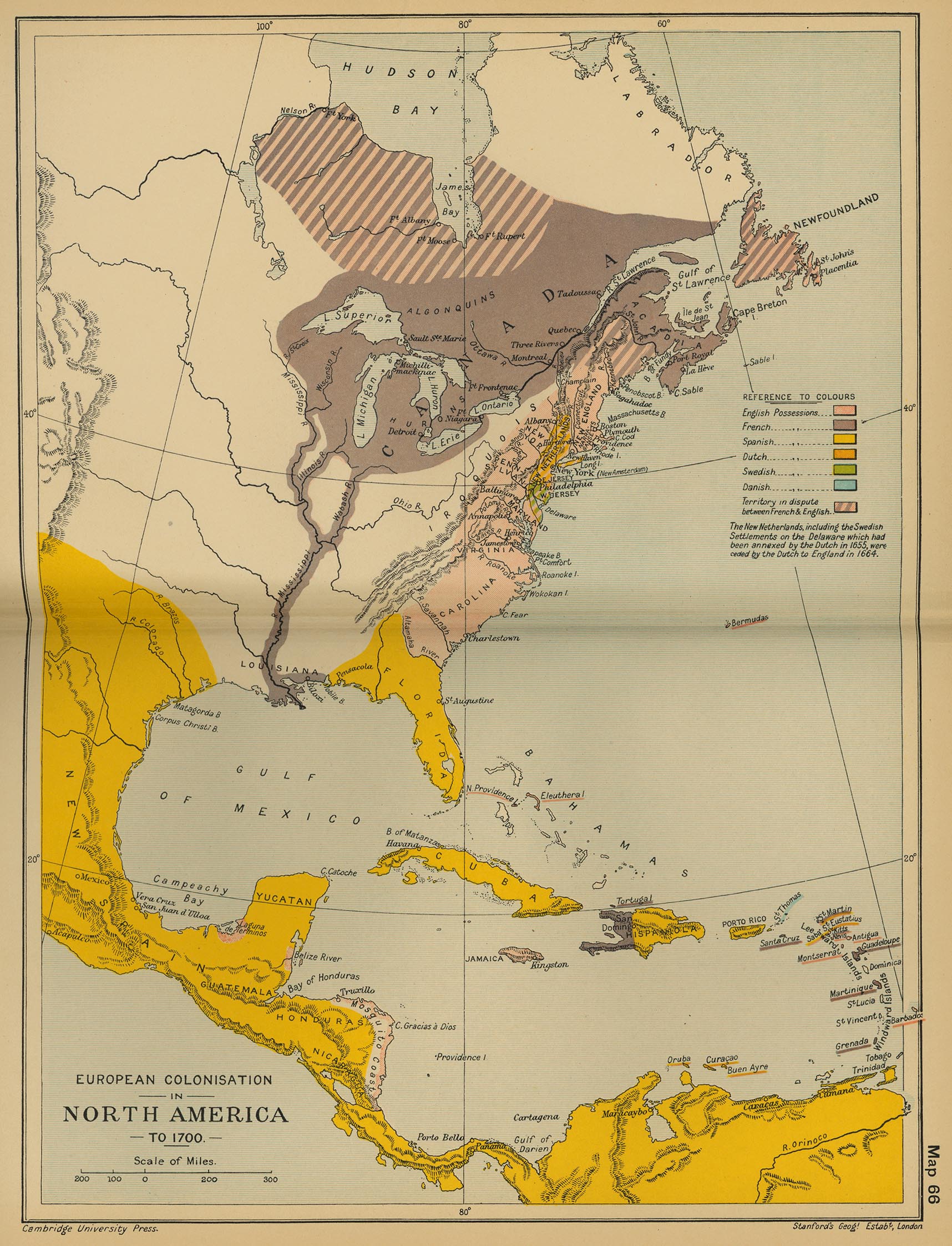
We, like Taylor, have been approaching colonial American history in a regional manner – jumping from North to South to Middle colonies as they developed.  This has been largely because these regions developed separately from one another – in any given year, someone in Plymouth mightn’t know what someone in Jamestown was up to.  This week, that begins to change, as the British colonies in North America begin to cohere.  In the spirit of that cohesion, I thought it might be worthwhile to give you all a “big picture” view of what we’ve been studying – so here are two visualizations.  The first is a timeline of European colonialism in North America from 1492 to the American Revolution.  The different colors represent different imperial powers – Red is Spain, Purple is Dutch, Blue is England, Maroon is Sweden and Green is French:

Big picture colonial timeline

The second is a map of North America circa 1700, which shows all of the different areas claimed (as distinct from actually settled) by different European powers.  Hopefully, together these two documents will give you a sense of what’s been happening across colonial North America, rather than just in each separate region.

Week Two Response


Warning: Undefined variable $num in /home/shroutdo/public_html/courses/wp-content/plugins/single-categories/single_categories.php on line 126

Warning: Undefined variable $posts_num in /home/shroutdo/public_html/courses/wp-content/plugins/single-categories/single_categories.php on line 127

Taylor organizes his discussion of the colonization of the New World by European country. He deals with the Spanish, the French, and the Dutch as separate entities, combining his discussion of them only when the Europeans interact in the course of their colonizing. This certainly makes his text easy to read and understand, and is even what one might expect from a textbook entitled American Colonies. This fulfillment of expectation, however, is the cause of my disappointment. Until this point Taylor has defied cultural stereotypes of American history by turning the tables and approaching the issue of colonization from a Native American standpoint. I am sure that American Indians were aware of political differences among Europeans but to a certain extent, it seems to me, that to the American Indians, one white European invading their land was not too different from the next.

Taylor returned to a more traditional approach to history in these chapters instead of continuing his trend of discussing events from the unsuccessful side. He certainly has good motives for sacrificing some of his political correctness and moral high ground. He gains clarity and straightforward organization, which he may have lost in a discussion that simply lumped all colonizers together and examined them from a Native American standpoint.

This change in technique, however, does not cause Taylor to completely abandon his interest in revealing the strength and power of Native Americans. As Jennifer points out in her post, Taylor asserts several times that in modern-day Canada the American Indians seemed to run the show. They negotiated prices and took advantage of French traders instead of the other way around. Thus, Taylor has not left his sense of responsibility for telling an unconventional story completely behind. He simply seems to have wavered slightly more towards the commonplace approach to history.

Week One Reading


Warning: Undefined variable $num in /home/shroutdo/public_html/courses/wp-content/plugins/single-categories/single_categories.php on line 126

Warning: Undefined variable $posts_num in /home/shroutdo/public_html/courses/wp-content/plugins/single-categories/single_categories.php on line 127

The introduction put some of my worries to rest, since many historical resources from previous classes I have taken have bordered on ethnocentrism. Taylor notes that the text will explore perspectives that have often gone unacknowledged in mainstream historical narratives such as those of women (“inconsequential helpmates,”) Natives (“unchanging objects of colonists’ fears and aggressions,”) and African slaves (“unfortunate aberrations in a fundamentally upbeat story”) (x). By acknowledging the faults in historiography in the earlier part of the twentieth century, Taylor shows that he will be offering a more inclusive and complete narrative of the story of colonial America.

I found chapter 1 to offer a wealth of information regarding Natives that was never presented to me in previous history courses. A notable fact that the reading shed light upon was the disparity between myth (that Native Americans were passionate conservationists) and reality (that their motives for minimizing ecological destruction came from animism) (19).

The topic of development also opened my eyes to the real reason behind the natives’ lack of mechanistic development. I had never thought to attribute the lack of societal development as seen in the “Old World” to animism. While I never subscribed to the idea that they were a “primitive people,” I was not aware that it was animism that “discouraged the sort of mechanistic development practiced by Europeans” (19-20). From the reading I came to see the Native Americans’ lack of technological development as a sign of restraint rather than one of inferiority. If they had desired to develop in ways the Old World did, they surely would have had the intellectual capacity to do so. Unfortunately, colonists chose to see the difference in technological development as an indicator of inferiority as opposed to one simply due to a stark difference of cultures.