Reading, Writing and Knowing in Early America and the Digital Age

Author: Dr. Shrout (Page 18 of 18)

Digital Humanities, The Debate Continues


Warning: Undefined variable $num in /home/shroutdo/public_html/courses/wp-content/plugins/single-categories/single_categories.php on line 126

Warning: Undefined variable $posts_num in /home/shroutdo/public_html/courses/wp-content/plugins/single-categories/single_categories.php on line 127

By admin

“within the field—every “What Is Digital Humanities?” panel aimed at explaining the field to other scholars winds up uncovering more differences of opinion among its practitioners”(Fitzpatrick, The Humanities, Done Digitally).

This quote sticks out to me because it clearly highlights that digital humanities do not have a clear definition and that there is continued debate about what they truly are. This allowed for me to more analyze the article than to take it as fact.

“I wrote that the digital humanities could be understood as “a nexus of fields within which scholars use computing technologies to investigate the kinds of questions that are traditional to the humanities” (Fitzpatrick, The Humanities, Done Digitally).

This quote does a good job of giving readers a brief overview of a basic understanding of digital humanities. Very helpful for someone who has never explored this field before. Also makes me think of the Wulf article, as she clearly explains how it is helpful to have background knowledge of the authors past experiences in regards to religion, marriage, economic status, and experiences.

“Digital humanities as it is currently practiced isn’t just located in literary studies departments; the field is broadly humanities based and includes scholars in history, musicology, performance studies, media studies, and other fields that can benefit from bringing computing technologies to bear on traditional humanities materials” (Fitzpatrick, The Humanities, Done Digitally).

This quote does a great job of emphasizing the versatility of digital humanities studies in a wide variety of academic fields. Makes the study of digital humanities seem very prevalent.

“Those differences often produce significant tension, particularly between those who suggest that digital humanities should always be about making (whether making archives, tools, or new digital methods) and those who argue that it must expand to include interpreting” (Fitzpatrick, The Humanities, Done Digitally).

This ties in to what Fitzpatrick says at the beginning about there still being much debate about what digital humanities truly are. This helps to make it clear as to what the debate is consisting of. Very interesting to think about the possibilities that digital humanities can provide for future research.


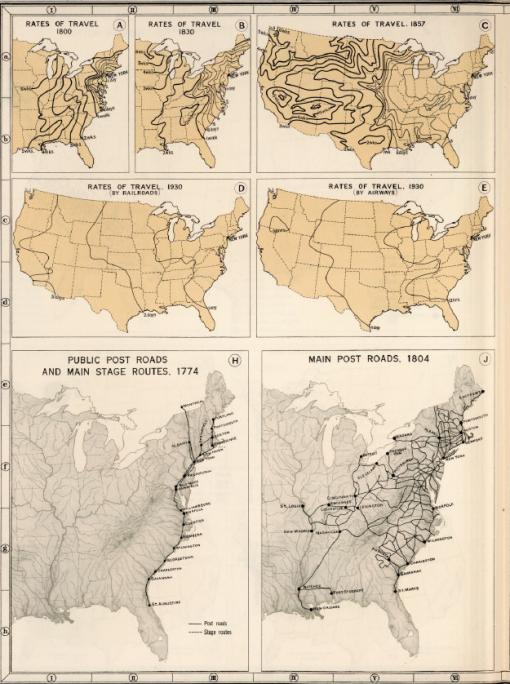
Rates of travel in early America


Warning: Undefined variable $num in /home/shroutdo/public_html/courses/wp-content/plugins/single-categories/single_categories.php on line 126

Warning: Undefined variable $posts_num in /home/shroutdo/public_html/courses/wp-content/plugins/single-categories/single_categories.php on line 127

By admin

Rates of travel early republic

From the Atlas of the Historical Geography of the United States, a map of how long it took to travel from New York at various points in American history, along with the more “reliable” postal roads in earlier periods:


A Commonplace Collection of Fitzpatrick


Warning: Undefined variable $num in /home/shroutdo/public_html/courses/wp-content/plugins/single-categories/single_categories.php on line 126

Warning: Undefined variable $posts_num in /home/shroutdo/public_html/courses/wp-content/plugins/single-categories/single_categories.php on line 127

By admin

Of all of the points made in Kathleen Fitzpatrick’s essay, “The Humanities, Done Digitally,” the following made an especially pronounced impact on me.

“Digital humanities as it is currently practiced isn’t just located in literary studies departments; the field is broadly humanities based and includes scholars in history, musicology, performance studies, media studies, and other fields that can benefit from bringing computing technologies to bear on traditional humanities materials.”

The above passage (paragraph 7) stood out to me for its mentioning of the different aspects of the humanities. Although digital history is the primary focus of study, it is important to note that the digital humanities encompass many other fields, including music and other performing arts. Technology of the modern age that focuses on these art forms is extremely commonplace, be it applications such as Spotify and Youtube, or digital music libraries and theatrical criticisms, but they are rarely thought of as a subfield of the humanities.

“The state of things in digital humanities today rests in that creative tension between those who’ve been in the field for a long time and those who are coming to it today, between disciplinarity and interdisciplinarity, between making and interpreting, between the field’s history and its future. Scholarly work across the humanities, as in all academic fields, is increasingly being done digitally. The particular contribution of the digital humanities, however, lies in its exploration of the difference that the digital can make to the kinds of work that we do as well as to the ways that we communicate with one another. These new modes of scholarship and communication will best flourish if they, like the digital humanities, are allowed to remain plural.”

This passage (paragraph 13) was interesting in the way that it reinforces the concept that the digital humanities are not just an “online” version of the previously established humanities. Instead, they integrate a modern method of communication to relay known information that can further promote discovery within the field.


Cutting and Pasting in the 18th Century


Warning: Undefined variable $num in /home/shroutdo/public_html/courses/wp-content/plugins/single-categories/single_categories.php on line 126

Warning: Undefined variable $posts_num in /home/shroutdo/public_html/courses/wp-content/plugins/single-categories/single_categories.php on line 127

By admin

Disclaimer: as a newly-minted historian, I rely heavily on my previous training in anthropology in my discussion of the following quotations.

Quotations from Karin Wulf, “Milcah Martha Moore’s book: Documenting Culture and Connection in the Revolutionary Era”

“That Moore was able to produce such a document reflects her education, her commitment to writing, and the leisure she was afforded by modest wealth, a supportive husband, and her own lack of children.” (2)

I like this quotation because I’m an anthropologist, and the above words basically spell out the fundamental assumption of anthropological theory in a nutshell: culture is a feedback loop made up of the constant interaction of the individual and the society (the individual’s environment and circumstances). Moore was literate because her particular societal position granted her access to education, but Moore’s book does not exist only because she was literate. Moore produced the book, a cultural artefact, because of her personal “commitment to writing.” Circumstances shape a person, but that person also takes actions to shape her world, thus changing the world’s circumstances by having lived.

“What it is instead is a particular view, a vista bounded by the socioeconomic, geographic, religious, political, and educational circumstances of Moore, the authors whose work she copied, and the subjects whose experiences they documented.” (4)

This quotation resonated with me for similar reasons as the first. It’s impossible to comprehend “the system” all at once, because the system doesn’t exist—at least not in the sense that one person or group is architect over all. We can only see systems of culture by delving deeply into individual circumstances and continuously fitting and re-fitting the puzzle pieces of the past.

“…the words she wrote reinforced bonds of intimacy and common knowledge.” (22)

I found this quotation interesting because of the implication that communication is a human bonding exercise. Interestingly, I think the observation skirts the precipice of the pit of functionalist explanations for human behavior, without falling in. The author does not suggest that Moore writes in order to fulfill some deep biological need for social activity, but I think someone bent on reading that theory in to the text could take it in that direction. I think this author does a good job of describing the outcome of Moore’s correspondence without making sweeping claims about the reasons behind human behavior.

“Quakers looked to the circulation of various manuscript materials for spreading inspirational materials among a broad constituency.” (25)

Why would Quakers favor manuscript exchange as a communication technology? This might be a big leap, but I think it would be interesting to explore whether Quakers preferred this highly personal and grassroots transmission style because of their tendency toward egalitarianism. Quaker worship generally has no leader, and all are invited to speak. Manuscript exchange to some extent mirrors the style of Quaker Meetings.

“Milcah Martha Moore no doubt included many of Griffitt’s poems in her commonplace book…because they captured the sentiments of many Quakers.” (43)

I’m sort of surprised that the author feels confident in the above generalization. It makes me feel like I want to look up the “psychology of the choice in transcription of texts” if such a field existed. The question this quotation brings up for me is: how much evidence does a historian have to compile before she can make a claim?


Text visualization and presidential history


Warning: Undefined variable $num in /home/shroutdo/public_html/courses/wp-content/plugins/single-categories/single_categories.php on line 126

Warning: Undefined variable $posts_num in /home/shroutdo/public_html/courses/wp-content/plugins/single-categories/single_categories.php on line 127

By admin

Here is a link to a set of data visualizations that track word use through different States of the Union. (here) Think about the ways in which this kind of analysis is different from other kinds of presidential histories, or histories of the State of the Union.


New Post!


Warning: Undefined variable $num in /home/shroutdo/public_html/courses/wp-content/plugins/single-categories/single_categories.php on line 126

Warning: Undefined variable $posts_num in /home/shroutdo/public_html/courses/wp-content/plugins/single-categories/single_categories.php on line 127

By admin       

Imaginotransference technology


Warning: Undefined variable $num in /home/shroutdo/public_html/courses/wp-content/plugins/single-categories/single_categories.php on line 126

Warning: Undefined variable $posts_num in /home/shroutdo/public_html/courses/wp-content/plugins/single-categories/single_categories.php on line 127

By admin

Book technology infographic-01

While there are some great theoretical articles on book-as-tech, I ended up going with an extended quotation from Jasper Fforde’s The Well of Lost Plots, on the genealogy of books – and then I made an infographic:

“First there was OralTrad, upgraded ten thousand years later by the rhyming (for easier recall) OralTradPlus. For thousands of years this was the only Story Operating System and it is still in use today. The system branched in two about twenty thousand years ago; on one side with CaveDaub Pro (forerunner of Paint Plus V2.3, GrecianUrn VI.2, Sculpt- Marble VI.4 and the latest, all-encompassing Super Artistic Expression-5). The other strand, the Picto-Phonetic Storytelling Systems, started with ClayTablet V2.1 and went through several competing systems (Wax-Tablet, Papyrus, VellumPlus) before merging into the award-winning SCROLL, which was upgraded eight times to V3.5 before being swept aside by the all new and clearly superior BOOK VI. Stable, easy to store and transport, compact and with a workable index, BOOK has led the way for nearly eighteen hundred years.When we first came up with the ‘page’ concept in BOOK VI, we thought we’d reached the zenith of story containment — compact, easy to read, and by using integrated PageNumberTM and SpineTitleTM technologies, we had a system of indexing far superior to anything SCROLL could offer. Over the years . . . . we have been refining the BOOK system. Illustrations were the first upgrade at 1.1, standardized spelling at V3.1 and vowel and irregular verb stability in V4.2. Today we use BOOK V8.3, one of the most stable and complex imaginotransference technologies ever devised — the smooth transfer of the written word into the reader’s imagination has never been faster.”


Welcome to HIS245


Warning: Undefined variable $num in /home/shroutdo/public_html/courses/wp-content/plugins/single-categories/single_categories.php on line 126

Warning: Undefined variable $posts_num in /home/shroutdo/public_html/courses/wp-content/plugins/single-categories/single_categories.php on line 127

Welcome to HIS245!  Course announcements will appear here.  If you’d like to get announcements as an rss feed, click here.

Newer posts »

© 2026 History 245

Theme by Anders NorenUp ↑