Reading, Writing and Knowing in Early America and the Digital Age

Category: Private (Page 5 of 11)

Before “Tick, Tock”


Warning: Undefined variable $num in /home/shroutdo/public_html/courses/wp-content/plugins/single-categories/single_categories.php on line 126

Warning: Undefined variable $posts_num in /home/shroutdo/public_html/courses/wp-content/plugins/single-categories/single_categories.php on line 127

By Sherwood

In the 1992 classic, Last of the Mohicans, A ranking officer of the British army commands his Mohawk guide: “Dawn. At the encampment. 6 A.M. sharp.”

Overshadowed by the steam engine, telegraph and other dramatic technological innovations, the most important invention of the late 18th and early 19th century receives less attention from historians than it deserves. During these two centuries, throughout the western world, people began to perceive time in terms other than the motion of the sun. Clocks, schedules and timetables made precision and punctuality indispensable characteristics of both economic and social spheres.

The order delivered in Last of the Mohicans represents one of the movie’s few (relatively speaking) historical inaccuracies. It’s a subtle mistake, but one that offers the opportunity to describe a really interesting and significant phenomenon.

For one, the statement is contradictory in that it provides two separate times at which the guide should arrive, one vague (“dawn”) and the other specific (“6 A.M. sharp”). Individuals during this period likely operated according to either the former or the latter, depending on their occupation, since ship captains needed precise departure times while farmers operated in accordance with the seasons. It’s unrealistic to imagine a scenario in which someone would have needed both systems.

For another, the events of The Last of the Mohicans mostly predated this shift in perception. Although sundials, pendulums, hour glasses and even mechanical clocks had existed for almost a millenium by the mid-18th century, the forces that made them not only necessary but indispensable had yet to come. Most significantly, innovations in transportation technology, like railroads and steamboats, demanded more precise measurements of time.

Sorlin describes the primary purpose of history, called “positive history”, as “an attempt to clarify – to sort out what is probable from what is false, to establish the chronology of events, to show the relationships between them, and to detect periods of strong social or political tension and define their characteristics” (34). He distinguishes this from the more qualitative purpose of history, which is to convey the ways in which past events are remembered. In the former capacity, The Last of the Mohicans fails, at least in this particular case, by misrepresenting chronology and ignoring the relationship between the temporal revolution and the forces that brought it about.

It’s worth mentioning that the writers may have just been trying to use language that modern-day viewers would be accustomed to. 6 A.M. makes sense to me. In truth, I’m not really upset about such a small mistake. Rather, I’m excited by and interested in the phenomenon it allowed me to describe. Finally, in reference to Alec’s blog post about how technology reflects the user, how did mechanical clocks represent individuals in the 19th century differently than sundials represented their predecessors? The tools we use to measure time demonstrate the extent to which it consumes us. As Faulkner once wrote about a watch: “I give it to you not that you may remember time, but that you might forget it now and then for a moment and not spend all of your breath trying to conquer it.


Drawing with light – the meaning of photography in antebellum America


Warning: Undefined variable $num in /home/shroutdo/public_html/courses/wp-content/plugins/single-categories/single_categories.php on line 126

Warning: Undefined variable $posts_num in /home/shroutdo/public_html/courses/wp-content/plugins/single-categories/single_categories.php on line 127

By Dr. Shrout

In many ways, photography feels like a radical change from what came before. Thinking back to our visit to the college art gallery, taking a photo with your phone, a digital camera or even a film camera seems like much less work than carving a wood block for a print, engraving a copperplate or setting up a lithograph.

In some ways, the Frank article reinforces this sense of radical paradigm shift, by highlighting the ways in which photography was a cultural touchstone for Emily Dickinson. Carolyn rightfully notes that the emphasis on photography might be a way into 19th century ideas about living life in public or private. She also noted that there might have been a gendered aspect to Dickinson’s aversion to photography:

It was perhaps accepted, if not encouraged, for men like Whitman to actively praise themselves; were a woman to have so enthusiastically thrust herself into the limelight, she might have been received to be unladylike.

Alec also brings up an aspect of Frank’s article that wasn’t fully developed – the physical significance of the daguerreotype. Alec asks us to consider whether the reflectiveness of daguerreotypes was (to borrow modern parlance) “a feature or a bug” – that is, he

would guess that the mirror-like quality of the daguerrotype was more a product of technical limitation than a conscious attempt at creating a print that reflected its user.

Wilson also riffed on this theme, noting that, despite Dickinson’s poetic riffing on the idea of representing her image, photographs were qualitatively distinct from text. He also raised the question of whether photographs are more “true” than other kinds of artistic rendering, suggesting on the one hand that the formality of early photographs robs the subjects of their individuality, but noting on the other that it was easier for Dickinson to shape her correspondent’s image of her textually than it would have been had she sent a photograph.

All three writers this week explored how the ascent of photography changed 19th century American culture – a theme we’ll continue to explore in class.


Historical photography sources


Warning: Undefined variable $num in /home/shroutdo/public_html/courses/wp-content/plugins/single-categories/single_categories.php on line 126

Warning: Undefined variable $posts_num in /home/shroutdo/public_html/courses/wp-content/plugins/single-categories/single_categories.php on line 127

By Dr. Shrout

legras.1826

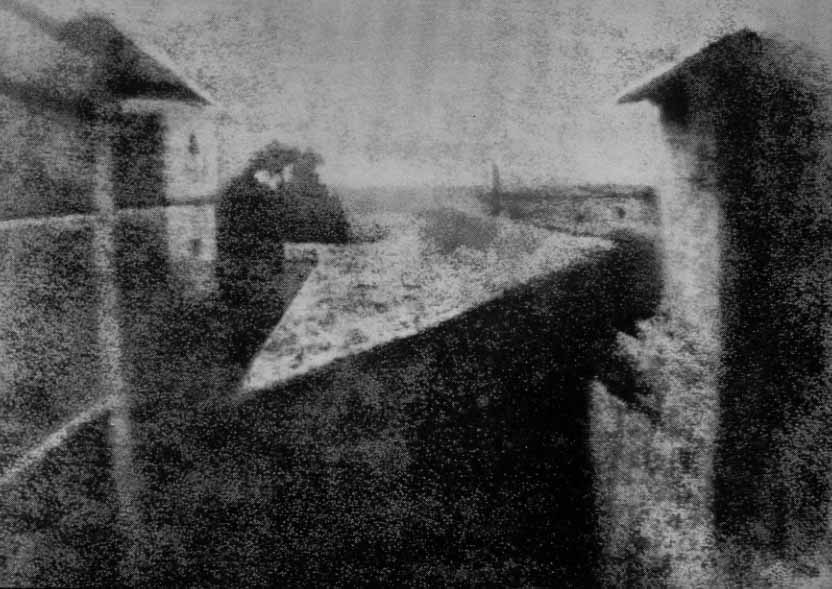
The “first” “photograph”

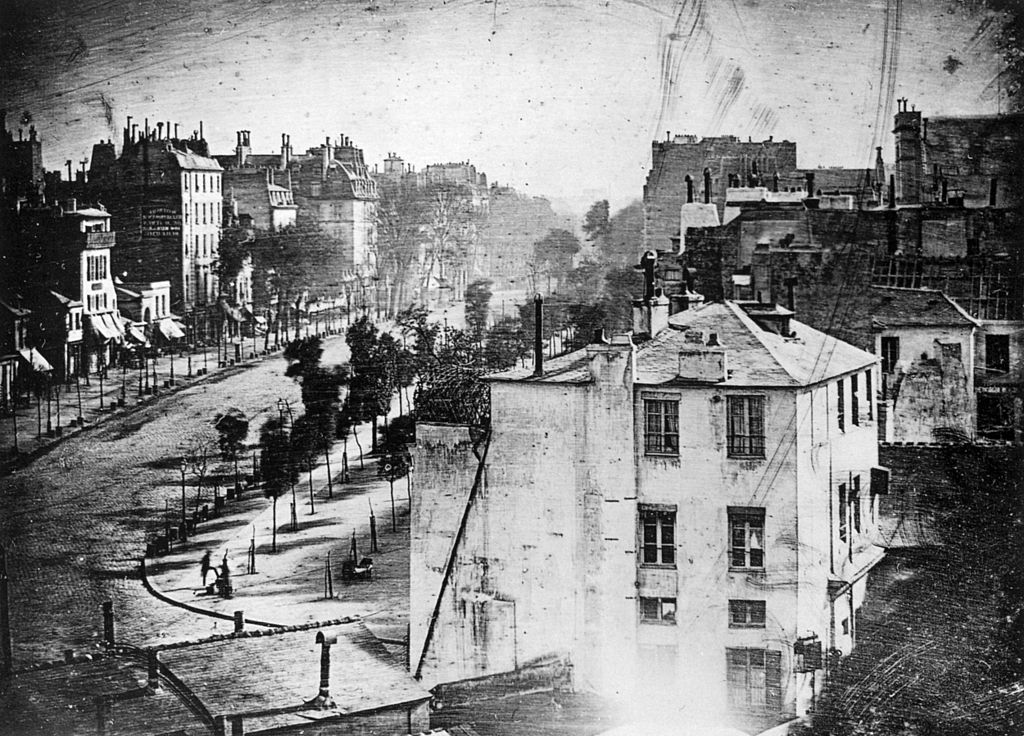
The first photograph of people (Daguerre, 1838)


Dickinson, Photography, and Whitman, oh my!


Warning: Undefined variable $num in /home/shroutdo/public_html/courses/wp-content/plugins/single-categories/single_categories.php on line 126

Warning: Undefined variable $posts_num in /home/shroutdo/public_html/courses/wp-content/plugins/single-categories/single_categories.php on line 127

By admin

Upon reading Adam Frank’s “Emily Dickinson and Photography,” I was interested to find Dickinson and Whitman put into contrast. Though both poets, these two writers couldn’t be more different. In Whitman’s work, we see a man throwing himself into the public eye, particularly in his 52-page long “Song of Myself.” He does not shy away from making himself the subject of his work. Adam Frank provides similar evidence to speak to this point: Whitman used an image of himself rather than a signature to mark Leaves of Grass as his work. In contrast, Dickinson’s short, modest poems hint at the personality of the writer herself, whom we now consider to be a recluse.

Frank argues that Dickinson’s writing system was an “attempt to control the emergent social value of the publicity of the private.” One would infer that Whitman, being Dickinson’s opposite, embraced the chaos of the private being made public. I tried to answer the question that arises from this contrast—Why did one writer spurn the public eye, and attempt to control the exposure of their creative work, while the other so joyfully embraced it?

First, I thought that the qualities of extreme introversion or extreme extroversion could explain these actions. Dickinson, in refusing to send T.W. Higginson her photograph, was perhaps acting out of modesty. Her refusal to publish her multitude of poetry was perhaps a defense against unwanted attention. And Whitman’s vivacious writing, in which he proclaims himself to be everything on earth and that everything on earth is Whitman, is perhaps evidence of extroversion.

However, then I brought gender inequality into the conversation. It was perhaps accepted, if not encouraged, for men like Whitman to actively praise themselves; were a woman to have so enthusiastically thrust herself into the limelight, she might have been received to be unladylike. I see evidence for this in Frank’s article, in which he references Karen Hulttunen’s research on Antebellum America. Hulttunen writes that a proper lady was expected to express herself through her body. In “the woman of sensibility, … the blush of honesty and purity, the sudden glow of love, the hues of sorrow and despair” all spoke through her skin.” Therefore, though I cannot by any means conclude that Dickinson’s attempt to control the publicity of the private was a direct result of women’s gender expectations, this certainly may have played a part.


Daguerro-“typical” Dickinson


Warning: Undefined variable $num in /home/shroutdo/public_html/courses/wp-content/plugins/single-categories/single_categories.php on line 126

Warning: Undefined variable $posts_num in /home/shroutdo/public_html/courses/wp-content/plugins/single-categories/single_categories.php on line 127

By Alec

I am a bit skeptical of Adam Frank’s primary argument that “[Emily] Dickinson’s writing … registers and theorizes experiences of looking conditioned by photographic materials”, if only because I felt that he was was occasionally grasping at straws to make ties between photography and Dickinson’s life and to find references to photography in her writing. That said, I was completely onboard with and intrigued by Frank’s observation that the physical qualities of technologies mold the ways that we use and interpret them. He notes that the daguerrotype, a metallic precursor to the paper-printed photograph, was necessarily reflective and thus “allow[ed] the viewer to see his or her own image superimposed over the photographic one”. This quality, he later argues, offered to its viewers a material hybridization of the “Calvinist requirements of self-examination and witnessing with sentimental sincerity and transparency” and thus supplemented the changing concept of “the self” during this time period.

This notion that a technology’s physical attributes can direct us toward certain values and sentiments is a powerful one, and holds true for just about every object. It makes sense, after all, that the way we hold/view/use an object will probably affect how we feel about it. Letter-writing, for example, is made even more personal by envelopes that require the sender’s own saliva for the seal. A thick, printed newspaper suggests a certain standard of journalism not typically associated with blogs or websites. Red sports cars evoke a sense of speed and adventure; station wagons, not so much.

In some cases these physical attributes are an intentional effort on behalf of the designer to evoke a certain emotion or idea in its users. Red paint doesn’t make a car drive any faster, nor does it dictate how a person uses the car – but the psychological suggestions are probably enough to convince many to drive a bit faster, and for onlookers to make certain judgments about the driver’s lifestyle. In other instances, this effect seems more a product of happenstance and/or practicality. For example, I would guess that the mirror-like quality of the daguerrotype was more a product of technical limitation than a conscious attempt at creating a print that reflected its user. In any case, I know that this topic of connecting the tangible and material qualities of an object to its immaterial, intangible qualities ones is a relatively small topic in Frank’s essay, but it’s a notion that I’m completely fascinated by, and plan to continue to look out for in other technologies we discuss in this course.


A systematic approach to studying technological change?


Warning: Undefined variable $num in /home/shroutdo/public_html/courses/wp-content/plugins/single-categories/single_categories.php on line 126

Warning: Undefined variable $posts_num in /home/shroutdo/public_html/courses/wp-content/plugins/single-categories/single_categories.php on line 127

By Dr. Shrout

The readings for class today both (as Avery writes) come at the question of the history of telegraphy from two different directions. One (Marvin) emphasizes the people who helped develop telegraphs – not the rockstars like Morse so much, but the engineers, operators and users who helped send information electroncially over vast distances. The other (Stephenson) focuses on the technology itself, but also emphasizes the incredible contingency of the development of telegraphic lines of communication.

Avery nicely summarized the links between these two pieces when she wrote:

Ultimately, technology is a tool animated by us. (Perhaps that comes into question when we start talking about artificial intelligence, but by all accounts we’re a long way off from that.) At the same time, new technologies can transform the way we interact and the ways we imagine animating new tools. Marvin and Stephenson’s works bring these two fundamentally human aspects, culture and technology, together.

I, however, want to push their historiographical import a bit farther. In her introdction, Marvin writes:

“[according to historians] everything before this artificial moment [the rise of appliances in the 20th century] is classified as technical prehistory, a neutral boundary at which inventors and technicians with no other agenda of much interest assembled equipment that exerted negligible social impact until the rise of network broadcasting.”

I wonder what all of you make of her historiographical positioning. Was there a paradigm shift with the introduction of electronic communication? Should we – as Stephenson does, and Marvin does less – contextualize modern forms of communication in light of their ancestors?


Technology and Culture


Warning: Undefined variable $num in /home/shroutdo/public_html/courses/wp-content/plugins/single-categories/single_categories.php on line 126

Warning: Undefined variable $posts_num in /home/shroutdo/public_html/courses/wp-content/plugins/single-categories/single_categories.php on line 127

By Avery

Marvin and Stephenson both take their readers on journey through the beginnings of telegraphy. The stories launch from separate but complementary facets of the innovation: Marvin launches with people and Stephenson with technology. Together, their stories create a picture of telegraphy that acknowledges the significance of both the wires that transmit information and the people whose culture decides what information is transmitted.

Marvin gives great deference to telegraphy, writing that this “first application of electricity to communication” was “as significant a break with the past as printing before it” (7). She goes on to describe the turf war waged by early electrical engineers eager to legitimize their profession. Marvin demonstrates the ways in which electrical engineers functioned both a subculture defining new territory, and as a manifestation of dominant culture values and norms. My main takeaway: technology does not exist in a vacuum; its possibilities and applications are part of the long arc of human culture.

Stephenson reminds his readers not to forget the physicality of technology. Especially in the age of “wireless” gadgets, it’s easy to forget that there are actual wires and cables that make our online communication possible. He, like Marvin, thinks the computer is not as innovative as the telegraph’s first electrical transmission over great space. And Stephenson’s story ends up in the same place as Marvin’s, joining technology and culture.

Stephenson predicts that the physical challenges to electronic communication will wane as humans (and their computers) get better and better at mapping the terrain and solving problems. Stephenson believes the one problem that will remain, one that has inhibited technological growth throughout history, is the problem of cultural difference. Thus, he writes that “there will always be a niche for people who have gone out and traveled the world and learned a thing or two about its ways.” In other words, technology does not exist in a vacuum; its possibilities and applications are part of the long arc of human culture.

Ultimately, technology is a tool animated by us. (Perhaps that comes into question when we start talking about artificial intelligence, but by all accounts we’re a long way off from that.) At the same time, new technologies can transform the way we interact and the ways we imagine animating new tools. Marvin and Stephenson’s works bring these two fundamentally human aspects, culture and technology, together.


Maps as history; maps as argument


Warning: Undefined variable $num in /home/shroutdo/public_html/courses/wp-content/plugins/single-categories/single_categories.php on line 126

Warning: Undefined variable $posts_num in /home/shroutdo/public_html/courses/wp-content/plugins/single-categories/single_categories.php on line 127

By Dr. Shrout

Last Tuesday and today are concerned with maps. One of the turns in digital history is the acceptance of dynamic, interactive maps as a form of scholarship. This can mean maps that tell a story (known as storymaps) or the datadriven maps that we looked at in class last week.

Carolyn differentiated between these two in her post. She helpfully summarized Ben Schmidt’s argument/historical intervention as:

“Schmidt contends that the more important contribution of the historian is their assembly and unbiased interpretation of the evidence. I infer, then, that this is the theory behind Schmidt’s argument for digitization.”

However, she also questions Schmidt’s conclusion:

“First, if the historian’s most important job is to collect and present the information, what do we call the people who interpret that data? Second, why assemble data for the sake of assembling data – isn’t the “so what?” question, the participation in the discussion of live question, what makes history a worthwhile subject?”

For me, Carolyn,s questions raised further ones – are maps inherently objective? Is the data that historians use cartographically any different from the data they use to write more “traditional” papers?

Wilson responded to Carolyn’s post by noting that Schmidt’s orientation of the map to the Pacific was in itself an argument –

“While doing so made my above observation about robust Pacific shipping connections more apparent, it did not seem to specifically focus on the trade with which the US was directly involved.”

Similarly, Alec noted that

“Maps, like any text, create arguments not just with the information they include but also the information they obscure and omit.”

Taking a different perspective, Sherwood posited that if the point of maps was to convey geographic information, maybe these are more dynamic representations than they are maps.

I will be interested to see how these ideas – about data as objective but maps as argument – are reconciled in class.

Both Kurt and Avery more directly took on the question of sources used in their map. Kurt rightly noted that the scale of the maps was not clear, and that

“First, we were wondering if this map dealt primarily with commercial shipping, or personal transit and travel. Also, we would have liked to know whether or not the experience a train ride chained dramatically with the change in travel times being so great”

Avery went further, suggesting that some historiographical context (or any context at all) would be helpful for a user understanding this map. This is something to consider as you make your own maps – how much context is needed? How much is too much? How much is not enough?

Sherwood took a slightly different tack in one post, critiquing the architecture of Neatline itself. His point is a good one – how much technical expertise is required to achieve a certain outcome? How much should we expect humanists to learn new tools?

Finally, Cordelia makes a point that no one else did, but which is quite important – maps let us experience the past in new ways. In her words:

[This map allowed the user] “to view historical events as they happen through the establishment of post offices. For example, the California Gold Rush is suddenly visible, as is the great Mormon migration to Utah.”

I look forward to thinking more about the multiple uses of maps in class today.


Maps or Not?


Warning: Undefined variable $num in /home/shroutdo/public_html/courses/wp-content/plugins/single-categories/single_categories.php on line 126

Warning: Undefined variable $posts_num in /home/shroutdo/public_html/courses/wp-content/plugins/single-categories/single_categories.php on line 127

By Sherwood

In his blog post “Reading digital sources: a case study in ship’s logs,” historian Ben Schmidt struggles with something of an existential question, regarding how to conduct historical analysis in the 21st century. He argues that the interpretive work of history remains relevant, but admits that the data historians have previously worked with has been digitized. However, although this shift towards a new medium demands historians change up their traditional methodology, Schmidt seems excited about the future of the field. He concludes that neither “humanistic competency or technical expertise from the sciences” are adequate for “humanistic readings of digital data.”

To corroborate his argument, Schmidt offers an example.

Consider the “millions of points” in a “medium-sized data set like Maury’s 19th century [ship] logs.” Schmidt’s goal is simply to interpret large sets of data at once, like this one, which he calls ‘reading’ them. He suggests that major trends become immediately apparent when data is represented visually. Digital tools make data visualization possible and easy.

He introduces a pair of maps that also serve as dynamic representations of early American shipping and the global whaling industry, respectively. Colored dots, representing ships, travel to and from major ports around the world. The most popular routes are dense with traffic, leading between England and the American seaboard, around the cape of Africa and below South America. During the summer months, the northern Pacific becomes flush with color, but in the winter, these ships migrate south. This phenomenon was similar to what Cordelia observed in her map, when “the California Gold Rush [was] suddenly visible, as [was] the great Mormon migration to Utah.” The true purpose of Schmidt’s maps, like the ones Cordelia analyzed, was “the ability to view historical events as they happened.” Also, Hawaii and the Galapagos were apparently popular pit stops.

Schmidt argues that this example, which makes apparent a wealth of information after only a few seconds, demonstrates strength of visualizations over other methods of understanding data.

Earlier on, I called these both maps and “dynamic representations.” However, if one considers the principal purpose of maps, which is to convey geographical information, they are more the latter than the former. The main focus of these tools is the data – patterns of ship routes around the world – not the geography.


Map PA


Warning: Undefined variable $num in /home/shroutdo/public_html/courses/wp-content/plugins/single-categories/single_categories.php on line 126

Warning: Undefined variable $posts_num in /home/shroutdo/public_html/courses/wp-content/plugins/single-categories/single_categories.php on line 127

By admin

I was struck by the visual representation of international whaling in the 1850s that we examined in class last week. For one, the extent to which international sea trade had developed is a bit shocking. I had not expected Pacific sea routes to be so well established. I was also surprised by the ports trafficked in South America. The Galapagos for instance seemed an unlikely candidate for a major 19th century port as I had assumed that they were largely self-sustaining fishing and agrarian economies. I was also surprised to see that ships tended to stop at several locations along the eastern coast of South America. This observation led me to believe that South American countries had not developed any railroad infrastructure at the time. I came to this realization through comparative analysis with the North American ports. In the US, it appeared that ships only really stopped in New York or another New England port. They also stopped at a Canadian port. This led me to believe that the US was able to get all the goods it needed from the one port, then ship them throughout the country from there. Doing so would have obviously required the use of the railroad infrastructure developed around that time. Therefore, more stops in South America could mean that they were unable to efficiently ship imported goods otherwise.

I was also intrigued by two of the choices Ben Schmidt made in his analysis. The first was to center the map on the Pacific Ocean. While doing so made my above observation about robust Pacific shipping connections more apparent, it did not seem to specifically focus on the trade with which the US was directly involved. Given his title in which he focuses on ‘America’ I expected a US-centric analysis, which would have likely zeroed in on the triangular trade in the Atlantic Ocean. His choice to end the analysis in the early 1860s did not really make sense to me either. I would have expected him to continue the analysis through the early 1870s in order to effectively examine the ways in which the completion of the transcontinental railroad in 1869 precluded an explosion in western port cities, such as Los Angeles and San Francisco. This is just a theory. It is entirely possible that the whaling trade broke down or stayed its original course after the 1860s, leading Schmidt to ignore the impact of the transcontinental railroad.


« Older posts Newer posts »

© 2026 History 245

Theme by Anders NorenUp ↑