Reading, Writing and Knowing in Early America and the Digital Age

Category: Public (Page 4 of 8)

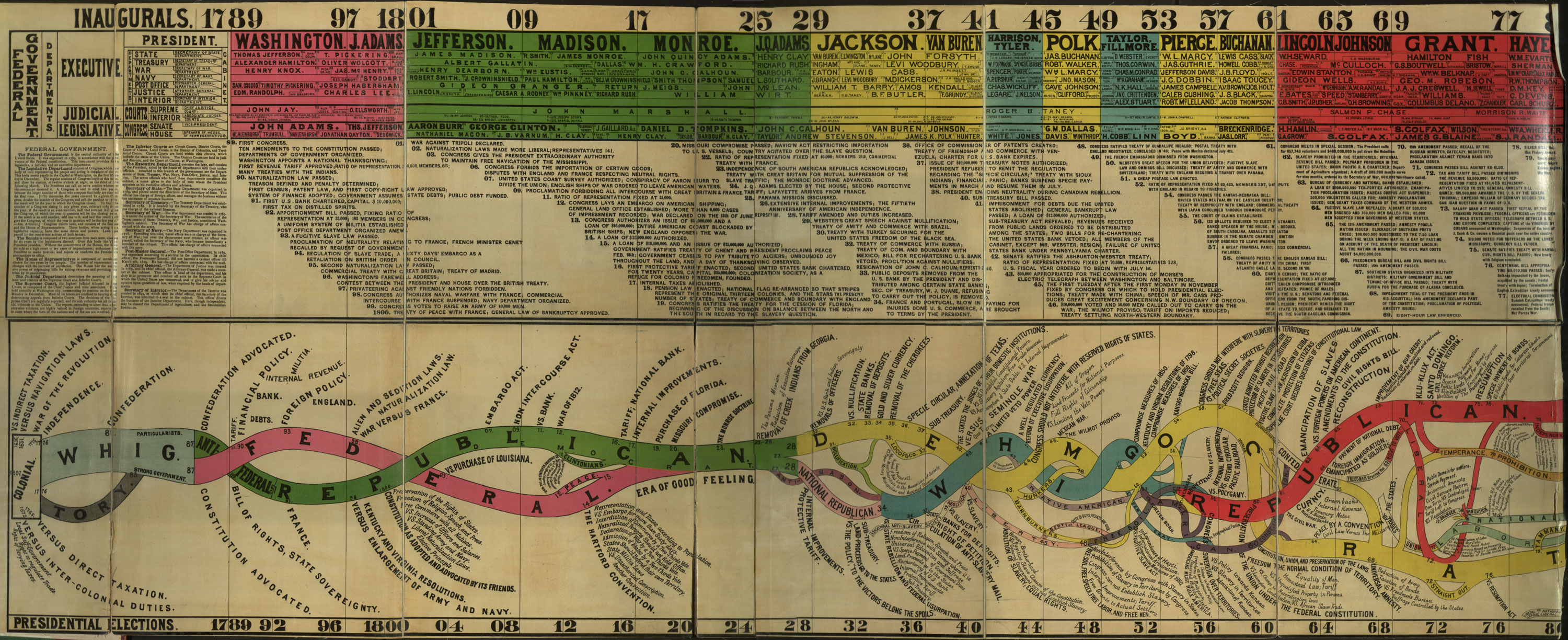
Antebellum American political culture


Warning: Undefined variable $num in /home/shroutdo/public_html/courses/wp-content/plugins/single-categories/single_categories.php on line 126

Warning: Undefined variable $posts_num in /home/shroutdo/public_html/courses/wp-content/plugins/single-categories/single_categories.php on line 127

conspectus-graph

A systematic approach to studying technological change?


Warning: Undefined variable $num in /home/shroutdo/public_html/courses/wp-content/plugins/single-categories/single_categories.php on line 126

Warning: Undefined variable $posts_num in /home/shroutdo/public_html/courses/wp-content/plugins/single-categories/single_categories.php on line 127

By Dr. Shrout

The readings for class today both (as Avery writes) come at the question of the history of telegraphy from two different directions. One (Marvin) emphasizes the people who helped develop telegraphs – not the rockstars like Morse so much, but the engineers, operators and users who helped send information electroncially over vast distances. The other (Stephenson) focuses on the technology itself, but also emphasizes the incredible contingency of the development of telegraphic lines of communication.

Avery nicely summarized the links between these two pieces when she wrote:

Ultimately, technology is a tool animated by us. (Perhaps that comes into question when we start talking about artificial intelligence, but by all accounts we’re a long way off from that.) At the same time, new technologies can transform the way we interact and the ways we imagine animating new tools. Marvin and Stephenson’s works bring these two fundamentally human aspects, culture and technology, together.

I, however, want to push their historiographical import a bit farther. In her introdction, Marvin writes:

“[according to historians] everything before this artificial moment [the rise of appliances in the 20th century] is classified as technical prehistory, a neutral boundary at which inventors and technicians with no other agenda of much interest assembled equipment that exerted negligible social impact until the rise of network broadcasting.”

I wonder what all of you make of her historiographical positioning. Was there a paradigm shift with the introduction of electronic communication? Should we – as Stephenson does, and Marvin does less – contextualize modern forms of communication in light of their ancestors?


C is for Canal: A Journey into Time and Space


Warning: Undefined variable $num in /home/shroutdo/public_html/courses/wp-content/plugins/single-categories/single_categories.php on line 126

Warning: Undefined variable $posts_num in /home/shroutdo/public_html/courses/wp-content/plugins/single-categories/single_categories.php on line 127

By admin

The 19th century was an interesting time in American history because as a young, vast nation, the advent of modern infrastructure greatly affected how it would come to be structured both economically and politically. More fundamentally, the influx of canals, roads, and railroads built in this time period would serve to carve a new perception of space in the minds of most americans, as new settlements became easier to build, and as the need for everything for survival to be produced in every town ceased to exist. The three sources analyzed in this essay demonstrate both the scope of the transformation american infrastructure underwent and also the reactions some Americans had to it.

The map produced by civil engineer, David Stevenson in 1838 gives a clear visual representation of the shape American infrastructure had taken by that time. It is also important to note that all rivers wide and deep enough would have been used to transport goods and people as well as the wholly man-made routes of transport. One feature of the map that jumps immediately to mind is the westerly trend of the canals across the United States, alluding to the use of infrastructure to expand into the mainland of America now that goods necessary for survival (food, textiles for clothing, firearms for hunting, construction materials, etc.) could be shipped over from the coast. This newfound expansionary power changed the mindset of Americans towards the prospect of moving west and was indicative of the ideological movement of manifest destiny that would sweep the nation in the 19th century. This map was produced early on in the railway boom in America and as such features very little in the way of railway lines (the number of lines would more than double before 1860), but we do see in this map a tendency to use rail in order to connect the northern and southern states. As another source analyzed in this essay will look into, the South was slower to hop aboard the notion of internal commerce, but the process, shown in its infancy in this map, to connect the states more naturally suited to agriculture with those more inclined towards industry was the beginning of a new way of looking at the geographical features of the nation. These railway lines, whilst also facilitating the movement of curious settlers, allude to the changing mentality towards economic specialization in the United States, and to the new understanding that different regions can be used of for the production of separate goods, which could improve both efficiency and average quality.

There were clear economic benefits to the revolutionary means of transporting goods long distances for both the northern factories and the southern plantations, but the map shows a clear disparity between the state of technological and infrastructural advancement in the North and that of the South. The editorial entitled, “National Industry” from the National Intelligencer outlines this same idea, as by the end it becomes more of an outcry to the landowners and agriculturalists in the South to embrace the exciting new world of internal commerce, making the point that they stand to make a great deal more money by using the newest technological advancements in order to ship their wares across the country to a new host of potential buyers. The point is outlined most clearly when the editor writes, in a plea to the southern landowners, “Who can have so much interest as you in the opening of canals and roads, the increase of national industry and capital, with all its ramifications, which must reach you like irrigating streams of living waters, and enhance the value of your possessions?”. It is clear from looking at strongly worded editorials like this one and the economic suggestions found in newspaper articles such as the article, “Thoughts on Commerce and Agriculture” from the Raleigh Register in which the author constantly sings the praise of devoting sales efforts to other Americans (newly possible as canals were beginning to take shape in 1800 when it was written) rather than overseas buyers. The new focus on the domestic market as a separate target for exporting goods is a perfect example of the changing views of space in America at this time because no longer were goods produced in America just distinctively American, but goods in each state could now be viewed (and therefore marketed as) as distinct to that particular state, allowing a drastic increase in the marketability for products in regions where there was a more suitable climate for them.

The final source investigated here will be a later part in Stevenson’s survey of American infrastructure in which he remarks on the staggering ease, affordability, and speed with which one can now traverse unbelievable distances hitherto undreamt by man. Stevenson remarks on page 187 how many of these railway lines and canals cut through forests that previously made travel impossible, acting as further proof of the fervor with which people were getting behind the expansion in infrastructure. The excitement with which Stevenson talks about the ground covered by and the space aboard the steamboats for both personnel and cargo coupled with the newspapers’ rave reviews of the prospects of using said new infrastructure to expand the southern economy provides overwhelming testament to the new vision that americans were conjuring for both themselves and for their country. As mentioned earlier, America is a much larger country than most, and with the advent of means of moving around it, Americans were finally starting to realize that their country spans a similar range and array of climates and resources as other continents, let alone other countries. Through their newfound ability to move about their young nation, they realized it was more like several countries in one, each with different advantages, than one homogenous land mass.

Stevenson, David, and Burndy Library. Sketch of the Civil Engineering of North America: Comprising Remarks on the Harbours, River and Lake Navigation, Lighthouses, Steam-Navigation, Water-Works, Canals, Roads, Railways, Bridges, and Other Works in That Country: by David Stevenson. London: John Weale, Architectural Library, 1838. Nineteenth Century Collections Online. Web. 19 Mar. 2015.

“Thoughts on Commerce and Agriculture.” Raleigh Register, and North-Carolina Weekly Advertiser [Raleigh, North Carolina] 15 July 1800: n.p. 19th Century U.S. Newspapers. Web. 23 Mar. 2015.

“National Industry.” Daily National Intelligencer [Washington, District Of Columbia] 8 Feb. 1817: n.p. 19th Century U.S. Newspapers. Web. 23 Mar. 2015.


The Young Housekeeper’s Friend: A Primary Source Analysis


Warning: Undefined variable $num in /home/shroutdo/public_html/courses/wp-content/plugins/single-categories/single_categories.php on line 126

Warning: Undefined variable $posts_num in /home/shroutdo/public_html/courses/wp-content/plugins/single-categories/single_categories.php on line 127

By admin

For my final project, I am investigating how cookbooks in the antebellum period reflect the socially prescribed roles for women, and how writing by women reflects their beliefs about their positions in society. Cookbooks, like commonplace books, were a place where women could compile pieces of information (in this case, mainly recipes) of personal value to them. In these books, they also give advice to other women intended to improve their lives, which makes cookbooks a prime point of entry for my investigation of women’s expectations for their lives and the lives of other women.

My first primary source that I chose to analyze is a cookbook by Mary Hooker Cornelius called The Young Housekeeper’s Friend. Published in 1859, it aims to provide young women who find themselves in unfamiliar territory after marriage with information on how to manage a household. The book has a very simple structure, with no table of contents to provide a reference point for the chapters Mrs. Cornelius has written. Her first chapter, titled “Counsels and Suggestions,” describes the role of the housewife and the personality characteristics she is expected to have in order to run a successful household.

In this chapter, Cornelius describes housewives as the necessary base on which society is built and depends. On the surface, this appears to both praise women. However, upon closer examination I realized that this justifies blaming women for the failures of men. Cornelius writes that the “every woman is invested with a great degree of power over the happiness and virtue of others,” a power which “when rightly directed, [is] unsurpassed by any human instrumentality in its purifying and restoring efficacy” (9). One may read this as evidence that antebellum society valued women highly for their balancing, purifying power. However, Cornelius refers to the Bible for a definition of what personality traits and work habits define a virtuous woman, and the list takes up an entire page. Therefore, with expectations so high, it would not be hard for the average woman to fall short. The consequences of this failure, Cornelius writes, are disastrous. “Many a day-laborer, on his return at evening from his hard toil, is repelled by the sight of a disorderly house . . . and perhaps is met by a cold eye instead of ‘the thrifty wifie’s smile.’” As a result, Cornelius concludes, “he makes his escape to the grog-shop or the underground gambling room” (9). Here we see the woman’s shortcomings being identified as the cause of man’s vices and moral shortcomings.

In my final project, I intend to investigate other sources like The Young Housekeeper’s Friend to see how other women have written about the role of women in the home as well as its impact on society. Hopefully I can find sources in which women (or men) have disagreed with Mrs. Cornelius or presented other roles for women, and put these opposing arguments into conversation.

Works Cited:

Cornelius, Mary Hooker. The Young Housekeeper’s Friend. Boston: Brown, Taggard and Chase, 1859.


Primary Source Analysis: The British Are Biased


Warning: Undefined variable $num in /home/shroutdo/public_html/courses/wp-content/plugins/single-categories/single_categories.php on line 126

Warning: Undefined variable $posts_num in /home/shroutdo/public_html/courses/wp-content/plugins/single-categories/single_categories.php on line 127

By Cordelia

My final project will consist of a comparison of British and American documents that showcase the differing uses of “framing” or bias to impact the general societal opinion towards the issues impacting the American continent in the colonial era. I began with a newspaper article from the Stamford Mercury of Stamford, England published on December 5, 1770. The article is entitled, “An Account of the Rise and Progress of the present unhappy War between Great-Britain and the American Colonies” and discusses, in depth, the reasons behind the current conflict.

The article, in and of itself, reads more as an editorial and, although it provides information and (as the title states) an account of the American cause, it provides a pro-British counterargument for every statement made. The author questions the reasons colonists have for complaining of taxation – the article making clear that taxation is truly the sole cause of the conflict – and addresses all possible conclusions. As possible reasons for wishing for the repeal of the acts passed by the British parliament, the author lists clauses of some of the colony’s charters referring to an exemption of taxes, the argument of taxation without representation, and a general attitude to go against the crown and create illegal bodies of government.

As an argument against the charters, the article states that the clauses exempting certain colonies from taxation were time stamped and are therefore void and should not be used in a case against taxation. In regards to taxation without representation, the author points out that there is a lack of parliamentary representation in many social areas of mainland England and that the colonists are selectively complaining about taxes. For example, the author points out, parliament makes laws about punishment for crimes and the colonies are not represented in those lawmaking sessions but they are still subject to punishment for crimes, yet this is not a reason they are using for independence. Therefore, the article argues, this argument is invalid. The final statement of the newspaper article pertains to the idea of the author that the colonists are not prepared to govern a vast land of people who do not fully comprehend the concept of representation and that they are simply disobeying parliament in creating illegal governing bodies.

This source will aid my project in creating a contrast of bias from colonial sources.

Work Cited

“An Account of the Rise and Progress of the present unhappy War between Great-Britain and the American Colonies.” Stamford Mercury [Stamford, England] 5 Dec. 1776: 4. 19th Century British Newspapers. Web. 22 Mar. 2015.


TA 2: “I Remain” Digital Archive Assessment


Warning: Undefined variable $num in /home/shroutdo/public_html/courses/wp-content/plugins/single-categories/single_categories.php on line 126

Warning: Undefined variable $posts_num in /home/shroutdo/public_html/courses/wp-content/plugins/single-categories/single_categories.php on line 127

By Eleanor

Screen Shot 2015-03-23 at 1.34.07 AMScreen Shot 2015-03-23 at 1.33.51 AM

Introduction:

Lehigh University’s digital archive I Remain: A Digital Archive of Letters, Manuscripts, and Ephemera presents over seven hundred primary sources possessed by the college. The archive’s contents date as far back as the 15th century and as recently as the 20th, and are penned primarily by Americans – famous ones in particular. That said, the archive prides itself in representing a “range of lives … from ordinary citizens to Presidents” and “writers in Europe and the United States.” Though it acts more as a showcase of Lehigh’s collection than as a coherent historical narrative, we still found the “I Remain” to be, on the whole, a perfectly functional and impressive digital archive. We will organize our assessment of the collection on three distinct criteria: 1) user interface and functionality, 2) the types and quality of the content, and 3) its intended audience and potential uses.

Functionality and Interface:

In terms of visual appeal, I Remain‘s user interface is nothing to write home about. There are no drop-down menus, no slick animations, no spiffy photo galleries – and for the most part, this is a good thing. Lack of visual bloat means that navigation is quick and straightforward, with only two real “modes” of operation. The first is “Browse”, which presents a list of the available categories and a short description of each. Clicking on a category directs to a filtered list containing only items in that category. The only discernible issue with this organization is that users are bound to the dozen pre-curated collections which, while interesting, may be too narrow in focus for many users. There is an “Honor” category but not a “Letters” category; a “Lehigh History” but no “American History”. Perhaps most concerning is the omission of a “View All” button – to see everything in the archive at once, users must head over to the “Search” page and perform an empty query.

Thankfully, said search feature offers a more advanced and research-oriented way of navigating the archive’s content. There are plenty of fields to tweak and tune, allowing users to fashion a highly selective search term. Of course, a search engine is as only as good as the body through which it searches – and in I Remain‘s case, the lack of transcribed sources presents a substantial obstacle for any interested in finding items containing specific words or phrases. The detailed item descriptions are considered by the search engine and help to counteract this shortcoming to some degree, but this still is not nearly as precise as a full-text search. Hopefully the archive’s creators realize the importance of a fully-featured mechanism for locating items, and choose to update the “Browse” and “Search” functionalities before refreshing the site’s ancient design.

Content:

I Remain contains 726 digital copies of historical media artifacts located in Lehigh University’s Special Collections library: a mixture of letters, manuscripts, and ephemera spanning the 15th to 20th centuries.Despite claiming such a wide span of temporal coverage, the archive focuses primarily on the 19th century. Almost two thirds of I Remain‘s content is from the the 1800s and only six items are dated before 1700. I think that the description of the archive should perhaps be altered to reflect this emphasis. That way, researchers looking for 19th century works could find this more easily and those looking for earlier works would know that they would be better off looking elsewhere.

On the introductory home page, the archive states that its purpose is to “study the evolution of communication, trace the development of social networks, examine material culture, and gain insight into the way working writers and scientists shaped their ideas and shared their thoughts”. The vast majority of the sources, 655 of the 726 items, are letters. That ties in well with the stated goal of the archive. Personal letters are a great way to gain insight into how people thought and to track historical social networks. Additionally, I Remain‘s content is broken up into eleven thematic categories in order to streamline browsing research. Looking at a bar chart breakdown of how many sources fall into the different categories, we can see that the areas that this archive seems to specialize in are “War and Politics”, specifically “Networking”, and the concept of the “Working Writer”, a category that they define as sources that speak about the process of writing and communicating information. This emphasis also supports the purpose of the archive. Political networking is an undeniably important historical social network and the “Working Writer” category clearly speaks to the second part of the archive’s goal.

The digital representations of the sources contained in I Remain are almost entirely very high quality and are accompanied with detailed content descriptions and metadata. However there are no text transcriptions of the handwritten letters and manuscripts. The old handwriting style and irregular spelling can make these documents very difficult to read. As the archive’s developers move forward, I would suggest working towards adding more transcriptions to make their content more accessible.

Utility and Audience:

As the archive was created by Lehigh University, there is an implied audience of the members of that specific school. This is further implied by the way that the site puts Lehigh history at the same level of importance as the Revolutionary War and other more global events. With this exists the implication that the university will be considered important to those who view the archive. This could be students or it could be faculty. However, the website is not private in any way and therefore, can be accessed by anybody with an internet connection. With this in mind, I Remain appears to be best suited for research purposes by college students looking for primary sources. The accessibility and navigational ease allow all age groups the chance to conduct research but the need for primary sources and a digital archive specializing in them really only presents itself for those in college and beyond. This, therefore, appears to be the intended audience and use of the digital archive.


Investigating Eighteenth Century African Americans and Print Media: A Historiography


Warning: Undefined variable $num in /home/shroutdo/public_html/courses/wp-content/plugins/single-categories/single_categories.php on line 126

Warning: Undefined variable $posts_num in /home/shroutdo/public_html/courses/wp-content/plugins/single-categories/single_categories.php on line 127

By admin

Within the study of an American print culture historically dominated by a White elite, some scholars have looked for answers to the question of how 19th century African Americans interacted with print media. Historians Morgan and Rushton, Richard Newman, and David Waldstreicher investigate this question through different lenses, together creating a dual-sided argument about the impact of this media: that it was used to oppress Blacks, but that it also was integral to Blacks’ subversion of the power structure and their efforts to fight back against their oppressors.

In “Visible Bodies: Power, Subordination and Identity in the Eighteenth-Century Atlantic World,” Historians Gwenda Morgan and Peter Rushton examine advertisements for runaway slaves and conclude that this form of print media furthered Black oppression. They base their investigation on Foucault’s theory that the systematic observation of one class of person by another is created by (and perpetuates) a power structure in which the observer has power over the observed. “Visibility is a trap,” wrote Foucault, and he who is seen but does not see “is the object of information, never a subject in communication.” Anchored by this theory, Morgan and Rushton approach advertisements for runaway slaves, servants, and criminals with the goal of demonstrating how the ads allowed the white, newspaper-reading elite to “see” slaves as human objects of information, and therefore withheld the power of being autonomous “subjects in communication” from Black Americans.[1]

In the course of arguing that the newspaper advertisements withheld Black autonomy, Morgan and Rushton consequently ignore Black autonomy. They describe how newspaper advertisements acted on Black Americans, instead of how Black Americans interacted with the print media. Casting the slaves as victims of surveillance, they simultaneously show how advertising reflected white society’s view of race. In newspaper advertisements, they write, “there were variations in the extent to which languages of ‘race’ and colour were used” and “these distinctions were generally lost on the British press.” For example, “Standard phrases such as ‘of a black complexion’ were used in British newspapers without the overtones of the racialized hierarchical language of the American colonies.” [2]

Morgan and Rushton’s focus on how the advertisements reflect White Society is also highlighted in their grouping of Black slaves and servants with convicts and criminals. That is, they repeatedly describe how bodily descriptions in advertisements spoke of runaway slaves in the same way as criminals and other plagues on society. “The poor, the criminal, the deserter from army or navy, the runaway slave or servant, were viewed and described precisely because they were not tame or obedient.” They conclude their essay by describing the further use of systematic classification in police systems and prisons, reminding readers that classification is used to control lower elements of society.[3]

Where Morgan and Rushton saw runaway slave advertisements as evidence of and a tool for the perpetuation of White dominance, historian David Waldstreicher sees another side. He explores Black autonomy in his article “Reading the Runaways: Self-Fashioning, Print Culture, and Confidence in Slavery in the Eighteenth Century Mid-Atlantic,” where he uses runaway advertisements “to analyze the acts of cultural hybridization black and racially mixed people committed for their own purposes,” and then, like Morgan and Rushton, evaluates “the owners’ use of print to counter the mobility of the unfree.”[4]

Waldstreicher add another level to Morgan and Rushton’s conclusions from their studies of runaway ads. For example, Morgan and Rushton answered the question, “to what extent did ordinary workers wear [wigs]?” with the evidence that “[Wigs] are frequently mentioned as an aspect of people’s appearance” in runaway advertisements and furthermore, wearing wigs “was one aspect of servants apeing their betters–an accusation often raised against them in popular representations of the time.”[5] We see here Morgan and Rushton observing servant behavior in the context of how White society defined and reacted to it. In contrast, Waldstreicher brings historians Shane White and Graham White into the argument, using their point that “runaway advertisements depict a great variety of hairstyles among slaves, ‘an expressive space that blacks were able to exploit.’” Waldstreicher continues, “Distinctive hair could be shaven or grown, and frustrated masters struggled to represent verbally the texture of the hair on the heads of mulattoes and mustees.” From this example, we see Waldstreicher using the same evidence as Morgan and Rushton, yet he argues that it demonstrates Blacks’ capitalizing on the expectations of masters by contravening how others defined them.[6]

Instead of focusing exclusively on runaway advertisements, historian Richard Newman looks to other forms of literature and concludes that print media is not only evidence for Black autonomy, as Waldstreicher argued, but that it facilitated it. In his essay “Protest in Black and White: The Formation and Transformation of an African American Political Community during the Early Republic,” Newman guides his investigation with the argument that “If [Blacks] were denied the vote and routinely fell under public scrutiny, [they] attempted nevertheless to infiltrate public life in any manner possible–to claim city streets as their own, to protest disfranchisement in speeches and newspapers, to assume a public role in debates over race.” This argument serves as the second half to Morgan and Rushton’s thesis. Though Blacks were systematically oppressed in part via the publication of runaway ads, they used other forms of print media to fight back.[7]

Newman brings theorist Jürgen Habermas into the conversation by drawing on his concept of the public sphere, and he claims that African Americans were instrumental in defining the public sphere as a political realm. Like Waldstreicher, he investigates not just the White element of the interaction between print media and African American, but researches the actions of the African American community. He argues that although “the rules of party politics and the very sites of political venues blocked black expression,” Black Americans were not simply passive victims but proactively inserted themselves in the public sphere through the creation of pamphlets. He writes that the creation of political pamphlets was in and of itself a political statement to white audiences; it announced that blacks were determined to enter the public sphere.[8]

We see from the combined works of Morgan and Rushton, Waldstreicher, and Newman that depending on the angle of approach and the theory undergirding the investigation, one can argue that print media was used to oppress 19th century African Americans, or that it was a tool that Blacks used to subvert the roles assigned to them and gain political autonomy.

[1] Foucault, Michel. “Panopticism.” In Discipline and Punish: The Birth of the Prison, 214. New York: Pantheon Books, 1977.

[2] Morgan, Gwenda, and Peter Rushton. “Visible Bodies: Power, Subordination and Identity in the Eighteenth-Century Atlantic World.” Journal of Social History 39, no. 1 (2005): 42.

[3] Ibid, 41.

[4] Waldstreicher, David. “Reading the Runaways: Self-Fashioning, Print Culture, and Confidence in Slavery in the Eighteenth-Century Mid-Atlantic.” The William and Mary Quarterly 56, no. 2 (1999): 247.

[5] Morgan and Rushton, 45.

[6] Waldstreicher, 254.

[7] Newman, Richard. “Protest in Black and White The Formation and Transformation of an African American Political Community during the Early Republic.” In Beyond the Founders: New Approaches to the Political History of the Early American Republic, 181. Chapel Hill: University of North Carolina Press, 2004.

[8] Ibid., 184.


Primary Source Analysis: Early Republic Presentation


Warning: Undefined variable $num in /home/shroutdo/public_html/courses/wp-content/plugins/single-categories/single_categories.php on line 126

Warning: Undefined variable $posts_num in /home/shroutdo/public_html/courses/wp-content/plugins/single-categories/single_categories.php on line 127

By admin

The Crevasse

The Crevasse is a print designed to decorate a banknote. The print was produced from a steel engraving in the second half of the 19 century. The engraving depicts a scene of a dock with riverboats. On the left side of the image, black men load cargo onto the Robert E. Lee, a riverboat. At right, black men work to fill a crevasse, or they break in the levee. At the far right, a white man stands holding a rifle. The presence of the Robert E. Lee riverboat and the use of slave labor imply that the scene takes place in a southern river port. Given that the use of slave labor was controversial, I assumed that a northern bank would not have issued currency with this print; therefore, the commission for this particular engraving must have come from a southern bank.

The Crevasse is a print designed to decorate a banknote. The print was produced from a steel engraving in the second half of the 19th century. The engraving depicts a scene of a dock with riverboats. On the left side of the image, black men load cargo onto the Robert E. Lee, a riverboat. At right, black men work to fill a crevasse, or they break in the levee. At the far right, a white man stands holding a rifle. The presence of the Robert E. Lee riverboat and the use of slave labor imply that the scene takes place in a southern river port. Given that the use of slave labor was controversial, I assumed that a northern bank would not have issued currency with this print; therefore, the commission for this particular engraving must have come from a southern bank.

Ambiguity creeps into the analysis though because I do not know the exact destination of the engraving nor do I know the intent of the receiving institution. The designer and engraver produced the print in New York, but the location of the group that commissioned the engraving is left unknown. While it shows a scene in what is likely a southern river port, the engraving may not have necessarily been used to produce currency in a location fitting the scene. If I am correct in assuming that a northern bank would not have issued this currency, then this print would have reflected some sense of pride in the issuer’s place. The image may have represented the issuer’s hometown or local port, or it would have at least reflected some pride in representing southern economy. However, it is possible that a northern institution would have issued these notes as a means of propaganda to show the evils propelling the southern economy.

Baldwin, Bald & Cousland Engraving

This source is similar to The Crevasse in that it is also a print made from a steel engraving. The print was produced in 1853, and it depicts two white children working a wheat field. The image shows a vast, flat rural horizon with bundles of wheat stacked throughout. Given the use of white child labor and the landscape, I assumed that the print was used to decorate a rural midwestern banknote. White child labor was typically used in rural midwestern areas as the high initial cost of buying slaves and the cost of maintaining living quarters and providing food proved unprofitable. The tracts of land were often small enough and the work relatively less intensive, so a family could effectively work the landscape employing free labor from the farmers’ children.

However, this analysis is flawed because it is impossible to determine the destination of the banknote; a similar problem arose with The Crevasse. The print was designed and produced in New York, but the location of the commissioning bank is left unknown. Here, the banknote could have reflected a pride in place if a rural midwestern bank commissioned it, as the bank would like to portray the underpinnings of the local economy. However, it is possible that an unrelated bank commissioned the print in which case the bank likely wanted a diverse selection of images to decorate notes of different values. In order to alleviate the concerns presented with analyzing banknote engravings for their appreciation of place, I would have to find the actual banknotes to show that the images were used in the area displayed.

Banknote Reporter’s ‘Latest Counterfeits’ Article

The “Latest Counterfeits” article was published on March 23, 1861. It was an article included in an edition of Hodge’s Bank Note Reporter, which was a weekly publication that provided information on the currencies in circulation. The publication reported the regional and national currencies, counterfeits and banks at risk of bankruptcy. This article listed currencies in the New England area whose legitimacy were spurious or had been definitively altered. It named the banks from which they came, the banks location, the denominations that were altered and the images displayed on the notes. This article was used to advance my argument that bank notes changed the idea of place because they gave Hodge the opportunity to define regional economies. In this article, Hodge restricts the “New England States” region as Rhode Island, Connecticut and Massachusetts. It cited five banknotes in total.

This analysis is flawed for a couple of reasons. The first being that Hodge’s judgment in determining relevant banknotes was likely biased. Hodge and his newspaper were based in New York, so this publication was more focused on the New England currencies that frequently circulated through New York. Therefore, he may not have been fully qualified to define regional economies as they were supported by several currencies of smaller bases that did not make their way to New York. In this case, he was not so much defining regional economies as he was reporting on the distant banks that influenced the New York economy. Moreover, he would have without a doubt missed several of these smaller currencies, limiting the usefulness of his newspaper everywhere but New York. While these considerations certainly create hesitation in employing this source to advance my narrative, the fact that Hodge’s Bank Note Reporter was published nationally with a specific focus on each region of the country leads me to believe that he had robust knowledge of each regional economy within the United States.


Maps and Trading


Warning: Undefined variable $num in /home/shroutdo/public_html/courses/wp-content/plugins/single-categories/single_categories.php on line 126

Warning: Undefined variable $posts_num in /home/shroutdo/public_html/courses/wp-content/plugins/single-categories/single_categories.php on line 127

By Kurt Vidmer

For my final research project, I will be analyzing the role that trading routes and trading posts played in the exchange of information during the antebellum United States. Although I will research information from around the country, I will work to pay particular attention to trade in the Southern region of the United States. With trade playing a large role in the American economy in the antebellum period, trading routes and posts served as somewhat of unofficial mail and information services for merchants and consumers. As my research continues I wish to deeper divulge into the role of trade as means of communication.

The initial primary source that I chose to analyze is an 1837 map entitled “United States”, created by William C. Woodbridge. This map includes all states east of Missouri, while also including western territories. What makes this map particular relevant to my research project is that it includes trading posts and forts, along with cities, universities, missionary stations, and Indian villages. Because it shows trading posts and forts, I can use this map to begin locating where certain trading posts are located, and use this information to analyze trends that may exist as far as post locations. Also, because this map provides names of the shown trading posts and forts, I can begin to research the individual trading posts and the type of people and products that each post consisted of. My end goal is to be able to find inventory and product lists of merchandise that went through individual posts in an effort to see specifically what type of information was being past through these trading posts and routes.

After thoroughly analyzing this map, I noticed some very interesting trends in relation to trading post locations. By far, Georgia, and specifically southern Georgia had the most trading posts and forts set up. Fort Scott, Fort Gaines, Fort Early, and Fort Hawkins were all located in Georgia. An expected characteristic that all of these trading forts had in common were that they were all located on rivers. There were also two trading forts located in Alabama, with Fort Jackson and Fort Stodard. These two were also located upon rivers. This helps to confirm my initial hypothesis that rivers would play a large role in the spread of communication and merchandise from post to post. Due to the fact that the majority of canals were formed in the north, due in large part because of the Great Lakes, natural bodies of water were vital for transportation in the southern United States.

However, there were also some characteristics about this map that surprised me. First off, there were hardly any trading posts located in North Carolina, South Carolina, and Virginia. This is confusing to me because I assumed that there would be many trading posts aligned along the southeastern coast to play a role with the trade from Europe. Yet as shown in the map, there were many more trading fort locations located in much closer proximity to the Gulf than the Atlantic. Also, even though the map says that it contains information about Indian Village locations, there are very few locations noted on the map, and none of which are in close proximity to any of the trading posts. This leads me to believe that Woodbridge did not have very accurate data on Indian locations because this map was published before the “Trail of Tears”, so it is almost certain that there were Cherokee villages located in Georgia and the Western Carolinas, yet the map does not indicate any such locations. It is my estimation that trading forts would have some relation to Indian Villages in attempt to maintain and control trade during this period, so in my future research, I will attempt to clear up this issue.

Overall, this map was a good starting point for me to begin locating trading posts and forts in America, and specifically to Southern United States. I will continue to press my research to find more specific and detailed locations, as well as information about the types of products being transported and traded.

Bibliography

Woodridge, William C. Geographical & statistical map of the United States. Hartford: 1837.


The Twilight Zone: Historians Investigate the Role of Railroads in Changing Perceptions of Space and Time


Warning: Undefined variable $num in /home/shroutdo/public_html/courses/wp-content/plugins/single-categories/single_categories.php on line 126

Warning: Undefined variable $posts_num in /home/shroutdo/public_html/courses/wp-content/plugins/single-categories/single_categories.php on line 127

By Sherwood

Railroads gave humans the power to overcome spatial and temporal obstacles that had troubled them in the past. The world and the passage of time as nineteenth-century Americans perceived them became smaller and faster, respectively, with the introduction of rail transport. Historians Charles W. J. Withers, William Cronon and Richard White illustrate how railroads warped the dimensions nineteenth-century Americans had previously existed within.

In “Place and the ‘Spatial Turn’ in Geography and in History,” Charles W. J. Withers theorizes about the vernacular used to describe geography. In particular, he investigates the usage of the term “place.” Withers compares place to space, acknowledging that they share “geographical ubiquity and metaphysical imprecision.”[1] However, he argues that place emerges from the interactions between people and space and therefore carries greater meaning. Furthermore, Withers speculates that the “the ‘collapse’ of geographical space given technical advances” and the “idea that the modern world has become more homogenized” suggest that geographical distinctiveness may be “a thing of the past.”[2] For example, journeys that had previously been arduous were made trivial by railroads. Similarly, the Internet has accelerated the pace of globalization and razed barriers between cultures. Only the relationship between geography and history— this notion of place— remains to distinguish spaces from one another, which otherwise have become less distant and more similar. Withers ultimately dismisses the faults of place, including its “persistence and seeming imprecision,” and advocates that historians recognize the authority of the term.[3]

In “Rails and Water,” William Cronon uses the example of nineteenth-century Chicago to demonstrate the role of railroads and waterways in the development of cities. He acknowledges the importance of natural advantages to achieving rapid growth, but echoes Withers by arguing that inhabitants ultimately define their surrounding environments: “resources, waterways, and climactic zones loom so large… that one can almost forget that people have something to do with the building of cities.”[4] Humans manipulate and repurpose the physical landscape into harbors, canals and roads. Cronon uses the phrase “second nature” to describe these improvements.[5] He goes on to describe the significance of Chicago as a market for grain, through which the farmers in the midwest could sell to consumers in the northeast. Built in 1848, the first railroad in the region transported over half the city’s wheat by 1852.[6] Rail transport defied difficult geography, operated independently of inclement weather and seemingly “accelerated [time].”[7] The ability to accomplish more in twenty-four hours made each day dramatically more valuable. Additionally, Cronon argues that the standard of efficiency established by railroads “raised people’s expectations about the regularity and reliability of transportation services.”[8]

In “Transcontinental Railroads: Compressing Time and Space,” Richard White describes the general development of American railroads during the mid to late nineteenth century, including the effect of the Civil War on the industry, the evolving relationship between nature and technology, the everyday dangers faced by workers and the process of standardizing track gauges. The latter issue plagued rail transport during this era: “in 1860 there were 31,286 miles of American railroads, but they could hardly be thought of as a system or even a collection of systems.”[9] White also elaborates on Cronon’s notion of “railroad time,” explaining how nineteenth-century Americans understood space in terms of time. These dimensions are perceived simultaneously and inseparably. “When passengers found that they could get to distant places more quickly,” White writes, “they translated reduced time into contracting space.”[10] Contrary to what one may think, seconds, minutes, hours and days comprised the units of measurement used to define distances, rather than inches, feet, yards and miles. For example, the wheat farmers described in Cronon’s “Rails and Water” likely concerned themselves less with the actual distance traveled than the time spent in transit. The successful sale of their product depended more so on their speed to market. White describes the “annihilation of time and space” that resulted from the introduction of railroads— a complex and delicate subject— with relative ease.[11]

Withers theorizes in depth and corroborates his argument with references to relevant scholarly works. Cronon describes the expansion of railroads from an economic perspective. White synthesizes their ideas. His explanation of how railroads changed perceptions of space and time is predicated on Withers’ notion of “place” and the historical narrative lain out by Cronon. Although White commands less authority than either of his contemporaries, he effectively combines them by using concise and colloquial language. Together, these articles suggest that the introduction of rail transport produced a twilight zone, in which the dimensions nineteenth-century Americans had previously existed within no longer applied.

[1] Charles W. J. Withers, “Place and the ‘Spatial Turn’ in Geography and in History,” Journal of the History of Ideas 70 (2009): 638.

[2] Withers, 637-8.

[3] Withers, 658.

[4] William Cronon, “Rails and Water,” in Nature’s Metropolis. (New York: W. W. Norton & Company, 1992), 55.

[5] Cronon, 56.

[6] Cronon, 67.

[7] Cronon, 75-6.

[8] Cronon, 78.

[9] Richard White, “Transcontinental Railroads: Compressing Time and Space,” The Gilder Lehrman Institute of American History, http://www.gilderlehrman.org/history-by-era/development-west/essays/transcontinental-railroads-compressing-time-and-space

[10] White.

[11] White.

Bibliography

Withers, Charles W. J. “Place and the ‘Spatial Turn’ in Geography and in History.” Journal of the History of Ideas 70 (2009).

Cronon, William. “Rails and Water,” in Nature’s Metropolis. New York: W. W. Norton & Company, 1992.

White, Richard. “Transcontinental Railroads: Compressing Time and Space.” The Gilder Lehrman Institute of American History. Accessed March 3, 2015. http://www.gilderlehrman.org/history-by-era/development-west/essays/transcontinental-railroads-compressing-time-and-space


« Older posts Newer posts »

© 2026 History 245

Theme by Anders NorenUp ↑