Reading, Writing and Knowing in Early America and the Digital Age

Category: Private (Page 7 of 11)

Sticking it to the (white) man


Warning: Undefined variable $num in /home/shroutdo/public_html/courses/wp-content/plugins/single-categories/single_categories.php on line 126

Warning: Undefined variable $posts_num in /home/shroutdo/public_html/courses/wp-content/plugins/single-categories/single_categories.php on line 127

By Avery

Newman presents an inspiring picture of black activist print culture in the early 19th century. He claims that black activists shrewdly and brilliantly made use of printed documents, especially pamphlets, to assert “black independence and control” (184). In Newman’s narrative, African-American freeman accomplish perhaps the ultimate evasion of the white American male panopticon. By making use of pamphlets, activists were able to subvert white definitions of space and bind the black community together. For example, the white landowner may not permit a free black to consort with enslaved people on his property, but when a small pamphlet slips onto the property, the author of the pamphlet and its readers have carved out their own space for communication, all unbeknownst to the landowner.

One of the most intriguing points Newman brings up is the advent of hierarchy in the black community. Newman claims that black advocates tended to rise to elite status and furthermore paints their rise as a calculated political move. In Newman’s view, black leaders differentiated themselves as “elite” so that they might mirror white structures of hierarchy. Doing so ensured that elite whites would be more willing to parlay with African-American leaders because they would be recognized as fellow elites. Now, I’m not sure I totally buy that argument considering the rarely egalitarian nature of humankind. I’m betting that blacks looking to define themselves as elite were also driven by at least somewhat selfish motives. However, Newman’s perspective does create an empowering vision of a marginalized group, even if it is a bit too rosy.

It is interesting to look at Newman’s argument beside our discussion of American Indian print culture. Newman focuses on the ways that black activists were able to stick it to the man, the ways that pamphlets proved black intellect and reified black history. As Sherwood points out, however, American Indian writers continued to face great scrutiny of their intelligence even after they had gained fluency in English. Obviously, later in American history, Jim Crow laws prove that black Americans also continued to be belittled and dehumanized, but at this point, just looking at Newman’s argument, it seems that black intelligence was more readily accepted than American Indian intelligence.


Communication and westward expansion


Warning: Undefined variable $num in /home/shroutdo/public_html/courses/wp-content/plugins/single-categories/single_categories.php on line 126

Warning: Undefined variable $posts_num in /home/shroutdo/public_html/courses/wp-content/plugins/single-categories/single_categories.php on line 127

By Dr. Shrout

This week, both Avery and Sherwood wrote about different aspects of information technology in the early nineteenth-century United States, and two different approaches to the question of how news/information/learning “worked” in an expanding American nation.

Avery linked Round’s discussion of Native appropriations of American print and religious cultures to John’s discussion of the expanding postal system. She also introduced a new theorist – Granovetter – who “proved that novel information tends to come from nodes that are not well-connected to the network (weakly tied to other nodes).” I wonder how Native print culture would fit into Granovetter’s model – did American Indians mostly consume news from other sites of American news production, or did Indian print culture percolate into wider American information contexts?

Sherwood took a different approach to networks that connected Native and white Americans. He pointed out that fluency in multiple languages (both English and Native syllabaries) allowed American Indians access to broader spheres of information. One of the things we’ll discuss in class today is how much power those spheres actually gave Native peoples, and how they deployed that power.


At least my spring break plans are finalised…


Warning: Undefined variable $num in /home/shroutdo/public_html/courses/wp-content/plugins/single-categories/single_categories.php on line 126

Warning: Undefined variable $posts_num in /home/shroutdo/public_html/courses/wp-content/plugins/single-categories/single_categories.php on line 127

By admin

Unfortunately, in trying to decide on one of my previous 3 suggested topics to follow up with for my final project, I have encountered significant problems with all of them and seem no closer to reaching a final decision. Please forgive any grammatical or formatting errors in this post as I am rushing to get my thought process down in writing before midnight!

Firstly, my issue with my first topic is, with hindsight, quite easy to foresee; whilst the internet has all sorts of articles and diagrams to represent how membership of certain groups had fluctuated over time, my biggest issue with this project idea is how I could unify all my findings under one argument. Whilst it would be possible to posit causes for any and all microscopic fluctuations in membership rates for any number of political groups based on dates and known occurrences, it would be impossible to take all of those suggested causes and tie them together with some sort of unifying argument, unless I changed my perspective and approached it in terms of the varying consequences on political memberships of one certain event.

My second idea is, while ripe with potential, in jeopardy of forcing me to bend sources to one particular argument. I am worried that with a focus on education/literacy standards/rates I will be tempted to force every historical occurrence into the timeline of American literacy.

Thirdly, whilst there was plenty of resources to be found in terms of the development of the railway (particularly with useful maps), aside from analysing the return addresses of hundreds of letters around certain dates I am struggling to see how I could plot the location of certain influential individuals over time. If this is the only way, would it take that long? And how certain could I be?

So that is where I sit at the moment, if anyone has any solutions for me or suggested other topics, please don’t hesitate to let me know!


Snappy Title: The Panic of 1837: How Racial Domineering Incited Financial Arrogance


Warning: Undefined variable $num in /home/shroutdo/public_html/courses/wp-content/plugins/single-categories/single_categories.php on line 126

Warning: Undefined variable $posts_num in /home/shroutdo/public_html/courses/wp-content/plugins/single-categories/single_categories.php on line 127

By admin

With my final project, I plan to explore the causes of the Panic of 1837, an economic recession beginning in 1837 and lasting six years. The recession had profound impacts on the American economy with the most notable being the realization of the necessity of an activist national bank. For the most part, the crash is attributed to misguided real estate speculation and erratic banking policy, but lending policy from the Bank of England and international specie flows played a role, as well. I will focus my analysis on the overestimation of expected land value with an interactive digital map divided by state or region, showing the land values each year following Andrew Jackson’s Indian Removal Act through the end of the recession. I hope that the map will convey the areas in which speculators had the highest hopes for the appreciation of land and how these expectations changed over time. Moreover, I will seek to explain the speculators’ initial expectations and any changes over time by combing through state bank records to determine whether or not banks were extending loans and, if so, to which businesses they lent and a rough idea of the default rate. This analysis will shed light on which emerging fields failed to meet expectations and which banks adopted reckless lending strategies, both of which contributed significantly to the depression. This aspect of the project, however, will not have a digital component outside of a write-up alongside the land value map.

I will guide my research by focusing on answering a couple of topic questions. The questions are as follows:

Which areas of the US most vigorously overestimated the appreciation of land?Did these areas feel stronger effects of the recession?

What were the expectations for the development of industry and agriculture following the Indian Removal Act of 1830? Which of these expectations were not met and how profound was the economic loss?

What were state banks’ lending policies in the years leading to and during the Panic of 1837? How did the dissolve of the national bank influence these policies?

I will begin to answer these questions with Harvard Library’s 1837: The Hard Times collection, which includes land maps and deeds, bank notes and a source on The Suffolk Bank’s lending strategy (one of the few banks that managed to avoid a bank run in 1837 due to sound lending). I will use the information from these sources to broaden my research to find similar documents originating from different areas of the United States.


Thinking about post offices as nodes in a network


Warning: Undefined variable $num in /home/shroutdo/public_html/courses/wp-content/plugins/single-categories/single_categories.php on line 126

Warning: Undefined variable $posts_num in /home/shroutdo/public_html/courses/wp-content/plugins/single-categories/single_categories.php on line 127

By Avery

In his discussion of the flourishing of the United States postal system, John makes a compelling makes the argument that this new information infrastructure resulted in a “democratization of the public sphere” (68). Normally I would be inclined to start picking apart his argument by pointing out the surviving power dynamics that leave certain voices on the sideline, but really I’d only be participating in an equally reductive form of history.

I was inspired by our discussion of runaway ads and American Indian literacy to restore the nuance in how I think about this period in United States history. Though the boundaries of the “public sphere” were not suddenly dissolved into a perfectly democratic Utopia (as Sherwood articulates, “the European consciousness was not prepared to fully accept natives into their societies”), there is great merit in the argument that the newly bolstered mail system created more opportunities for organization and resistance in marginalized communities.

John brings up Jackson’s censorship of Southern slave-related mailings. Now, it’s debatable whether or not Southerners count as a “marginalized” group, but certainly Jackson’s impulse to censor shows that he felt less in control of information flow that he would like. When paired with Round‘s survey of American Indian persons’ subversive use of literature and newspapers, John’s discussion of Jackson’s censorship evidences John’s view that an expanding physical postal infrastructure also led to an expanding discursive field.

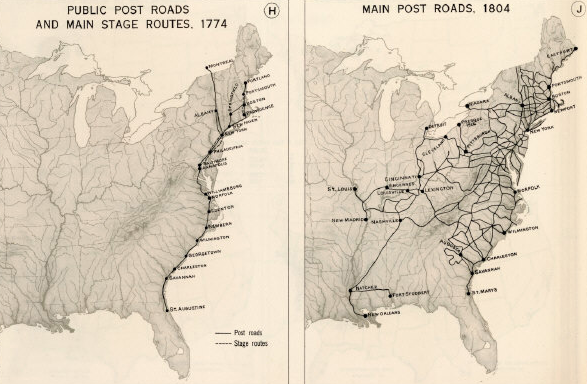
One way to think about the connection between the structure and function of American postal infrastructure is to apply network analysis principles (I know, here she goes again…). Increased postal infrastructure resulted in a more complex postal information network; there were suddenly more nodes (post offices) and more efficient paths among them (postal routes). One of the most interesting ideas in network analysis is the “strength of weak ties” hypothesis posited by Granovetter. Granovetter proved that novel information tends to come from nodes that are not well-connected to the network (weakly tied to other nodes). The explosion of post offices in the late 18th and early 19th century United States gave far-off communities a connection to the central network. This resulted in more new information circulating in the network as a whole.

This networked perspective does not credit the United States with a sudden epiphany of perfect democracy; instead it explains the information landscape as one where more new information was able to enter the public sphere. To me, this approach strikes the balance between a Utopian view and a view that ignores spaces of marginalized communities’ resistance.


Runaway Database


Warning: Undefined variable $num in /home/shroutdo/public_html/courses/wp-content/plugins/single-categories/single_categories.php on line 126

Warning: Undefined variable $posts_num in /home/shroutdo/public_html/courses/wp-content/plugins/single-categories/single_categories.php on line 127

By Cordelia

Although runaway slave ads were familiar to me before this activity, the Freedom on the Move database entry really enlightened me on the greater specifics found within them. I thoroughly enjoyed this activity because it makes me feel like I’m legitimately making a difference with something in the field. It also, as I said, really highlighted the details of the ads. For example, I never before would have noticed what types of information regarding the slaves the ads included, but when forced to input data on the topic, I suddenly understand.

The data entry itself was quite simple to do. The specific entry fields made the process easy, as it told you what you were supposed to be looking for. However, there could be some improvement in the specificity of these fields. For example, the ad that I did was for not one, but two runaways. This made a few of the data entry points difficult, as I had to account for both of them in a way that could be understood. Therefore, I had to make a note on the bottom to explain this entry. Though I understand that not all metadata can be accounted for, it becomes more difficult to sufficiently document all aspects of the ad when much of the pieces of it have to be included as a last-minute notation.

One other thing I noticed upon which I believe the data entry system could be improved is the reliance upon the digital transcription of the ad. Because the rest of the data entry and metadata setting is based upon the image of the transcribed ad rather than the transcription with the original image, if the transcription has any mistakes, the rest of the data is off. I would suggest including the original image of the ad with the rest of the data input, you could double-check the transcription before documenting the content of the ad.

Other than these things, I think the runaway slave ad database was a fascinating concept that I was happy to participate in.


Improving “Freedom on the Move”: Searchability


Warning: Undefined variable $num in /home/shroutdo/public_html/courses/wp-content/plugins/single-categories/single_categories.php on line 126

Warning: Undefined variable $posts_num in /home/shroutdo/public_html/courses/wp-content/plugins/single-categories/single_categories.php on line 127

By Eleanor

I think something really important to add to Freedom on the Move is an improved search functionality. As it is, you can only search by the name of the newspaper that the ad was published in, by the state it was published in, or by optional user-inputted tags. If I wanted to look at all the ads searching for runaway female slaves, for example, the only way I could do that would be by searching the tags for “woman”, “female”, “female slave”, and any other descriptions of the topic that I could think of. Even then, I would only get the advertisements that had been tagged during the first transcription step as featuring women. Tagging is completely optional and there is no standardized vocabulary, so it is currently very difficult to search the database for ads relevant to specific topics. That makes this database a less-than-ideal source for historians trying to gather primary source data to answer research questions.

I agree with Alec that implementing more drop-down menus or other multiple-choice options could streamline the description process. That could also help with the searching issue. For example, the gender of the slave is not a free-entry text field; it is marked by the user by filling in the “Male” bubble, the “Female” bubble, or neither. This means that somewhere in the data collection, every ad that has been processed and contains a male slave should have the category “Male” attached to it and every ad that contains a female slave has the category “Female”. This is a much better starting point to be at than if gender had been a free input field – then we would probably have some combination of “woman”, “female”, “F”, “girl”, etc. describing the female slaves instead of one uniform descriptor. This standardized categorization makes it significantly easier from a programming standpoint to go in and make the processed ads filterable by the gender of the slave. Taking this multiple choice approach with as many data fields as possible will not only quicken and clarify the data entry process, but will also make improving the searchability of the database much easier to do.

Also, I had a similar experience to Kurt with being repeatedly signed out of the site, which was irritating. Some times when I tried to visit it, I would be consistently kicked out as soon as I had signed in and was forced to just come back later in the day and try again.


Freedom on the Move-Good, but not Great


Warning: Undefined variable $num in /home/shroutdo/public_html/courses/wp-content/plugins/single-categories/single_categories.php on line 126

Warning: Undefined variable $posts_num in /home/shroutdo/public_html/courses/wp-content/plugins/single-categories/single_categories.php on line 127

By Kurt Vidmer

I really enjoyed working with the “Freedom on the Move” resource. This resource enabled us to look at runaway slave ads in a way that forced us to truly analyze the ad in a deep and systematic fashion. The different sections of the process forces the user to truly divulge into the ad, and ask themselves various questions in an effort to stretch the ability of the analyzer. I also liked how it left room for interpretation, such as language spoke.

It was particularly enjoyable when we analyzed an ad as a class. This activity was very beneficial because it allowed everyone in the class to build off each others comments and suggestions. As students, we all analyze documents in different ways, naturally being drawn to certain characteristics of a source. With the entire class working together on a specific runaway ad together, we were able to systematically analyze the ad through a variety of points of view.

Also this resource is very fun and beneficial, it does have some areas needed for improvement.

First and foremost, it needs to sure up some technological glitches. It refuses to let me sign in on my computer, as it continues to automatically sign me out. Needless to say, this was very frustrating.

Also, I believe that some improvements must be made with what answers are acceptable. For categories such as age, it does not allow users to put in an age range. I think that being able to put in ranges and estimations would benefit this website.

Similar to what Alec said, I would also suggest that it more clear about how specific information should be submitted. It is unclear whether or not paraphrasing or simplifying is acceptable or not.

Aside from these few suggestion, this website was very fun to work with and forced me to stretch my level of analysis.


Living Up to European Expectations


Warning: Undefined variable $num in /home/shroutdo/public_html/courses/wp-content/plugins/single-categories/single_categories.php on line 126

Warning: Undefined variable $posts_num in /home/shroutdo/public_html/courses/wp-content/plugins/single-categories/single_categories.php on line 127

By Sherwood

In chapter two of his book “Removable Type: Histories of the Book in Indian Country, 1663 – 1880,” author Phillip Round describes how natives likened themselves to Europeans during the 18th century, especially through literature. First and foremost, literacy enabled natives in the northeast to become Christians. They read the Bible and religious tracts, and wrote about their own religious views and experiences. In short, they were able to engage with the English colonists in an conversation that was not only European (Christendom), but also distinctly English (Protestantism). During the first Great Awakening of the 1730s and 40s, the element of performance that emerged from dramatic, evangelical gatherings gave traditional native rituals, which were themselves performative, greater authority in the eyes of Europeans.

Besides religion, the natives also became more similar to Europeans by organizing their communities with written documents, including “records, dispositions, wills, petitions, [and] letters” (49). They also became more materially similar by employing “knives, combs, scissors, guns, [and] hatchets” (49). Incorporating these cultural practices made natives more effective at negotiating with Europeans, but did not resolve the tension between the two parties. For one, they frequently and violently clashed with each other. For another, an underlying incongruity made it impossible for natives to fulfill European expectations. And that’s what I want to talk about.

The position that European migrants imposed upon natives during the 18th century, which Round briefly describes, seems altogether contradictory- Europeans celebrated natives for being “noble and ‘republican’ in their traditional oratory,” but admonished them for being “‘unlettered’ and anti-intellectual in their grasp of alphabetic literacy” (48). In the eyes of the Europeans, natives like the 18th century Mohegan missionary Joseph Johnson could have either one or the other, but not both. For whatever reason, the noble lifestyle that Europeans admired in natives was fundamentally at odds with the “alphabetic literacy” that Europeans expected and encouraged. Johnson was forced to abandon his own culture and adopt Christendom, among other European customs, in exchange for his literacy; he was made to meet the Europeans on their terms. This contradiction caused literate natives to doubt their own their own writing abilities, despite being fluent in multiple languages and frequently reading the Bible, as was true in the case of Johnson. Apparently, despite a significant degree of assimilation, the European consciousness was not prepared to fully accept natives into their societies.

I think I’m the first to post for this week, so I had some difficulty finding another post to reference. I do think Cordelia’s post is tangentially related though, since it describes a similar phenomenon. Black students are taught and expected to accept the romanticized story of our nation’s founding, which is a primarily white narrative. But however well they internalize this perspective, tension between blacks and whites will likely remain.


« Older posts Newer posts »

© 2026 History 245

Theme by Anders NorenUp ↑