
Warning: Undefined variable $num in /home/shroutdo/public_html/courses/wp-content/plugins/single-categories/single_categories.php on line 126
Warning: Undefined variable $posts_num in /home/shroutdo/public_html/courses/wp-content/plugins/single-categories/single_categories.php on line 127
Richard Jensen’s work “No Irish Need Apply: A Myth of Victimization” has me questioning my entire understanding of the struggle “my people” (three of four of my grandparents are immigrants from Ireland) went through in the U.S. Growing up all I heard about was the lack of the opportunities my grandparents had growing up and how WASP America had kept their relatives down for years (relatives in this case being aunts and uncles of my grandparents). Jensen’s work though brings to light thought about an issue I never once questioned. As Eli said in his work everything that I had been told growing up was “plausible” due to where the stories I was hearing came from as well as the number of people saying the same exact story. But now I simply have to change my understanding of the “struggle” my ancestors went through. To that I am going to have to steal the words of College Gameday Analyst Lee Corso “NOT SO FAST SWEETHEART!”
I get that some of the prejudices that the Irish claim they went through were fabricated but life was by no means a walk in the park for these individuals. Irish citizens in the United States I would argue were the slaves of the North due to the type of work that they performed. Their desire for work in whatever capacity possible made them open to anything (and I mean anything) and because of that the argument can be made that the Irish are to blame for their role in society (something that can be seen by many Irish society members to remain with their “kind”). However, just because one is willing to work at the lowest possible level does not mean that they have no dignity or sense of pride. The Irish were exploited for the willingness to work, plain and simple. I don’t think that Jensen gives the Irish enough credit in the fact that they may have recognized their role in society. I believe that the Irish community’s close bond stems from the recognition that many community members simply had no option but to do as told. There is an old expression that goes “one man is no man,” and the Irish embody this philosophy. While one or maybe even many community member may have had wealth because the majority of the community didn’t have that value there was an issue with society. I think the Irish think that if one many can’t attain the life they desired, outside forces must be working against that person because others got what they desired.
I can’t dispute the evidence that Jensen provides, it is all backed in the research that he performed (research that is very commendable as I feel that he went against popular opinion throughout his entire writing process). However, I believe that history is largely based upon the ways in which an individual wants to view history. History often plays out in a “to the victor go the spoils fashion,” and because of that everything can always be argued. Did the Irish win their and that’s why they can claim they were held down by oppressive white business owners? An Irish Catholic from Massachusetts did become President of the United States so I would say that they Irish did win their struggle and because of that they can present their history as they like. Irish community bonds where one wants to see everyone succeed before declaring a movement/cause a success and because that was never possible I truly believe that is where Irish ideology of the world against an individual emerges from.

_Irish_Frankenstein.jpg)
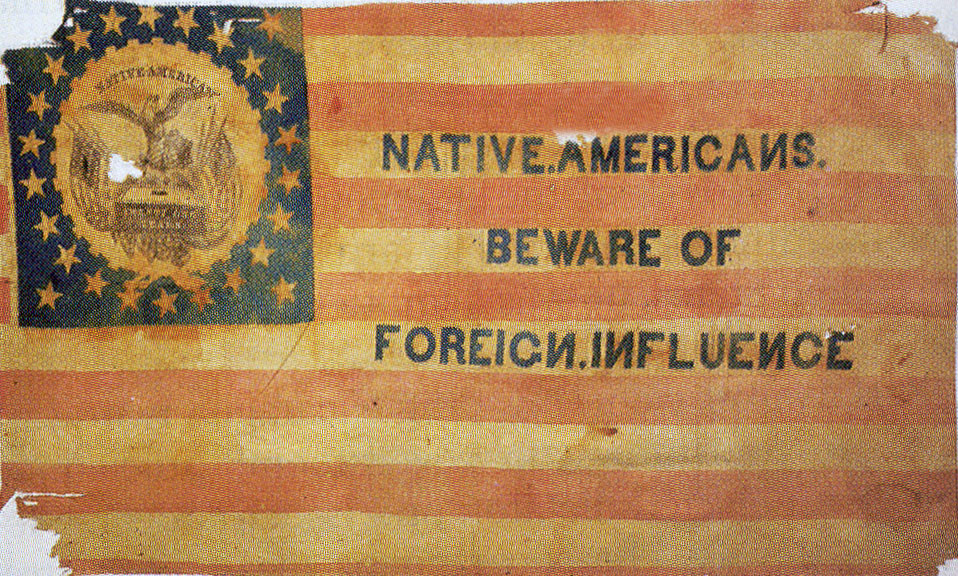 These two chapters in Wilentz’s book, Chants Democratic, discuss nativism in length. This topic is particularly interesting to me as I’m writing my thesis on a similar topic (The effect of the Great Depression on European Immigration 1933-1939) and I saw many similarities in the 1830s and 1930s. One contrast between the two periods, however, was the mutual respect among native and immigrant journeymen. Wilentz attributes this respect to the same level of training the immigrants had as the native artisans (266). Furthermore, due to internal strife within the movement, the political nativism in the 1830s did not achieve the unity and popularity that nativism would reach later in America’s history. (Fun Fact of the day: Unemployment was higher for craft workers between 1836 and 1842 than during the Great Depression).