
Warning: Undefined variable $num in /home/shroutdo/public_html/courses/wp-content/plugins/single-categories/single_categories.php on line 126
Warning: Undefined variable $posts_num in /home/shroutdo/public_html/courses/wp-content/plugins/single-categories/single_categories.php on line 127
 In his article, “‘For Something beyond the Battlefield’: Frederick Douglass and the Struggle for the memory of the Civil War,” David Blight describes Frederick Douglass’s efforts to promote equality for African Americans through remembrance of the Civil War. Douglass felt that remembering the war and the war’s true meaning (the abolishment of slavery in his eyes) would help end white racism. As Blight points out, the South achieved greater remembrance of the war and romanticized its heroes. Growing up in the South, I can attest to this type of thinking. Throughout Virginia, public schools are named after Confederate generals (Robert E. Lee, Stonewall Jackson, etc.) and many of these generals are revered for their service to their great state. This thinking completely counters the beliefs of Douglass and Albion Tourgee. Both figures do not believe the South fought an honest battle, and therefore, does not deserve unification with the heroic North. During the period, their thinking was colored with emotion. I cannot argue with the emotional scars of being a former slave and the resentment carried by these former slaves for the South. I can, however, say that Douglass’s and Tourgee’s assertions are sweeping generalizations. Not all Confederates were fighting to maintain the institution of slavery. Robert E. Lee, for example, fought for his state’s rights (I don’t think he owned slaves) against his personal desire for the country to remain intact. Although Lincoln asked Lee to fight for his nation, Lee chose to fight for Virginia. Douglass neglects to remember the honor in fighting against your own personal beliefs because of your loyalty. Furthermore, Douglass’s hatred for Lee is seemingly unwarranted. Lee was not “the soldier who kills the most men in battle,” that Douglass painted him to be. Instead, Lee was a gentleman who surrendered his troops before a planned insurrection occurred in the North. The South was radical, but Lee is remembered so fondly for a reason. Following the war, he supported reconstruction and became president of Washington & Lee University (formerly Washington College until Lee served as president).
Benny (not Johnny) Hartshorn makes a pretty good point about contextualizing Douglass’s arguments. I, too, believe that Douglass felt his actions were going to be remembered, and this belief probably shaped his writing. He wanted to be remembered as the man who fought for African American equality and was unforgiving of the South so other African Americans might follow in his footsteps. Concurring with Ben, Douglass was more concerned with the lasting effects of the war as opposed to the actual battles. He failed, however. Often, the Civil War is portrayed as the war against brothers and often divided families. I think since slaves were emancipated (due to a military strategy, not moral beliefs) in 1863 instead of at the start of the war, takes a backseat to the dividing aspect of the war.
 According to an extensive academic study conducted by BroBible (http://www.brobible.com/sports/article/10-most-hateable-fan-bases-college-football/page-2), Notre Dame Irish football fans are the most hated fans in the country. While college football seemingly has nothing to do with either of these articles, the hatred behind the Irish, specifically the Irish-Catholic at least runs along the same lines as both of these articles. As I read through the “‘No Irish Need Apply’: A Myth of Victimization,” I felt Richard Jenson’s research was thorough, yet quite selective. I agree with his overall argument, but not necessarily the method he used as justification. Initially, his argument focused on the lack of a visible NINA sign as justification for the myth of victimization felt by Irish during the period and many subsequent generations later. I kept reading, however, and warmed up to his argument when he discussed the economic plight of the Irish, which was what I thought he lacked initially. As is my understanding of Irish immigration, a massive wave occurred concurrently with the potato famine. Why were so many Irish migrating? They left their homeland because they were tired, hungry, and poor. They were the wretched refuse that Emma Lazarus later described in her poem “A New Colossus”. These immigrants came to this country with nothing, so they probably did not fit the traditional mold of a white settler from the Old World. I would imagine that these newcomers were shunned due to their extreme poverty rather than their Irish heritage, but at this time, the two were interwoven and topped off with Catholicism. Furthermore, Jenson uses many diverse geographic and time periods to create his argument. For the most part, and where I think his argument holds the most weight, Jenson discusses Irish encounters in New York City during the mid-1800s. He continues, however, by bringing up farmers in Iowa and treatment of Irish in Brooklyn. While these statistics and narratives have their place in history, it is not in this article. Another point of contention that Jenson makes describes the relationship the Irish had with African-Americans and the Chinese. He says the Irish “repeatedly attacked employers who hired African-Americans or Chinese.” (415) Did he think that maybe the Irish attacked these groups to “fit in” with other whites? Or maybe they attacked these employers because the Irish were on strike and members from either of these two races worked for cheaper thereby nulling the Irish strike? I understand he’s saying that the Irish weren’t attacked, but they were white. Irish or not, violence against whites was more frowned upon than violence against another race during this period. I just don’t buy a lot of his arguments. One of his strongest details alludes to the lack of socioeconomic mobility of the Irish. Granted this is all my speculation without additional research, but I think this restricted mobility refers back to the problem of being a penniless, hungry immigrant who is willing to work anywhere that puts food on the table. The Irish stuck together as a group, so people in the neighborhood helped others get jobs where they were working; therefore, (because Irishmen were helping Irishmen get jobs) the Irish dominated the fields of work, specifically as canal workers and longshoremen. I agree much more with Kevin Kenny’s article, “Race, Violence, and Anti-Irish Sentiment in the Nineteenth Century” which can be discussed further in class. I also agree with Wade’s comments about Kenny’s article. I didn’t notice until reading Wade’s post that I enjoyed Kenny’s clarity and consistency over Jenson’s arguments. I just didn’t think Jenson used appropriate justification, as I’ve already said, and his arguments were more jumbled and not flowing chronologically. Is that Vince Vaughn in the background of Lamo’s picture? Let’s embrace that as well.
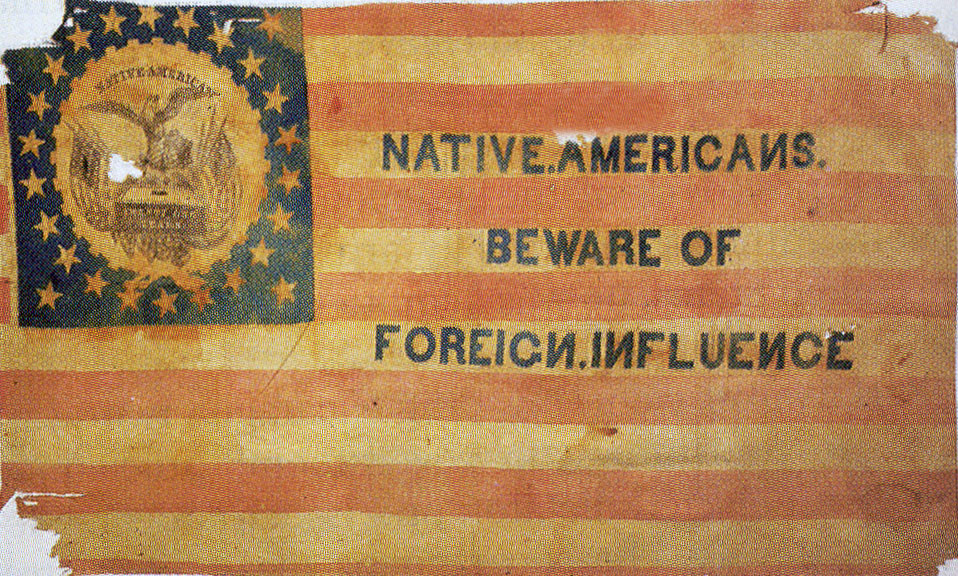 These two chapters in Wilentz’s book, Chants Democratic, discuss nativism in length. This topic is particularly interesting to me as I’m writing my thesis on a similar topic (The effect of the Great Depression on European Immigration 1933-1939) and I saw many similarities in the 1830s and 1930s. One contrast between the two periods, however, was the mutual respect among native and immigrant journeymen. Wilentz attributes this respect to the same level of training the immigrants had as the native artisans (266). Furthermore, due to internal strife within the movement, the political nativism in the 1830s did not achieve the unity and popularity that nativism would reach later in America’s history. (Fun Fact of the day: Unemployment was higher for craft workers between 1836 and 1842 than during the Great Depression).
 I agree with Wade that Patricia Reid’s extensive background information is a little excessive and dilutes her argument. She does, however, makes some points in her article, “Margaret Morgan’s Story: A Threshold Between Slavery and Freedom, 1820-1842,” worth dissecting. Her strongest point states the obvious, yet summarizes her entire article. For those blacks who had their freedom undocumented or unrecorded, their freedom was based on white authority (368). Her example of Richard Allen’s struggles with the slave catcher who had a fake cause, serve as prime justification for her argument. I’ve often wondered how blacks in the north determined their freedom from slave catchers. Since technology merely allowed for a paper stating “this man is a free man” (or something like that) for a slave to carry around, a slave catcher could easily ask for documentation proving the slaves freedom, tear up said document, then claim this was the slave he was looking to catch. Immoral? Absolutely. But a quick way to make a few extra bucks. Interestingly though, some whites did stand up for their fellow man against these unethical slave catchers. Without white support, however, blacks had a much more difficult time defending themselves against the claims of a white person (we all remember the difficulties Django had about proving his freedom) As we’ve talked about in class, this is a similar problem Native Americans faced as well.
 The concept of marriages in Cherokee culture also varied significantly from European marriages. Although the two cultures were similar in the reverence for childbearing ability, Cherokee women were revered for this ability and they derived much of their power from it (55). Perdue’s description of infidelity astonished me. As she states, married women were not given complete freedom to intermingle with other men; however, the attitude was drastically different than if a man cheated on a woman. Part of this attitude change derived from the lack of support men had to tell on their wives. In Cherokee culture, according to Perdue, it seemed in the man’s best interest to never speak of his wife’s infidelity. Additionally, when a man did decide to take action, an implausible experiment was the only way to punish his wife (reviving a dead fly and burrowing the fly in the woman’s body).
 As many in this class can attest, I possess borderline ignorant qualities regarding my stubbornness and argumentativeness (that’s a word). I like to be right. And I like to argue…just to argue. When in the course of human events, however, it becomes necessary for one to readjust his thinking for truthiness and justice. This I have done.
 The title is not a direct shot at my esteemed colleague’s, AJ Pignone, previous post, but I do disagree with the overall mentality of the post. Ian and AJ both hit the nail on the head by pointing out Slaughter’s incredible detail describing the Whiskey Rebellion. And at times, I’ll admit, I read over three or four pages, went to turn the page yet again, but I had to re-read those previous pages because I realized I had no idea what Slaughter was trying to say. The detail is a plus though. It’s better to have too much detail and force the reader to sift through the intricacies than to leave something out. Furthermore, Slaughter does do a decent job of summing up each of his chapters in the final paragraphs.
 My favorite tid-bit of information Slaughter enlightens his reader with on pg. 169, “Treasury department reports showed that no revenue was collected in the entire state of Kentucky and that collections on domestic spirits from Pennsylvania, North Carolina, South Carolina, and Georgia were far below the costs of enforcement.” This fact shows the lack of success of the tax because of the response from frontiersmen. The cost of protecting (or attempting to protect) the frontier constituted over 80% of the nation’s budget. Similar argument poised by the British following the Seven-Years War (once again caused by westward expansion): you started this war, so you help pay for it. The settlers in the west not only refused to pay the tax, but they protested violently against the tax collector, the middleman. Maybe the Whiskey Rebellion coined the term, “don’t shoot the middleman,” because that’s exactly what was happening during this time. The frontier was a violent place, there is no denying that claim. However, this violence overflowed to attacks against our own people, Americans attacking Americans, a truly despicable act. What separates the settlers of this time from those rebels in tumultuous countries in present day who attack their government officials because they feel their government’s treatment is unjustified? Without getting into a political debate, I’m simply trying to draw a comparison of internal strifes and how we as present day Americans view those other riotous countries with unfavorable opinions. I can speculate that those in the East viewed the Westerners with similar contempt during this excise fiasco.