'Merica


Warning: Undefined variable $num in /home/shroutdo/public_html/courses/wp-content/plugins/single-categories/single_categories.php on line 126

Warning: Undefined variable $posts_num in /home/shroutdo/public_html/courses/wp-content/plugins/single-categories/single_categories.php on line 127
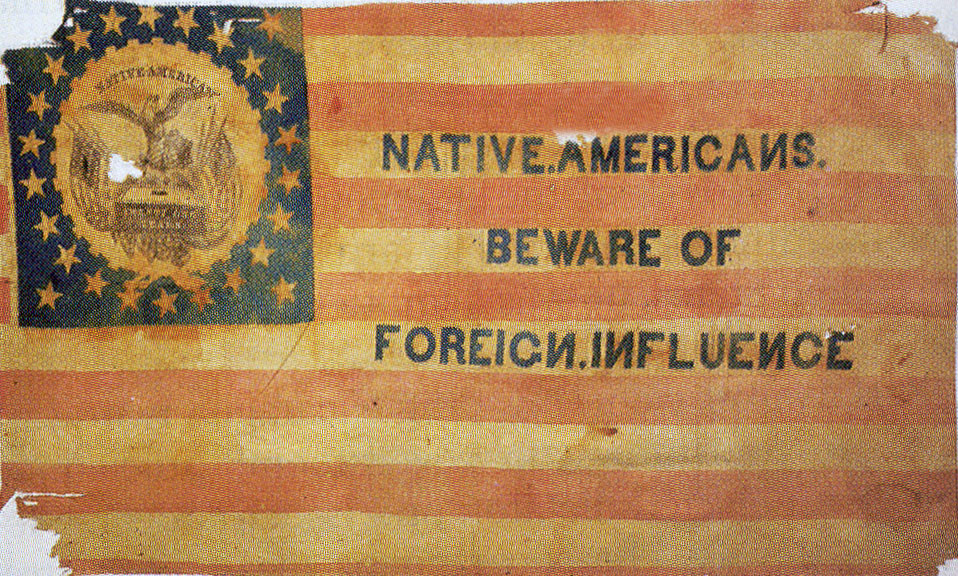
These two chapters in Wilentz’s book, Chants Democratic, discuss nativism in length. This topic is particularly interesting to me as I’m writing my thesis on a similar topic (The effect of the Great Depression on European Immigration 1933-1939) and I saw many similarities in the 1830s and 1930s. One contrast between the two periods, however, was the mutual respect among native and immigrant journeymen. Wilentz attributes this respect to the same level of training the immigrants had as the native artisans (266). Furthermore, due to internal strife within the movement, the political nativism in the 1830s did not achieve the unity and popularity that nativism would reach later in America’s history. (Fun Fact of the day: Unemployment was higher for craft workers between 1836 and 1842 than during the Great Depression).

Wilentz details the shift from an agrarian dominated economy to the rise of the manufacturing economy. Farmers had always been viewed as the most important laborers (274), but the mechanical labor was gaining ground and the unions saw it as the most important form of labor. Farmers clung to the doctrine of rural moral supremacy, yet the mechanics knew that this rural moral supremacy would continue the United States dependence on Britain for manufactured goods, much like when we were a colony.  When the drought came in 1836, farmers standing dropped even further as they were not able to provide the products and goods that they relied on selling.

To speak to Marie Hemann’s points, I agree with his conclusions. To add to his astute observations, I think it’s important to note the atmosphere of New York during this time. Wilentz hits the nail on the head when he describes the demographic of New York and its undesirable situation for a revival. “New York, with its immigrants, its Bowery, its traditions of popular anticlericalism, and its sheer size, lacked almost all the prerequisites for a successful revival.” (280) In my humble opinion, New York’s size was the greatest factor in this failure for a revival. With many people come many different beliefs and views on issues. This leads to a lower percentage of influence for those in the revival. What I mean by that statement can be further explained by this hypothetical example: if the revival movement in a small town of 100 people converts 10 of these people, their influence is much greater because these 10 people know everyone in the town and can work to encourage them to come to Jesus. Now, in a city, such as New York, let’s say 1,000 people of 100,000 people join the revival. Granted, more total people joined the movement, however these 1,000 people don’t know the other 99,000 people of New York and have a much more difficult time to influence them. Furthermore, the breakdown of those who partook in the revival, specifically the Brainerd Presbyterian Church, emphasize the setup for a failed revival. Many of those participants in the congregation were women, and of those women, nearly half were unmarried. So, the revival wanted to change the drinking habits of men, yet few men (in comparison to women) joined the church. And many of these women were not in constant relation to men by being unmarried, so their influence on men was very limited. (280)


Contemplating Religious Revival Ruling Rochester


Warning: Undefined variable $num in /home/shroutdo/public_html/courses/wp-content/plugins/single-categories/single_categories.php on line 126

Warning: Undefined variable $posts_num in /home/shroutdo/public_html/courses/wp-content/plugins/single-categories/single_categories.php on line 127

I found Johnson’s A Shopkeeper’s Millennium to be an extremely revealing work of social history about the religious revival in Rochester in the early 1830s. Johnson does an effective job of demonstrating the “Shopkeeper’s Millennium” as a period in which middle class merchants held enormous economic and social power in Rochester as a result of millenarian religious revival. Johnson’s argument that Charles Finney’s religious revival was the basis for a redefinition of politics, labor, and social life is convincing because of his ability to demonstrate that the conversions of the 1830s produced societal reforms that were unlike those of the 1820s that pitted working men against their employers. Rather, this movement underscored a “war on sin” that removed any explicit attacks between the bourgeoisie and the working class and instead focused on the “evils” that plague all men (115). I believe Johnson only augments this claim when he adds that the communal nature of revivals “shattered old divisions” of class and established new communities (101). This creates a clear distinction in Johnson’s writing between what appears to be a struggle identified by Marxist theories in the 1820s and one of religious sentiments in the succeeding decade.

In Johnson’s final chapter, however, I felt his argument began to unravel. While he previously focused on the tenets and religious effects of Finney’s revival, Johnson proceeds to discuss revival and conversion in Rochester as an economic agent to provoke change in the city. For example, he writes “the most powerful source of the working man’s revival was the simple, coercive fact that wage earners worked for men who insisted on seeing them in church” (121). Statements like these imply that conversion by laborers could have been a mere means to acquire a job or steady income, as opposed to a change in fundamental values and beliefs. This is in direct contrast with Johnson’s previous claims about the revival’s legitimacy because it calls into question the true effect religion had in reshaping nineteenth century Rochester. Rather, it emphasizes manipulations of religion to receive desirable economic results. In his afterword, Johnson tries to cover up this implication when he states “the revival was not a capitalist plot” (141). However, when writing this, Johnson is referring to only those men who dictated social change in Rochester, the middle class businessmen, and continues to ignore exploration of any significant depth behind motivations of those experiencing the change, the working class wage laborers. While those participating in revivals could have thoroughly believed what they publicly professed, the working class laborers very easily could have accepted those same beliefs as merely a small price to pay to insure stable living.

With respect to my colleagues, I agree with most of what has been argued. Specifically, I agree with Ben that many of the inferences made by Johnson were plausible and his ample evidence behind these claims – particularly in examples like those of the extended families that helped to precipitate early business in Rochester – only helped to push his thesis. With that being said I also understand Price’s remarks about Johnson’s sweeping generalizations. One example that struck me occurred at the end of the book where Johnson writes “workmen no longer listened when proprietors spoke” (140). However, we were already told that the dissonance between employer and employee emerged from the increased privatization of their lives, not from a lack of listening (57). While these statements are likely dramatized and used more to provoke an image than used as fact, they did make me wary to trust all the claims advanced by Johnson in A Shopkeeper’s Millennium.

The Heart and Soul of The United States States: Rochester, New York


Warning: Undefined variable $num in /home/shroutdo/public_html/courses/wp-content/plugins/single-categories/single_categories.php on line 126

Warning: Undefined variable $posts_num in /home/shroutdo/public_html/courses/wp-content/plugins/single-categories/single_categories.php on line 127

In Paul E. Johnson’s “A Shopkeeper’s Millenium,” he tries to make a case for the connections between politics, religion, and the market in relation to the religious revival that occurred in Rochester, New York in the late 1820s to early 1830s. At times, the connection is brought to light, like when he states “The political dividing line was not social class but family jealousies compounded by religion and geographic origins” (65). This quote relates back to his discussion regarding the feud between the Rochesters and the Bucktails in both a political and religious sphere. Yet, statements such as these are actually the only places the connections are made clear. Most of the piece is a dense narrative that mentions a series of people, their origins, their work, who they were associated with, and so on. It is easy to find yourself five pages into a chapter and be completely unaware as to what Johnson is arguing at that moment. Without the occasional sentence declaring a connection between one of the three ideas, it is easy to not see the association at all, which I believe hurts Johnson’s argument in the piece as a whole.

Though Johnson’s piece does suffer from this flaw, it is nice to see my hometown gaining some recognition for once. An interesting piece that I noticed in “A Shopkeeper’s Millennium” that has continued to this day is the business associations amongst relatives. Johnson mentions how most of the first men to settle and cultivate business in Rochester did so through family connections (25). This idea is continued further, as Johnson asserts that businesses were also brought into existence through in-law connections or close personal friendships (27). In today’s Rochester, this same idea has continued. A number of law firms are family run between brothers. Even more so than this, the biggest business to come out of Rochester, Wegmans, is completely family run through relatives and in-laws. For instance, Danny Wegman’s step-son-in-law is head of Wegmans’ liquor department throughout all of its stores. It’s somewhat nice to see how the connections that spurred Rochester’s growth in the early 19th century is the thing that is still keeping the city a profitable place to live.

In response to Ben’s post on Johnson’s choice to use Rochester for this type of study, I completely agree. As Ben describes in his post, “Rochester was also a blend of so much of the rest of the country” (Benjamin Hartshorn, Philadelphia, PA). This statement could not be more accurate to describe Rochester during the early 19th century. Being an inland city, it featured many of the characteristics that city would that was distant from the ocean, like focusing on agriculture. Yet, by having the Erie Canal, it connected Rochesterians to major cities like New York through the Hudson River, and the rest of the country and world from there. This city also featured a visible diversity in the classes of people that resided within the city’s bounds. From the wealthy land owners down to the unskilled laborers, Rochester had it all (still does too). Being a blend of the rest of the United States, Rochester was a great choice by Johnson to study regarding the effects of the Second Great Awakening. Though, as I said before, his study features some flaws because of the lack of clear connections between his central ideas.