A Comparison of the Johnstown Flood, the Galveston Hurricane, And Those Who Portrayed Them


Warning: Undefined variable $num in /home/shroutdo/public_html/courses/wp-content/plugins/single-categories/single_categories.php on line 126

Warning: Undefined variable $posts_num in /home/shroutdo/public_html/courses/wp-content/plugins/single-categories/single_categories.php on line 127

The narrative style Erik Larson employs to describe the Galveston Hurricane of 1900 is, at a rudimentary level, similar to that of David McCullough. Larson, similar to McCullough, does not intertwine footnotes with the text, which as Sarah and Emily argue discounts the reliability of the narrator. The Johnstown Flood however, offers a variety of accounts to provide balance and diversity to the narrative, while Isaac’s Storm emphasizes a dominant narrative fostered by other lesser accounts.

Science also differentiates the two novels: it was heavily stressed in Isaac’s Storm and nearly disregarded in The Johnstown Flood. The description of the formation of a hurricane felt similar to Bill Bryson’s A Short History of Nearly Everything, and I wonder if Larson would have benefited as a historical writer by implementing a citation scheme similar to Bryson’s (Bryson provides footnotes).

The residents of Galveston cultivated a feeling of security similar to that of Johnstown residents. Unlike the Chicago Fire or the Johnstown Flood, the Galveston Hurricane was not preceded by months of foreboding weather. Similar to the residents of Johnstown, the Galvestonians were accustomed to small floods, and severely doubted the likelihood of anything a disaster. However, I believe Johnstown residents to be more ignorant of potential threat, due to a history of flooding and the poor location, than Galveston residents, who had never experienced a hurricane before. Instead of placing partial blame on Galvestonians, Larson expresses his disappointment in the United States Weather Bureau’s confidence and the Cuban weather cable ban. Further, he places blame much more indiscreetly on authorities, including Isaac. Larson transforms the principal character, Isaac, into an antagonist by noting the observation of a decreasing barometric pressure yet neglecting to warn people.

However, all this being said, it is easier to criticize the inaction of meteorologists knowing what we know now about weather patterns and the outcome of the hurricane. AJ phrased it well in his post: “The era that this event occurred in, the way people went about handling the situation and the eventual misjudged outcome, I believe explains a lot about where disaster preparedness was at the time and showed Americans what desperately needed to change.” I understand why Isaac trusted his former knowledge and dismissed the threat of catastrophe.

Waitin on a Sunny Day


Warning: Undefined variable $num in /home/shroutdo/public_html/courses/wp-content/plugins/single-categories/single_categories.php on line 126

Warning: Undefined variable $posts_num in /home/shroutdo/public_html/courses/wp-content/plugins/single-categories/single_categories.php on line 127

As the rain pours on Davidson’s campus, students shuffle into the Union to dry off like wet dogs after a swim in the lake. This weather sucks. This accumulation might reach an inch by the end of the day, and we’re all tired of it. Fortunately, I’m jammin to The Boss, so I really don’t have a care in the world. Isaac Cline, however, didn’t have the luxury of Bruce Springsteen and witnessed something drastically more intense than our little drizzle. This hurricane is the deadliest in American history and ranks as the second costliest. The rain caused by the hurricane was significant, but proved harmful when coupled with the extraordinarily high windspeeds and a massive storm surge.
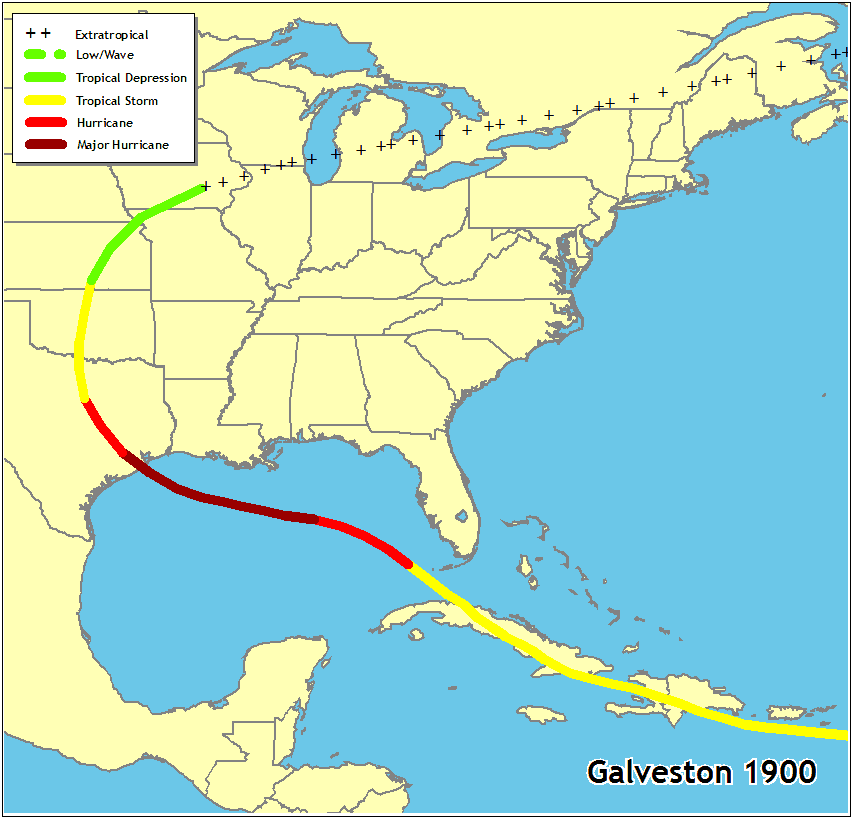
Larson’s book was more interesting to me than to most of esteemed classmates because I chose the Galveston Hurricane for my research topic. I’m also a numbers guy, so when I read winds over 120+ mph or 6,000 people died or the storm surge was 16 feet high, those statistics resonate with me. Think about it. Try sticking your hand (or head) out the window while driving on I-77 at two thirds the speed of the winds, yet one can still feel the wind’s power and control. Think about three times Davidson’s campus (all your friends, collegeues, lunch ladies, and professors) dead. Imagine water that all of a sudden reaches and submerges the first two floors of Chambers with class still in session. Powerful stuff.

My favorite aspect of Larson’s portrayal of this event was the inclusion of the history of hurricanes from a meteorological perspective. I enjoyed learning what causes the waves of hurricanes and how hurricanes were viewed during this period. Maybe I’m a nerd, but I think this gives the story a more historical science approach and showed the depth of Larson’s research. However, Larson probably intended for me to gain some other message from the book than an appreciation for his research. Unlike my good friend, AJ, I’ll tackle the issue (eh? See what I did there? Football analogy for a football player). The hubris of the period astounds me, although I guess it shouldn’t because that’s been a consistent theme throughout this class. The national weather service was new and wanted to assert itself as an accurate weather forcaster, but continued to hinder its rise to respectability with inaccurate weather reports. So, when the Cubans tried to warn Americans of the storm’s path, the Americans were too arrogant to believe them. To borrow a phrase from Captain Gene Mauch in The Other Guys, “shake your *hands*, this *waving* contest is over.” If the Americans in the weather service put aside their egos and listened to the voices of experience, many lives may have been saved. I think the city would suffer substantial damage either way, but many lives could have been saved with an accurate warning. One aspect of the story that I don’t understand was the timing of the storm. Now we’re able to plot the path of the storm with satellites and all that good stuff, but shouldn’t they have been able to know the speed of the storm and figure out its trajectory from there? If the storm is moving at 15 mph and it hasn’t hit Florida, hasn’t hit Louisiana, so it must be headed further out and going for Houston area. I’d have to draw a map to better show my point, but somebody dropped the ball in my opinion.


Lastly, Larson humanized the book, which increased the story’s potency. Reading the scene of the first train trying to make it back to the island with references to the debris, especially a child’s toy, was quite sobering. Furthermore, Joseph’s dog miraculously staying with his family after the house fell apart only to jump back in the water out of duty to the missing member of the family. Animal deaths always get to me because of their innocence. Obviously Larson intended for that moment to be heart-wrenching and worded the story in such a way, but it works. Many of Larson’s stories were chosen for that purpose and makes this story more of a narrative than an academic work. Although, much like the Johnstown Flood by McCulloh, I think it’s an excellent source to use.


When We Finally Learned


Warning: Undefined variable $num in /home/shroutdo/public_html/courses/wp-content/plugins/single-categories/single_categories.php on line 126

Warning: Undefined variable $posts_num in /home/shroutdo/public_html/courses/wp-content/plugins/single-categories/single_categories.php on line 127

As the first post for the week I am going to try and address the focus question posed on our syllabus and see if Isaac’s Storm relates to much of the things we have been discussing throughout the semester regarding the lack of awareness and preparedness in the historical disasters we have been analyzing. The work Isaac’s Storm by Erik Larson ultimately discusses the meteorologist Isaac Cline and his role in predicting the Galveston Hurricane of 1900. The era that this event occurred in, the way people went about handling the situation and the eventual misjudged outcome, I believe explains a lot about where disaster preparedness was at the time and showed Americans what desperately needed to change. This was during a time where people believed that their technology had overcome the forces of nature and that their advancements superseded the dangers nature could throw at them. In their assessment, Galveston, Texas, a city on the calm waters of the gulf could not possibly be devastated by any storm as professional opinion generally agreed that the storm was not headed north. In the grand scheme of things, meteorology as a science was still controversial; differing opinions about the weather as god’s own will and forecasting were often debated.

Our preparedness was not where it should have been and where it went after this disaster. At the time, meteorologists did have modern weather instruments available to them and this technology was seen as enough. Isaac Cline worked for the weather bureau out of Galveston, and sent frequent telegrams to the headquarters in Washington, but official weather mapping wasn’t the struggle at the turn of the 20th century, it was predicting the track of the storm. Weather preparedness may not have been the issue at hand, the issue was prediction preparedness. Scientists did not have an accurate means to predict the track of a hurricane and this enabled Hurricane Isaac to tear apart Galveston. I wont get into the distrust of Cuban meteorologists because that issue is rather evident and ultimately, shows the lack of research and awareness on the Americans part. The Weather Bureau’s misguided prediction of the storm in Cuba and their inability to trust their meteorologists is a factor of this event that I do not want to get into. All that needs to be mentioned is that the Cubans had predicted hurricanes far more accurately than the newly formed U.S. weather bureau which was soon realized by all involved.

What are to be discussed are the awareness, alertness and preparedness of the citizens in Galveston. Just like the Johnstown Flood people everywhere disregarded signs of danger, believed they were immune from harm, choose to carry on their daily lives and truly showed the unpreparedness and cockiness of our American ideas at the time. People in Galveston went to work and carried out their day on Saturday, despite Isaac Cline’s warning. By 12:30, most of the streets were flooded from the storm surge. Even unsupervised children played in this dangerous current for most of the day until their own bodies filled the water. Still and even at that point, men were determined to deny the storm’s existence, and made every effort to get to work. The book mentions restaurants opened at Midway, at lunch hour men went out to their favorite restaurants, men laughed and joked about “frightened women”, and some people continued to commute into Galveston by train.

This leads me to compare Price’s statements about the Johnstown Flood and their inability to stay prepared and the unconscionable decisions of the citizens of Galveston. He writes in a previous blog, “Nevertheless, the preparation process in case of this scenario was appallingly mismanaged. This issue of acknowledgment versus preparation is vitally significant in not only the Johnstown flood, but in innumerable disasters throughout history. How could so much risk be universally accepted, yet not be addressed directly and seriously?” He asks the right question in that situation and I am forced to ask the same one now.  The fact that people were completely willing to deny the forces nature and carry on their day is rather shocking. We now know that technology fails us at times, and that is what people at the turn of the 20th were about to learn. It is unfortunate that they had to learn this lesson with the sacrifice of 10,000 lives but it goes to show the level of preparedness in American ideas at the time. The shaping of this event towards our disaster awareness almost needs to go without mentioning that it is so drastic. Something needed to be done yet; it took this storm to make that happen. The country learned that nature is not tamable on that day. We understood we needed to switch our focus to preparedness and damage control.

Bouncing Back


Warning: Undefined variable $num in /home/shroutdo/public_html/courses/wp-content/plugins/single-categories/single_categories.php on line 126

Warning: Undefined variable $posts_num in /home/shroutdo/public_html/courses/wp-content/plugins/single-categories/single_categories.php on line 127

Blog Post 7 (for Thursday, 3/12)

In the aftermath of the Johnstown flood, the surviving inhabitants of Johnstown reacted much more methodically than I had imagined they would, considering how traumatic the event was. They were preoccupied with establishing order, and with conducting the business of rebuilding in a disciplined manner.

Almost immediately, the survivors gathered to elect temporary leadership; Arthur Moxham and his partner Tom Johnson were chosen. Under their guidance, committees were formed to gather food and drinkable water, as well as to locate other survivors and gather the dead. These actions represent an interesting contradiction, however— while food and water were pressing deficiencies, and other survivors ought to be sought out, what practical use does a body count have? None, other than to quantify the destruction of the flood.

And even though collecting and observing the brutalized bodies of their neighbors was an emotionally demanding task, it was done with organization and careful planning. The dead were carried back to established morgues, where they were either identified, or categorized with extreme detail. Record entries describe their gender, height, weight, age, hair, dress, and the items they carried. Furthermore, graves were dug rather unnecessarily for each of the deceased, despite the trouble.

I would have expected more looting and robbery, a greater sense of religiosity, and an increase in personal interests as opposed to community interests amongst the survivors. McCullough mentions some of this, but mostly emphasizes a much more uplifting narrative. In the aftermath of the flood, individuals were inclined to cooperate, much like the cogs of the industrial machines they had once operated. Furthermore, Molly describes how members of the press and other visitors came from all around to assist in the relief effort while compiling their stories. I can only wonder whether the sense of community and desire for order that these individuals showed, even after having been reduced to utter chaos, was particular to those who lived during the Gilded Age and Progressive Era.

Societal v. Individual Culpability: Parallels between Johnstown’s and Triangle’s Historical Narratives


Warning: Undefined variable $num in /home/shroutdo/public_html/courses/wp-content/plugins/single-categories/single_categories.php on line 126

Warning: Undefined variable $posts_num in /home/shroutdo/public_html/courses/wp-content/plugins/single-categories/single_categories.php on line 127

As Sarah notes in her post, many historians have critiqued McCullough for his writing style for not being truly historical or academic in nature. While some of this criticism is certainly well deserved, I would like to note that his patchwork style is extremely valuable in the way that it allows us to understand the Johnstown Flood as a structural societal fault, rather than one of individual culpability.

One of the largest takeaways from our class discussion on Tuesday was the way in which McCullough was able to effectively diffuse blame among individuals. This was accomplished by skillfully weaving together a narrative that references a multitude of characters rather than focusing on one character that best represents the narrative that he is hoping to portray. No one person’s action is overly singled out as accountable. Interestingly, The Johnstown’s Flood was still able to single out heroic actions. It is this inability to conclusively find fault and this ability to identify heroes that is of great interest to me, particularly in the way that it parallels the Triangle Factory Fire of 1911. I recently wrote a paper for another class that attempted to argue that the Triangle Fire is so imprinted into the national memory because of its massive juxtaposition between public understanding and legal recourse. To provide some background the Triangle Fire was a factory fire that resulted in the deaths of 146 women. Importantly, it resulted from an improperly constructed building with a faulty fire escape, locked doors that actually prevented workers from escaping, and a complete lack of any fire protocol or oversight by its owners who were repeatedly warned of its dangers. Yet despite seemingly obviously guilt, no one was charged. This to me was the most interesting; the fire seemed to occupy precisely the point in history at which public understanding outpaced legislation. General public understanding acknowledged the insufficiency and evils of factory conditions and the culpability of owners for consciously risking lives to increase profits, yet, despite this public agreement, legal recourse didn’t exist. To public the Triangle Fire clearly the fault of the individual owners, yet legally it was representative of a societal deficiency that individuals couldn’t be held accountable for. In the same way McCulloughs writing style implicitly argues that the Johnstown Flood, regardless of how many seemingly inexcusable individual faults contributed to its destructiveness was, at its core, a structural flaw in society. As tempting as it is to blame the South Fork Fishing and Hunting Club, after all they were basely responsible for the dam’s dangerous conditions, McCullough prose seems to suggest that the disaster was truly born from structural flaws. This is strongly paralleled by the way that there was a massive public outcry for the condemnation of the factories owners, yet a preceding report had shown that, relative to other garment factories, the Triangle Factory had far from the most dangerous conditions.

Remembering Disaster and a Historian’s Role


Warning: Undefined variable $num in /home/shroutdo/public_html/courses/wp-content/plugins/single-categories/single_categories.php on line 126

Warning: Undefined variable $posts_num in /home/shroutdo/public_html/courses/wp-content/plugins/single-categories/single_categories.php on line 127

A historian analyzes sources and weighs their reliability and accuracy. Emily notes, “David McCullough has been critiqued by historians for not being a ‘real’ or ‘serious’ historian.” While McCullough’s Johnstown Flood is not a “typical” scholarly work, he does occasionally critique or correct stories about the Johnstown flood. For instance at the beginning of chapter 7, McCullough writes that, “Some survivors, years later, would swear it had been a bright, warm morning, with a spotless blue sky” (183). In reality, the weather was “foul” (184). In this instance, people have constructed a memory they honestly think they experience. It is a reminder that diaries and personal accounts, while probably not intentionally lying, may misremember the actual event. With “every one of them[survivors]…brimful of tales of his experiences,” there are bound to be mis-recalled facts or invented memories (207).

Another way facts are skewed is through willfully fabricated details. Much of this fabrication seems to occur in connection with the media. For instance, McCullough writes, “whatever the reporters may have lacked in the way of facts, they made up for in imagination” (220). Sometimes a competing agenda—whether it is selling more newspapers or maybe embellishing a story for appearances’ sake—can cause people to alter the facts.

Besides these two quotes being instances of unreliable memories and accounts of history, they are also two places where McCullough does enter into a more critical historian mode of writing. He does acknowledge that some sources he used had inaccuracies and tries to recreate the probable reality. Of course, for a scholar, this little earmarks are likely not sufficient. McCullough does not give specific citations, nor does he seem to critically analyze every source. This is largely because, as Emily noted, his is a popular history for a general audience. The book can be more entertaining than a theoretical and technical treatise. It can bring historical events, as Emily argues, “to a broader audience than would otherwise be exposed to it.” I wonder if there could ever be a combination of these two tracks? A rigorous, researched, and critical work that is not dry or inaccessible and still manages to entertain? This reminds me a bit of Robert Fisk’s “Let us rebel against poisonous academics and their preposterous claptrap of exclusion.” Essentially, Fisk argues that academics have set up obscure language and certain standards that say “Keep Out…This Is Something You[non-academics/the general population] Are Not Clever Enough to Understand.” Could there be a balance to these two sides or popular literature and scholarly work? Maybe McCullough’s story could stand as it is, but in the back there is a list of sources and the decisions McCullough made about what to include and why? Granted, the work would be extraordinarily long, but it would allow the readers to choose how much they wish to engage in the work. They can simply read the popular story or they may dive into the thought process and analysis behind the work and research.


The Role of the Press in the Aftermath of the Johnstown Flood


Warning: Undefined variable $num in /home/shroutdo/public_html/courses/wp-content/plugins/single-categories/single_categories.php on line 126

Warning: Undefined variable $posts_num in /home/shroutdo/public_html/courses/wp-content/plugins/single-categories/single_categories.php on line 127

Was the press’ obsessive coverage of the flood harmful or helpful to the recovery of Johnstown?  McCullough seems to present two radically different arguments in his telling of the Johnstown Flood.  On the one hand, McCullough describes members of the press as opportunistic vultures just looking for their next scoop, but on the other, he repeatedly points out that their coverage helped Johnstown obtain upwards of three million dollars in relief funds.

In chapter VII McCullough describes an interesting interaction between Arthur J. Moxham, Johnstown’s temporary “dictator,” and the National Guard.  Earlier in the chapter McCullough wonders at Moxham’s clear-headedness, labeling his decision to begin clearing the mess as “extraordinary” (190).  Yet McCullough sends the National Guard packing when they show up because he believed it best that “the people handle their problems themselves.”  I thought Moxham made an interesting point, but wondered how he could possibly turn down free help when it was offered.  After reading on, I realized the help was not exactly free.  Johnstown would have to find shelter and food for any visitors who tried to help or write about the flood—shelter and food that the population of Johnstown desperately needed.

The accounts of the many different reporters who came to Johnstown demonstrate that members of the press did not take this into consideration when coming to town.  One reporter for the Philadelphia Press, Richard Harding Davis, expected to find a restaurant, a horse and buggy, and a pressed shirt (216).  Instead, he had to compete for resources with the rest of Johnstown and the many relief workers, reporters, family members, and opportunists in town.  Many reporters stretched the truth beyond recognition, and in some cases the lies spread by the reporters led to trouble for members of the Johnstown community.  With headlines as brass as “Fiends in Human Form” and “Drunken Hungarians, Dancing, Singing, Cursing, and Fighting amid the Ruins,” newspapers like the New York Herald endangered the lives of the Hungarians in town since they fed on prejudices and created panic (211).

However, McCullough balances this irreverent description of the press by citing the millions of dollars of relief their publicity had inspired.  Not only did the press’ publicity garner the town money, but also supplies like lumber, furniture, quicklime, etc. (225).  McCullough notes that leaders of Johnstown declared that any able bodied man who stayed in Johnstown needed to help with relief efforts, and many members of the press adhered to this rule to stay in town.

With all of this information, I wonder what opinion of the press I am supposed to have.  As Amani points out, McCullough inserts his own opinions about humanity into his narrative.  With that in mind, I was left with the idea that McCullough believed the press to be a short-term hindrance to the reconstruction of Johnstown, but an overall blessing for the survivors.

Outbreaks of Typhoid Fever in Davidson, NC: A Case Study for the Treatment of Disease during the Gilded Age


Warning: Undefined variable $num in /home/shroutdo/public_html/courses/wp-content/plugins/single-categories/single_categories.php on line 126

Warning: Undefined variable $posts_num in /home/shroutdo/public_html/courses/wp-content/plugins/single-categories/single_categories.php on line 127

Disease is a particularly potent subset of disaster as it is a silent killer that has not historically been well understood. Due to the mystery surrounding its’ spread, it has incited folklore for centuries. I propose to examine Typhoid Fever in the town of Davidson as a case study for the spread of disease in Gilded Age America.  Typhoid, the common name for Salmonella typhi, is a waterborne disease that can cause high fever, rash, and gastrointestinal problems.[1]   I will study outbreaks of Typhoid Fever in Davidson, NC from the foundation of the college in 1832 until 1920, when Typhoid Fever vaccinations were more common, thus reducing the morbidity and mortality of the disease.[2]   In comparing the treatment of patients and possible outbreaks in a small town setting with those in national data, I will attempt to better understand the way that Americans in this time period viewed disease.  More specifically, I will examine the folklore surrounding Typhoid, in Davidson and on the national scale, in order to better understand the views that were held by lay contemporaries of a disease that was not yet commonly understood.   I intend to study the folklore surrounding the spread of Typhoid as well as its’ treatment, in addition to the relationship between the prevalence of these ideas in popular literature and their correlation with local and national outbreaks.

I will use resources from the Davidson College Archives as well as information on the disease in other locals within the same period.  One particularly interesting source that I have located is a pamphlet published in 1916 entitled “Typhoid Fever and How to Avoid it.”  I intend to use this source to gain valuable insight into the commonly held beliefs surrounding the disease, as laid out in a self-help type format, a form that became prevalent during the Gilded Age.   I will also examine our class text, Typhoid Mary, to examine one case study of Typhoid in New York at the turn of the century.  I intend to use this second case study to examine the treatment of patients and asymptomatic carriers.  I will use the literature from the Davidson area to form a case study on the myths surrounding the presumed prevention and treatment of Typhoid Fever during the Gilded Age.


[1] “Typhoid Fever,” Centers for Disease Control and Prevention, last modified May 14, 2013, http://www.cdc.gov/nczved/divisions/dfbmd/diseases/typhoid_fever/.

[2] “Typhoid Fever History,” News Medical, http://www.news-medical.net/health/Typhoid-Fever-History.aspx

Sacrifices in The Johnstown Flood


Warning: Undefined variable $num in /home/shroutdo/public_html/courses/wp-content/plugins/single-categories/single_categories.php on line 126

Warning: Undefined variable $posts_num in /home/shroutdo/public_html/courses/wp-content/plugins/single-categories/single_categories.php on line 127

In chapters I-III of his work, McCullough describes the many different factors that led to the Johnstown Flood, setting up his depiction of the chaos of the events of the flood itself in chapters IV-VI.  Because he takes so much care to set the scene for this disaster early on, McCullough is free to jump around from individual account to individual account when describing the events of the flood.  These vignettes are more compelling to me than a single, dry description of the flood’s path of destruction.  I found myself rooting for figures like Plummer and his brother, who sacrificed their jobs in defying and gouging Hess and sounding the train’s whistle (115), and mentally scolding Samuel S. Miller for abandoning his post and the passengers on his train, an act McCullough describes as “a good deal less coolheaded and quite a lot more human” (125).

While I don’t know that I would go as far as to say that McCullough’s “historical authenticity is questionable,” as Price argues, I definitely agree that McCullough’s style has a few major drawbacks.  I was particularly frustrated with a few of the photos and drawings McCullough chose to include at the end of Chapter IV.  McCullough does not provide a satisfying amount of context alongside each image the way a formal essay might.  For example, McCullough includes an image of a dead body in trapped in the wreckage of the flood and claims it was fake (137).  Here he implies that the photographers staged a photo, but he does not explain why a photographer might have done this—a question that I think would reveal a great deal about the public’s conception of the flood.  McCullough sacrifices in-depth analysis for a flowing and captivating narrative.  While I wish to defend McCullough’s historical authenticity, I do question his writing style since it leaves out information I think might be helpful to his readers (although admittedly, McCullough does not purport to explain sensationalist reactions to the flood in these chapters, and he does provide some analysis elsewhere).

Memory of Disaster


Warning: Undefined variable $num in /home/shroutdo/public_html/courses/wp-content/plugins/single-categories/single_categories.php on line 126

Warning: Undefined variable $posts_num in /home/shroutdo/public_html/courses/wp-content/plugins/single-categories/single_categories.php on line 127

As Dr. Shrout mentioned in class the other day, David McCullough has been critiqued by historians for not being a ‘real’ or ‘serious’ historian.  This critique extends beyond McCullough and to the entire sub-genre of narrative histories.  However, I argue that this is a genre that is needed to expose large sections of the population to more in depth analyses and accounts of past events.

As a history major, I am thrilled by the idea of reading scholarly accounts of events.  However, I know that not every Davidson student shares this opinion, much less the general population.  I argue that narrative histories serve to bring history to a broader audience than would otherwise be exposed to it.

In reading the news in the last few days, I have come across extensive coverage of Flight MH370.  Disappeared early Saturday morning with well over 200 people on board, I raise the question of how this disaster will be remembered.  The Johnstown Flood, which took over 2,000 lives, has faded from popular memory.  However, the Chicago Fire killed only a few hundred, but has remained ingrained in our national memory.  How will this international disaster be remembered in the different countries?

Price focuses on the responsibly for the disaster-how the diffusion of responsibly at the South Fork Hunting Club was at least partially to blame for the events that followed.  I inquire how the lack of a clear responsible party will affect the way that MH370 will be remembered.  As discussed in class, much of the legacy of Johnstown was that it set the precedent that the upper class had a responsibility for the lower classes.  How will MH370 change perceptions or practices?  If it fails to have widespread policy or opinion, will it be destined to be as forgotten as the Peshtigo Fire?