
Warning: Undefined variable $num in /home/shroutdo/public_html/courses/wp-content/plugins/single-categories/single_categories.php on line 126
Warning: Undefined variable $posts_num in /home/shroutdo/public_html/courses/wp-content/plugins/single-categories/single_categories.php on line 127
 As the rain pours on Davidson’s campus, students shuffle into the Union to dry off like wet dogs after a swim in the lake. This weather sucks. This accumulation might reach an inch by the end of the day, and we’re all tired of it. Fortunately, I’m jammin to The Boss, so I really don’t have a care in the world. Isaac Cline, however, didn’t have the luxury of Bruce Springsteen and witnessed something drastically more intense than our little drizzle. This hurricane is the deadliest in American history and ranks as the second costliest. The rain caused by the hurricane was significant, but proved harmful when coupled with the extraordinarily high windspeeds and a massive storm surge.
Larson’s book was more interesting to me than to most of esteemed classmates because I chose the Galveston Hurricane for my research topic. I’m also a numbers guy, so when I read winds over 120+ mph or 6,000 people died or the storm surge was 16 feet high, those statistics resonate with me. Think about it. Try sticking your hand (or head) out the window while driving on I-77 at two thirds the speed of the winds, yet one can still feel the wind’s power and control. Think about three times Davidson’s campus (all your friends, collegeues, lunch ladies, and professors) dead. Imagine water that all of a sudden reaches and submerges the first two floors of Chambers with class still in session. Powerful stuff.
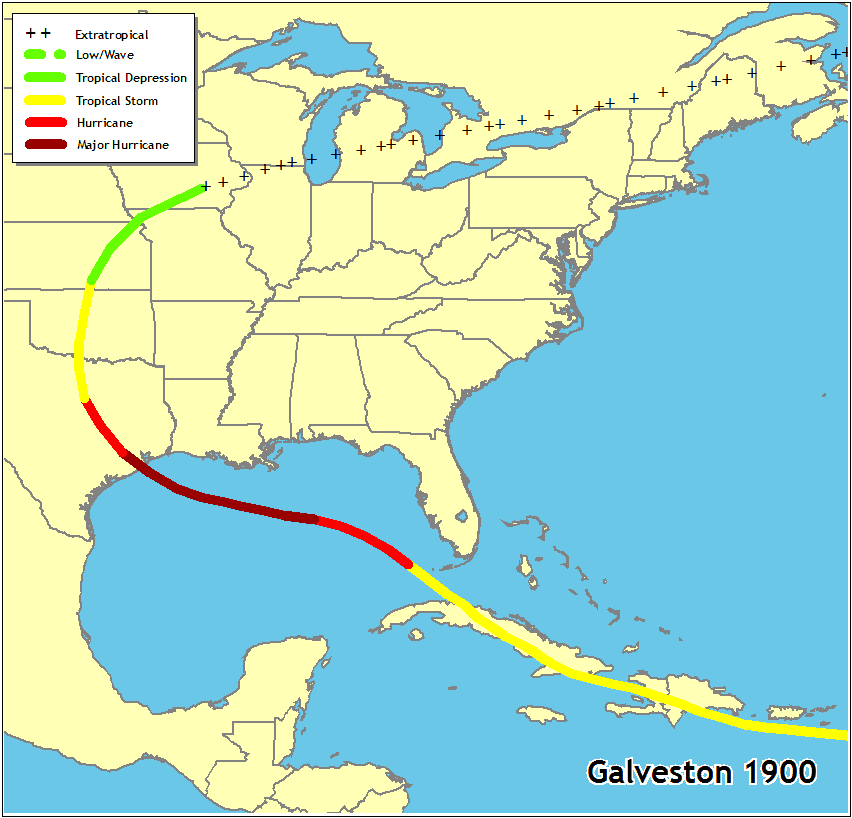
My favorite aspect of Larson’s portrayal of this event was the inclusion of the history of hurricanes from a meteorological perspective. I enjoyed learning what causes the waves of hurricanes and how hurricanes were viewed during this period. Maybe I’m a nerd, but I think this gives the story a more historical science approach and showed the depth of Larson’s research. However, Larson probably intended for me to gain some other message from the book than an appreciation for his research. Unlike my good friend, AJ, I’ll tackle the issue (eh? See what I did there? Football analogy for a football player). The hubris of the period astounds me, although I guess it shouldn’t because that’s been a consistent theme throughout this class. The national weather service was new and wanted to assert itself as an accurate weather forcaster, but continued to hinder its rise to respectability with inaccurate weather reports. So, when the Cubans tried to warn Americans of the storm’s path, the Americans were too arrogant to believe them. To borrow a phrase from Captain Gene Mauch in The Other Guys, “shake your *hands*, this *waving* contest is over.” If the Americans in the weather service put aside their egos and listened to the voices of experience, many lives may have been saved. I think the city would suffer substantial damage either way, but many lives could have been saved with an accurate warning. One aspect of the story that I don’t understand was the timing of the storm. Now we’re able to plot the path of the storm with satellites and all that good stuff, but shouldn’t they have been able to know the speed of the storm and figure out its trajectory from there? If the storm is moving at 15 mph and it hasn’t hit Florida, hasn’t hit Louisiana, so it must be headed further out and going for Houston area. I’d have to draw a map to better show my point, but somebody dropped the ball in my opinion.
Lastly, Larson humanized the book, which increased the story’s potency. Reading the scene of the first train trying to make it back to the island with references to the debris, especially a child’s toy, was quite sobering. Furthermore, Joseph’s dog miraculously staying with his family after the house fell apart only to jump back in the water out of duty to the missing member of the family. Animal deaths always get to me because of their innocence. Obviously Larson intended for that moment to be heart-wrenching and worded the story in such a way, but it works. Many of Larson’s stories were chosen for that purpose and makes this story more of a narrative than an academic work. Although, much like the Johnstown Flood by McCulloh, I think it’s an excellent source to use.