Warning: Undefined variable $num in /home/shroutdo/public_html/courses/wp-content/plugins/single-categories/single_categories.php on line 126
Warning: Undefined variable $posts_num in /home/shroutdo/public_html/courses/wp-content/plugins/single-categories/single_categories.php on line 127
While Galveston never fully regained its premier economic position following the massive destruction of the 1900 hurricane, its efforts to rebuild were extraordinary and reflected both the hubris of the age as well as a a welcomed sense of practicality. The hurricane took the lives of some 6,000 – 8,000 and resulted in property damage amounting to approx. $30 million. Yet despite these tremendous numbers, “there was no public discussion about abandoning the island.” W.L. Moody (who interestingly went on to found American National Insurance Company) told a reporter, “There was no question about it, “Galveston will be rebuilt stronger and better than ever before.”
So with this firm conviction city leaders boldly began to seek out ways in which to “eliminate the dangers of disaster.” CRC Member Ike Kempner, also the city treasurer, was primarily considered with ensuring the economic integrity of Galveston following its destruction. Galveston still boasted a large deep-water port, but the threat of another disaster discouraged investors. So while Galveston desperately needed to protect the city from future disasters, it had to do so in a way as not to disclose the city’s precarious geography. “Building a sea wall or taking other precautionary measures seemed to acknowledge the city’s dangerous position, yet without some moves by Galveston leaders to calm fears of future calamity, people would not remain, return, rebuild, or invest.” In that sense, the efforts to rebuild Galveston were as concerned with erecting sea walls and buildings as with reconstructing a new mindset – that while Galveston was an important economic hub, it was also vulnerable to natural disasters. Galveston became the meeting place of Gilded Age hubris and Progressive practicality. And nowhere was this more evident than in the remarkable construction of the sea wall. An ambitious undertaking to say the least, the sea wall was constructed “with great faith in modern technology and an equal resolve to remain on an unprotected sandbar.”
The seawall still protects the city of Galveston today. It extends almost ten miles along the Gulf of Mexico Side of Galveston, protecting nearly one-third of the beachfront. However the seawall resulted in some unforeseen consequences, like the erosion of the beach in front of the wall. Resultantly, the city must actively engage in “beach renourishment” – in which sand is dredged and brought to the shore. But in 2011 Rice University released a study suggesting that the environmental and economical costs of dredging are so tremendous that in the event of a future hurricane – Galveston should not rebuild some of its coasts. It’s been over one hundred years since the hurricane and we’re still recovering.
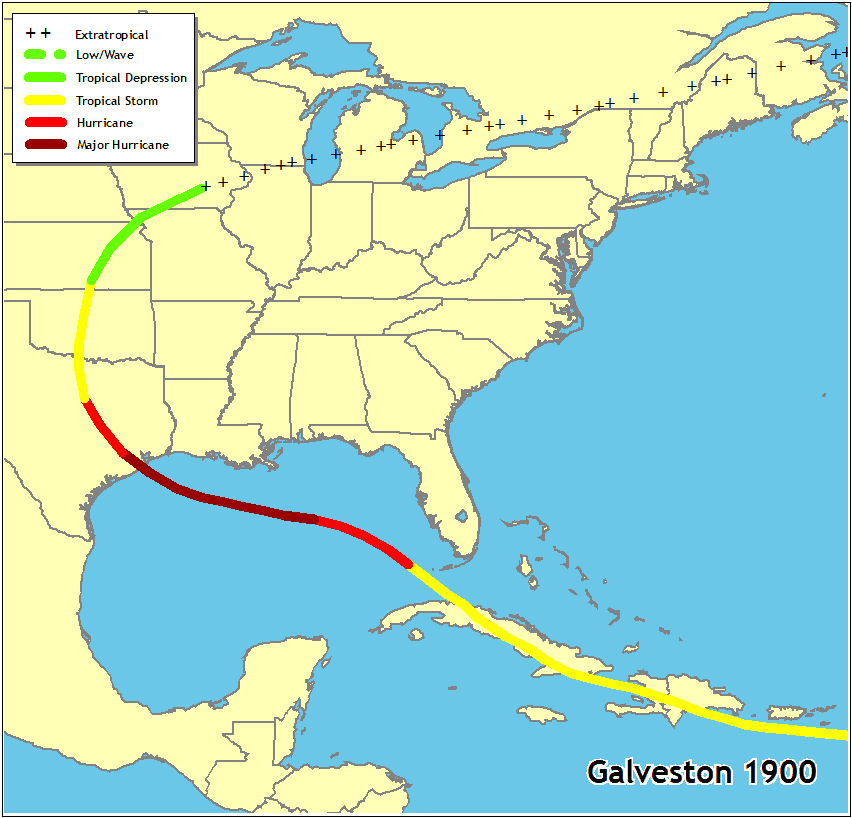
 As the rain pours on Davidson’s campus, students shuffle into the Union to dry off like wet dogs after a swim in the lake. This weather sucks. This accumulation might reach an inch by the end of the day, and we’re all tired of it. Fortunately, I’m jammin to The Boss, so I really don’t have a care in the world. Isaac Cline, however, didn’t have the luxury of Bruce Springsteen and witnessed something drastically more intense than our little drizzle. This hurricane is the deadliest in American history and ranks as the second costliest. The rain caused by the hurricane was significant, but proved harmful when coupled with the extraordinarily high windspeeds and a massive storm surge.