Rebuilding Galveston: Then and Now


Warning: Undefined variable $num in /home/shroutdo/public_html/courses/wp-content/plugins/single-categories/single_categories.php on line 126

Warning: Undefined variable $posts_num in /home/shroutdo/public_html/courses/wp-content/plugins/single-categories/single_categories.php on line 127

While Galveston never fully regained its premier economic position following the massive destruction of the 1900 hurricane, its efforts to rebuild were extraordinary and reflected both the hubris of the age as well as a a welcomed sense of practicality. The hurricane took the lives of some 6,000 – 8,000 and resulted in property damage amounting to approx. $30 million. Yet despite these tremendous numbers, “there was no public discussion about abandoning the island.”  W.L. Moody  (who interestingly went on to found American National Insurance Company) told a reporter, “There was no question about it, “Galveston will be rebuilt stronger and better than ever before.”

So with this firm conviction city leaders boldly began to seek out ways in which to “eliminate the dangers of disaster.” CRC Member Ike Kempner, also the city treasurer, was primarily considered with ensuring the economic integrity of Galveston following its destruction. Galveston still boasted a large deep-water port, but the threat of another disaster discouraged investors. So while Galveston desperately needed to protect the city from future disasters, it had to do so in a way as not to disclose the city’s precarious geography. “Building a sea wall or taking other precautionary measures seemed to acknowledge the city’s dangerous position, yet without some moves by Galveston leaders to calm fears of future calamity, people would not remain, return, rebuild, or invest.” In that sense, the efforts to rebuild Galveston were as concerned with erecting sea walls and buildings as with reconstructing a new mindset – that while Galveston was an important economic hub, it was also vulnerable to natural disasters. Galveston became the meeting place of Gilded Age hubris and Progressive practicality.  And nowhere was this more evident than in the remarkable construction of the sea wall.  An ambitious undertaking to say the least, the sea wall was constructed “with great faith in modern technology and an equal resolve to remain on an unprotected sandbar.”

The seawall still protects the city of Galveston today. It extends almost ten miles along the Gulf of Mexico Side of Galveston, protecting nearly one-third of the beachfront. However the seawall resulted in some unforeseen consequences, like the erosion of the beach in front of the wall. Resultantly, the city must actively engage in “beach renourishment” – in which sand is dredged and brought to the shore.  But in 2011 Rice University released a study suggesting that the environmental and economical costs of dredging are so tremendous that in the event of a future hurricane – Galveston should not rebuild some of its coasts. It’s been over one hundred years since the hurricane and we’re still recovering.

Blame it on the Weatherman


Warning: Undefined variable $num in /home/shroutdo/public_html/courses/wp-content/plugins/single-categories/single_categories.php on line 126

Warning: Undefined variable $posts_num in /home/shroutdo/public_html/courses/wp-content/plugins/single-categories/single_categories.php on line 127

At the turn of the century (1900), a detrimental hurricane hit Galveston, Texas. Galveston was experiencing a period of substantial growth and success, after hurricane hit, the city was devastated.

As we discussed in class last week about the effectiveness of a narrative history story, Isaac’s Storm can be categorized as such because the book its self is neither history or science but a combination of the two. Most of the book is an account given by Cline himself, as well as descriptions by survivors of the hurricane. The impact that not putting citations within in the text but at the end is effective because it keeps the flow of the novel. This novel allows the reader to envision what it would be like to live through a category 5 hurricane, Larson is able to show the reader the trust that the public placed in upper level officials, and weather technology and how we still do this today.  After reading this novel it made me realize the truth how reliant I am on technology. At night I will check weather.com to see what the upcoming forecast looks like and plan accordingly.  I know that I am one of millions who rely on today’s technology, be it on the phone or the computer. The irony of this, for example, in New York  the amount of times the “weathermen” have predicted a snowstorm that will produce ten inches of snow, however, the next morning when you get up it has only snowed a few inches and the sun is shining (even though the night before people were in hysterics). But every time it seems to go the same. However, as my waryness of techonolgy holds the is the old saying, “better safe then sorry”.

This very idea goes along with what people could have been feeling in Gaveston, Texas. Peoples trust or distrust with the idea of a meteorologist has ultimately impacted their lives. Ignorance is something that caused hundreds and maybe even thousands their lives. The idea of religion and how it effected the preparedness and thoughts of people during this period. Similar to the mention in AJ’s post that meteorology as a science was still seen as controversial, most people still believed that the weather was God’s own will and therefore should not be forecasted. So how does one prepare for what they deem to be enviable?

Similar to the other posts and addressing the central question of how the Galveston hurricane shaped American ideas about disaster preparedness, I found that while reading this novel what came to mind was a quote originally said by John Wooden, “failing to prepare is preparing to fail”. This quote can be applied to most of the disasters we have studied thus far. It holds true in the essence that because of the lack of preparation whether in Galveston, Texas or Chicago, for a large scale natural disaster can cost the lives of many and the overall destruction of a city’s infrastructure.


Lack of Preparedness and the Hubris of Men


Warning: Undefined variable $num in /home/shroutdo/public_html/courses/wp-content/plugins/single-categories/single_categories.php on line 126

Warning: Undefined variable $posts_num in /home/shroutdo/public_html/courses/wp-content/plugins/single-categories/single_categories.php on line 127

After reading A.J.’s post, I think he correctly identifies preparedness as being one of the most important issues regarding this disaster. Like the Johnstown Flood, the Galveston Hurricane seemed to have caught its victims by surprise. Due to the shoddy forecasting ability of meteorologists in this period, the citizens of Galveston were shocked by the storm’s devastation. Similar to the citizens of Johnstown, the Galveston residents mistakenly diagnosed the flooding as a normal occurrence. The stories of children playing in the floodwaters and the general feeling of a business as usual atmosphere are similar in both disasters.

The notion of preparedness will probably be a topic that we discuss extensively in class tomorrow. Clearly, Galveston was not prepared for the hurricane in 1900. One of the most obvious reasons is the lack of viable information about the impending storm. According to the experts, this storm was supposed to move north rather than northeast towards Texas. Only later would they acknowledge that the storm was headed towards Texas, but still insisted that the storm would not be much to worry about. The lack of information coupled with what Larson calls, “the hubris of men” made this massive storm even more deadly.

Larson’s notion of “the hubris of men” is an important idea to analyze. Similar to other disasters that we have studied in class, the Galveston Hurricane featured men that believed they had conquered nature and were summarily reminded that they had not. Disregard for the power of nature seems to be a reoccurring theme during this period. The Galveston Hurricane served as a wake up call of sorts for these men. After the hurricane a seawall was built and engineers raised the height of the city with jacks. The Galveston Hurricane made it clear that man had not conquered nature.

Finally, I want to comment on why Isaac Cline is given possession of this storm by Larson. It seems ambiguous while reading Isaac’s Storm as to whether Isaac is being blamed for the storm or is being defended. Larson points out that Cline may have saved thousands of lives by warning residents of houses near the gulf that a storm was coming. Conversely, Larson details how Cline ignored the signs the storm presented and chose to minimize its severity. Rather than condemning or praising Isaac Cline, Larson seems to want,” to explore the lives of history’s little men.”  The phrase “history’s little men” would obviously hurt the feelings of the far-from modest Isaac Cline, but helps readers to understand why Larson chose to frame the Galveston Hurricane around Isaac Cline.

Ignorance is Definitely not Bliss


Warning: Undefined variable $num in /home/shroutdo/public_html/courses/wp-content/plugins/single-categories/single_categories.php on line 126

Warning: Undefined variable $posts_num in /home/shroutdo/public_html/courses/wp-content/plugins/single-categories/single_categories.php on line 127

Overall, I liked Larson’s account of the Galveston Hurricane. It was an easy read, and it definitely adds to the historical study of the event by way of using first-hand accounts of the hurricane.

Looking back at what the people thought about the likelihood of a storm through the lens of seeing news about many Gulf Coast hurricanes in my lifetime, I am shocked by everybody’s lack of acknowledgment of potential danger. Price talked about how the people of Johnstown acknowledged the threat of flood, even if they did not properly prepare for the flood. In Galveston, however, the people did not even acknowledge the potential for a storm, which led to greater loss. It surprised me that they thought of the gulf as a warm lake rather than an ocean. Even though the Cubans were 100 percent accurate about the hurricane, the National Weather Service did not even take the slightest bit of stock in them, thinking that they were concerned enough about science. It also surprises me that it was illegal for Isaac to call the hurricane warning, as he was trying to save lives when he did so.

The city did learn quickly from this disaster, building a huge storm surge wall and elevating the city, but this one disaster put them forever behind in a race with Houston to become the greatest gulf city, and we see the effects of that result today. Houston continues to be one of the fastest growing cities in the United States, while Galveston is a dwindling port city. The hurricane drastically hindered the city’s course of growth, as people looked to Houston more and more to invest.

Waitin on a Sunny Day


Warning: Undefined variable $num in /home/shroutdo/public_html/courses/wp-content/plugins/single-categories/single_categories.php on line 126

Warning: Undefined variable $posts_num in /home/shroutdo/public_html/courses/wp-content/plugins/single-categories/single_categories.php on line 127

As the rain pours on Davidson’s campus, students shuffle into the Union to dry off like wet dogs after a swim in the lake. This weather sucks. This accumulation might reach an inch by the end of the day, and we’re all tired of it. Fortunately, I’m jammin to The Boss, so I really don’t have a care in the world. Isaac Cline, however, didn’t have the luxury of Bruce Springsteen and witnessed something drastically more intense than our little drizzle. This hurricane is the deadliest in American history and ranks as the second costliest. The rain caused by the hurricane was significant, but proved harmful when coupled with the extraordinarily high windspeeds and a massive storm surge.
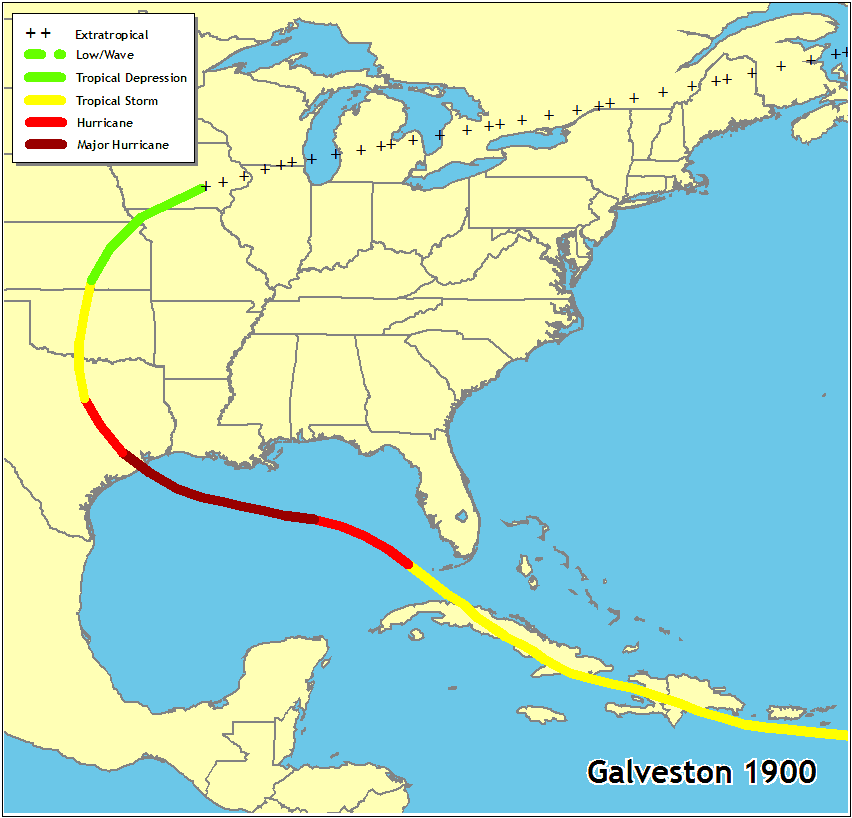
Larson’s book was more interesting to me than to most of esteemed classmates because I chose the Galveston Hurricane for my research topic. I’m also a numbers guy, so when I read winds over 120+ mph or 6,000 people died or the storm surge was 16 feet high, those statistics resonate with me. Think about it. Try sticking your hand (or head) out the window while driving on I-77 at two thirds the speed of the winds, yet one can still feel the wind’s power and control. Think about three times Davidson’s campus (all your friends, collegeues, lunch ladies, and professors) dead. Imagine water that all of a sudden reaches and submerges the first two floors of Chambers with class still in session. Powerful stuff.

My favorite aspect of Larson’s portrayal of this event was the inclusion of the history of hurricanes from a meteorological perspective. I enjoyed learning what causes the waves of hurricanes and how hurricanes were viewed during this period. Maybe I’m a nerd, but I think this gives the story a more historical science approach and showed the depth of Larson’s research. However, Larson probably intended for me to gain some other message from the book than an appreciation for his research. Unlike my good friend, AJ, I’ll tackle the issue (eh? See what I did there? Football analogy for a football player). The hubris of the period astounds me, although I guess it shouldn’t because that’s been a consistent theme throughout this class. The national weather service was new and wanted to assert itself as an accurate weather forcaster, but continued to hinder its rise to respectability with inaccurate weather reports. So, when the Cubans tried to warn Americans of the storm’s path, the Americans were too arrogant to believe them. To borrow a phrase from Captain Gene Mauch in The Other Guys, “shake your *hands*, this *waving* contest is over.” If the Americans in the weather service put aside their egos and listened to the voices of experience, many lives may have been saved. I think the city would suffer substantial damage either way, but many lives could have been saved with an accurate warning. One aspect of the story that I don’t understand was the timing of the storm. Now we’re able to plot the path of the storm with satellites and all that good stuff, but shouldn’t they have been able to know the speed of the storm and figure out its trajectory from there? If the storm is moving at 15 mph and it hasn’t hit Florida, hasn’t hit Louisiana, so it must be headed further out and going for Houston area. I’d have to draw a map to better show my point, but somebody dropped the ball in my opinion.


Lastly, Larson humanized the book, which increased the story’s potency. Reading the scene of the first train trying to make it back to the island with references to the debris, especially a child’s toy, was quite sobering. Furthermore, Joseph’s dog miraculously staying with his family after the house fell apart only to jump back in the water out of duty to the missing member of the family. Animal deaths always get to me because of their innocence. Obviously Larson intended for that moment to be heart-wrenching and worded the story in such a way, but it works. Many of Larson’s stories were chosen for that purpose and makes this story more of a narrative than an academic work. Although, much like the Johnstown Flood by McCulloh, I think it’s an excellent source to use.


When We Finally Learned


Warning: Undefined variable $num in /home/shroutdo/public_html/courses/wp-content/plugins/single-categories/single_categories.php on line 126

Warning: Undefined variable $posts_num in /home/shroutdo/public_html/courses/wp-content/plugins/single-categories/single_categories.php on line 127

As the first post for the week I am going to try and address the focus question posed on our syllabus and see if Isaac’s Storm relates to much of the things we have been discussing throughout the semester regarding the lack of awareness and preparedness in the historical disasters we have been analyzing. The work Isaac’s Storm by Erik Larson ultimately discusses the meteorologist Isaac Cline and his role in predicting the Galveston Hurricane of 1900. The era that this event occurred in, the way people went about handling the situation and the eventual misjudged outcome, I believe explains a lot about where disaster preparedness was at the time and showed Americans what desperately needed to change. This was during a time where people believed that their technology had overcome the forces of nature and that their advancements superseded the dangers nature could throw at them. In their assessment, Galveston, Texas, a city on the calm waters of the gulf could not possibly be devastated by any storm as professional opinion generally agreed that the storm was not headed north. In the grand scheme of things, meteorology as a science was still controversial; differing opinions about the weather as god’s own will and forecasting were often debated.

Our preparedness was not where it should have been and where it went after this disaster. At the time, meteorologists did have modern weather instruments available to them and this technology was seen as enough. Isaac Cline worked for the weather bureau out of Galveston, and sent frequent telegrams to the headquarters in Washington, but official weather mapping wasn’t the struggle at the turn of the 20th century, it was predicting the track of the storm. Weather preparedness may not have been the issue at hand, the issue was prediction preparedness. Scientists did not have an accurate means to predict the track of a hurricane and this enabled Hurricane Isaac to tear apart Galveston. I wont get into the distrust of Cuban meteorologists because that issue is rather evident and ultimately, shows the lack of research and awareness on the Americans part. The Weather Bureau’s misguided prediction of the storm in Cuba and their inability to trust their meteorologists is a factor of this event that I do not want to get into. All that needs to be mentioned is that the Cubans had predicted hurricanes far more accurately than the newly formed U.S. weather bureau which was soon realized by all involved.

What are to be discussed are the awareness, alertness and preparedness of the citizens in Galveston. Just like the Johnstown Flood people everywhere disregarded signs of danger, believed they were immune from harm, choose to carry on their daily lives and truly showed the unpreparedness and cockiness of our American ideas at the time. People in Galveston went to work and carried out their day on Saturday, despite Isaac Cline’s warning. By 12:30, most of the streets were flooded from the storm surge. Even unsupervised children played in this dangerous current for most of the day until their own bodies filled the water. Still and even at that point, men were determined to deny the storm’s existence, and made every effort to get to work. The book mentions restaurants opened at Midway, at lunch hour men went out to their favorite restaurants, men laughed and joked about “frightened women”, and some people continued to commute into Galveston by train.

This leads me to compare Price’s statements about the Johnstown Flood and their inability to stay prepared and the unconscionable decisions of the citizens of Galveston. He writes in a previous blog, “Nevertheless, the preparation process in case of this scenario was appallingly mismanaged. This issue of acknowledgment versus preparation is vitally significant in not only the Johnstown flood, but in innumerable disasters throughout history. How could so much risk be universally accepted, yet not be addressed directly and seriously?” He asks the right question in that situation and I am forced to ask the same one now.  The fact that people were completely willing to deny the forces nature and carry on their day is rather shocking. We now know that technology fails us at times, and that is what people at the turn of the 20th were about to learn. It is unfortunate that they had to learn this lesson with the sacrifice of 10,000 lives but it goes to show the level of preparedness in American ideas at the time. The shaping of this event towards our disaster awareness almost needs to go without mentioning that it is so drastic. Something needed to be done yet; it took this storm to make that happen. The country learned that nature is not tamable on that day. We understood we needed to switch our focus to preparedness and damage control.