Isaac’s, Stockman’s, Dunwoody’s, and Moore’s Storm


Warning: Undefined variable $num in /home/shroutdo/public_html/courses/wp-content/plugins/single-categories/single_categories.php on line 126

Warning: Undefined variable $posts_num in /home/shroutdo/public_html/courses/wp-content/plugins/single-categories/single_categories.php on line 127

AJ, as Catherine notes, does a good job at placing the Galveston Hurricane in a larger historical context and understanding its larger significance by arguing, “The era that this event occurred in, the way people went about handling the situation and the eventual misjudged outcome, I believe explains a lot about where disaster preparedness was at the time and showed Americans what desperately needed to change.” In doing so he defends, Isaac, who Catherine once again rightly paints as the books antagonist, by understanding the Hurricane’s human toll as largely resultant of the age rather than the actions of a few individuals. It is also a departure from what I understood to be an argument of Larson’s book; that the extent of the destruction can largely be attributable to issues born from individual decisions, namely those of Isaac Cline, William Stockman, H.C.C. Dunwoody, and Willis Moore. This is well evidenced in Larson’s desire to draw attention to the truthfulness of Isaac’s story concerning the his role in the warning of the hurricane; on page 168 and 169 he discusses how the inconsistencies between Isaac’s claim that his warnings saved the lives of over 6000 people and the possibility that he didn’t actually warn anyone (and even if he had it wouldn’t have saved 6000 lives). In drawing attention to these inconsistencies, he seems to be using the book as a platform to attack the common historical narrative, a narrative that the weather bureau, as the authority on storms, no doubt played a large role in shaping after the hurricane, and to furthermore place some of the blame onto the individuals who he believed to be disproportionately culpable for the massive losses of human life and destruction. This is also evidenced in the way that he constantly discusses the ways in which Morris’ desire for control, Dunwoody’s careerism, and Stockman’s hubris played in creating a society so vulnerable to disaster. While this desire to attribute personal guilt can be seen as a push back against a narrative that largely painted the disaster as a largely unavoidable societal failing and a call for reform, I believe we must additionally understand it as a product of Larson’s writing style. As was discussed in class and as I discussed in my blog post last week, McCullough’s ability to discuss characters without a disproportionate amount of attention paid to each one helped us, or at least me, to understand the Johnstown flood as a product of societal shortcomings. Conversely, Larson constructs his narrative around the thread of Isaac Cline’s life (going so far as to title his book Isaac’s storm, which in itself implies guilt). This narrative style, which puts such a large focus on one character as a sort of case study, seems to be predisposed by framing more individual guilt than a style, such as McCullough’s, which pays such even attention to such a multitude of characters.

A Comparison of the Johnstown Flood, the Galveston Hurricane, And Those Who Portrayed Them


Warning: Undefined variable $num in /home/shroutdo/public_html/courses/wp-content/plugins/single-categories/single_categories.php on line 126

Warning: Undefined variable $posts_num in /home/shroutdo/public_html/courses/wp-content/plugins/single-categories/single_categories.php on line 127

The narrative style Erik Larson employs to describe the Galveston Hurricane of 1900 is, at a rudimentary level, similar to that of David McCullough. Larson, similar to McCullough, does not intertwine footnotes with the text, which as Sarah and Emily argue discounts the reliability of the narrator. The Johnstown Flood however, offers a variety of accounts to provide balance and diversity to the narrative, while Isaac’s Storm emphasizes a dominant narrative fostered by other lesser accounts.

Science also differentiates the two novels: it was heavily stressed in Isaac’s Storm and nearly disregarded in The Johnstown Flood. The description of the formation of a hurricane felt similar to Bill Bryson’s A Short History of Nearly Everything, and I wonder if Larson would have benefited as a historical writer by implementing a citation scheme similar to Bryson’s (Bryson provides footnotes).

The residents of Galveston cultivated a feeling of security similar to that of Johnstown residents. Unlike the Chicago Fire or the Johnstown Flood, the Galveston Hurricane was not preceded by months of foreboding weather. Similar to the residents of Johnstown, the Galvestonians were accustomed to small floods, and severely doubted the likelihood of anything a disaster. However, I believe Johnstown residents to be more ignorant of potential threat, due to a history of flooding and the poor location, than Galveston residents, who had never experienced a hurricane before. Instead of placing partial blame on Galvestonians, Larson expresses his disappointment in the United States Weather Bureau’s confidence and the Cuban weather cable ban. Further, he places blame much more indiscreetly on authorities, including Isaac. Larson transforms the principal character, Isaac, into an antagonist by noting the observation of a decreasing barometric pressure yet neglecting to warn people.

However, all this being said, it is easier to criticize the inaction of meteorologists knowing what we know now about weather patterns and the outcome of the hurricane. AJ phrased it well in his post: “The era that this event occurred in, the way people went about handling the situation and the eventual misjudged outcome, I believe explains a lot about where disaster preparedness was at the time and showed Americans what desperately needed to change.” I understand why Isaac trusted his former knowledge and dismissed the threat of catastrophe.

Waitin on a Sunny Day


Warning: Undefined variable $num in /home/shroutdo/public_html/courses/wp-content/plugins/single-categories/single_categories.php on line 126

Warning: Undefined variable $posts_num in /home/shroutdo/public_html/courses/wp-content/plugins/single-categories/single_categories.php on line 127

As the rain pours on Davidson’s campus, students shuffle into the Union to dry off like wet dogs after a swim in the lake. This weather sucks. This accumulation might reach an inch by the end of the day, and we’re all tired of it. Fortunately, I’m jammin to The Boss, so I really don’t have a care in the world. Isaac Cline, however, didn’t have the luxury of Bruce Springsteen and witnessed something drastically more intense than our little drizzle. This hurricane is the deadliest in American history and ranks as the second costliest. The rain caused by the hurricane was significant, but proved harmful when coupled with the extraordinarily high windspeeds and a massive storm surge.
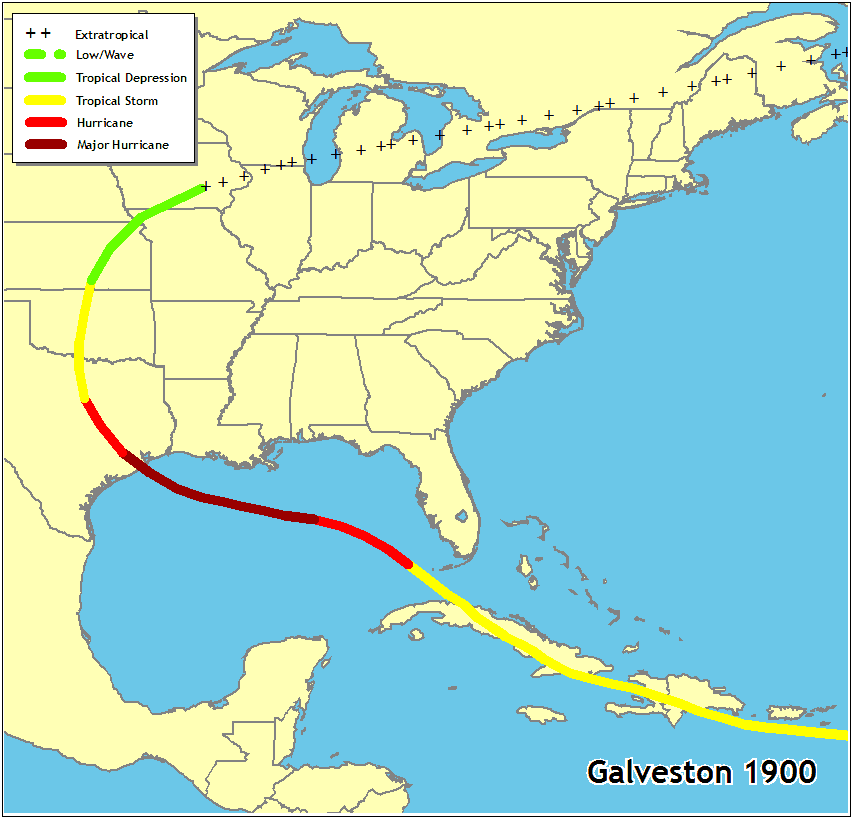
Larson’s book was more interesting to me than to most of esteemed classmates because I chose the Galveston Hurricane for my research topic. I’m also a numbers guy, so when I read winds over 120+ mph or 6,000 people died or the storm surge was 16 feet high, those statistics resonate with me. Think about it. Try sticking your hand (or head) out the window while driving on I-77 at two thirds the speed of the winds, yet one can still feel the wind’s power and control. Think about three times Davidson’s campus (all your friends, collegeues, lunch ladies, and professors) dead. Imagine water that all of a sudden reaches and submerges the first two floors of Chambers with class still in session. Powerful stuff.

My favorite aspect of Larson’s portrayal of this event was the inclusion of the history of hurricanes from a meteorological perspective. I enjoyed learning what causes the waves of hurricanes and how hurricanes were viewed during this period. Maybe I’m a nerd, but I think this gives the story a more historical science approach and showed the depth of Larson’s research. However, Larson probably intended for me to gain some other message from the book than an appreciation for his research. Unlike my good friend, AJ, I’ll tackle the issue (eh? See what I did there? Football analogy for a football player). The hubris of the period astounds me, although I guess it shouldn’t because that’s been a consistent theme throughout this class. The national weather service was new and wanted to assert itself as an accurate weather forcaster, but continued to hinder its rise to respectability with inaccurate weather reports. So, when the Cubans tried to warn Americans of the storm’s path, the Americans were too arrogant to believe them. To borrow a phrase from Captain Gene Mauch in The Other Guys, “shake your *hands*, this *waving* contest is over.” If the Americans in the weather service put aside their egos and listened to the voices of experience, many lives may have been saved. I think the city would suffer substantial damage either way, but many lives could have been saved with an accurate warning. One aspect of the story that I don’t understand was the timing of the storm. Now we’re able to plot the path of the storm with satellites and all that good stuff, but shouldn’t they have been able to know the speed of the storm and figure out its trajectory from there? If the storm is moving at 15 mph and it hasn’t hit Florida, hasn’t hit Louisiana, so it must be headed further out and going for Houston area. I’d have to draw a map to better show my point, but somebody dropped the ball in my opinion.


Lastly, Larson humanized the book, which increased the story’s potency. Reading the scene of the first train trying to make it back to the island with references to the debris, especially a child’s toy, was quite sobering. Furthermore, Joseph’s dog miraculously staying with his family after the house fell apart only to jump back in the water out of duty to the missing member of the family. Animal deaths always get to me because of their innocence. Obviously Larson intended for that moment to be heart-wrenching and worded the story in such a way, but it works. Many of Larson’s stories were chosen for that purpose and makes this story more of a narrative than an academic work. Although, much like the Johnstown Flood by McCulloh, I think it’s an excellent source to use.