The Atlantic View of the The Industrial Revolution


Warning: Undefined variable $num in /home/shroutdo/public_html/courses/wp-content/plugins/single-categories/single_categories.php on line 126

Warning: Undefined variable $posts_num in /home/shroutdo/public_html/courses/wp-content/plugins/single-categories/single_categories.php on line 127

When we first hear about the Industrial Revolution in our freshman history classes, we are told that Great Britain achieved extraordinary technological feats like the invention of the first railroad train and the invention of the steam engine. We are also exposed to the miserable conditions the working poor have to deal with by working in the steel and textile mills. So we led to believe that the effects of the Industrial Revolution were only localized to Great Britain or Europe but it is not revealed that the Industrial Revolution had far reaching effects on the rest of the world, especially the Atlantic realm. Even though the textile mills were started in Great Britain, textile production also thrived on the east coast of the United States with the help of Samuel Slater (Egerton et al. 433). Now both of these industries need raw cotton to produce consumer items for a growing middle class and they both procured cotton from the American South. During this time cotton production was a slave based economy. My colleague Tyler Mendoza points out that industrialization did not end slavery but changed what it was. I am in full agreement, but I also think slavery indirectly made the Industrial Revolution possible. Even the archaic establishment of slavery was eventually abolished in the late 1800s, the connection between cotton and textile production was slavery. Hence institution of slavery acted as a bridge or a conduit between not only raw cotton and mass produced textiles, also between mercantilism and capitalism.

What I also found interesting about the chapter was the Atlantic migration. When we study about the Industrial Revolution we are led to believe that the rural populace facing either starvation or being pushed of farm land by the enclosure movement, were forced to move to the cities to find work usually in factory. According to Egerton et al., numerous factors such as the British Corn Laws, the Irish Potato Famine, and technological advancements in transatlantic travel led to the mass exodus of Europeans emigrating to the whole American continent (Egerton et al. 441 – 443). Although Europeans were emigrating to the Americas to find a better life for their families, there was also a sinister aspect behind it. Wanting to “whiten” the mostly African population, the Spanish – American republics were trying to direct the nationality in a more elitist framework (Egerton et al. 445). Republics that shared a border with the Atlantic Ocean, like Brazil who received large numbers of German colonists, where successful while others like Peru were unsuccessful.
…read more

Juntas


Warning: Undefined variable $num in /home/shroutdo/public_html/courses/wp-content/plugins/single-categories/single_categories.php on line 126

Warning: Undefined variable $posts_num in /home/shroutdo/public_html/courses/wp-content/plugins/single-categories/single_categories.php on line 127

The Age of Revolutions

The United States Revolution from the British Empire inspired a series of revolutions throughout both the new and old world. Inspired by their enlightened ideas the French followed suit and established their own republic issuing the declaration of rights of man. This made way for the republic of San Dominque to rebel and establish the republic of Haiti. When Napoleon marched into the Iberian peninsula it weakened both Portugal and Spains ability to hold onto their colonies. This allowed Venezuela, Ecuador, Chile, Argentina, Brazil and Mexico to become independent of their old world leaders.

Chapter 12 of the Atlantic World chooses to focus on Simon Bolivar, class struggles between the Creoles and the poor, and racial struggles, but what captured my attention was a central theme to the class. This theme was introduced during our reading of treacherous rivers in North America and the increase trials of treason, the theme of interpreting what a monarch would want while furthering their own political gain. We see this theme throughout the chapter with the formation of Juntas in Spanish America, these juntas claim to be enacting the will of Ferdinand VII yet leave some things open for interpretation. The most prominent decisions of the Juntas is the establishment of free trade which was extremely beneficial for the merchants in the New world. The Juntas provided several rights to its citizens and were set up as a form of autonomous governments, for as long as Joseph Bonapart sat on the Spanish throne. These autonomous governments would play a pivotal role during the age of revolution.

…read more

Industrialization and a New Imperialism


Warning: Undefined variable $num in /home/shroutdo/public_html/courses/wp-content/plugins/single-categories/single_categories.php on line 126

Warning: Undefined variable $posts_num in /home/shroutdo/public_html/courses/wp-content/plugins/single-categories/single_categories.php on line 127

The 18th century came with many technological advances that called for a larger work force. Britain had an increasing need for textile production. With new inventions the United States was able to compete in the cotton market with India. Technological inventions such as the cotton “gin” by Eli Whitney combined with rot-resistant cotton caused for an all-time high or exploitation of slave labor in the southern United States, mainly in the Carolinas. This increase of slave labor also brought along a backlash on the morality of slavery, leaving slave owners on the defensive. I found it interesting that slave owners used the bible to justify slavery, while abolitionists just the bible to condemn it. We can further make a connection that the ideas of the civil war were creeping up at the beginning of industrialization. This began a greater division between the North and the South.

My classmate, Vince Tursini discussed the importance that women played in the Mexican economy in his post on Chapter 5 of Caterina Pizzigoni’s, “The Life Within,” he says, “ Individual accounts of women capable of capitalizing on the labor and productivity are shown in the readings”. This type of capitalizing on labor and productivity is also show in Chapter 13 of the Atlantic world. As the south capitalized on slave labor, the north began to force on a “family system”, in which entire villages were surrounded by company owned farmland. In this system, men and the sons worked in the fields, while their wives and daughter worked on looms within the factory. This illustrated an awkward transition from farm life to an industrial economy. Women were now more likely to earn wages for their work, instead of just working on the family farm. This idea can also tie back to the evolution of white women article in which the theory on progressive gender roles and expectation of women’s’ work come into play. If there is an economic need for women outside of the house then it becomes okay for women to work. If the economic need did not arise they would have still been stuck in the home.

…read more

Chapter 13 of the Atlantic world


Warning: Undefined variable $num in /home/shroutdo/public_html/courses/wp-content/plugins/single-categories/single_categories.php on line 126

Warning: Undefined variable $posts_num in /home/shroutdo/public_html/courses/wp-content/plugins/single-categories/single_categories.php on line 127

The main focus of Chapter 13 of the Atlantic world is the rise of industrialization. The chapter opens by discussing the population boom that England experienced during the mid 18th century to early 19th century, due to advances in technology. The authors then go on to discuss that thanks to this large growth in population and new technologies, this would also lead to a growing working population and demand for textiles. Thanks to these changes there was a need for change in regards to labor, and so this would lead into the growth of the textiles industry.

In this reading, it is noted that the rise of Industrialization meant a shift in slave labor and how it was used. This was also noted by warm turtle tank (Name not given), they note the same thing in regards to industrialization and slavery. Expanding on this, I find it interesting that the rise of industrialization did not eliminate slavery but rather shifted what the emphasis of it was. Instead of slave plantations focusing on tobacco or sugar, as noted in the sugar islands readings, they instead were able to adapt.

Overall I enjoyed this reading, as it talked about a topic which I am interested in. I did however at times get sidetracked as the textbook can be at times a bit “dry” or dull.

…read more

Primary Sources


Warning: Undefined variable $num in /home/shroutdo/public_html/courses/wp-content/plugins/single-categories/single_categories.php on line 126

Warning: Undefined variable $posts_num in /home/shroutdo/public_html/courses/wp-content/plugins/single-categories/single_categories.php on line 127

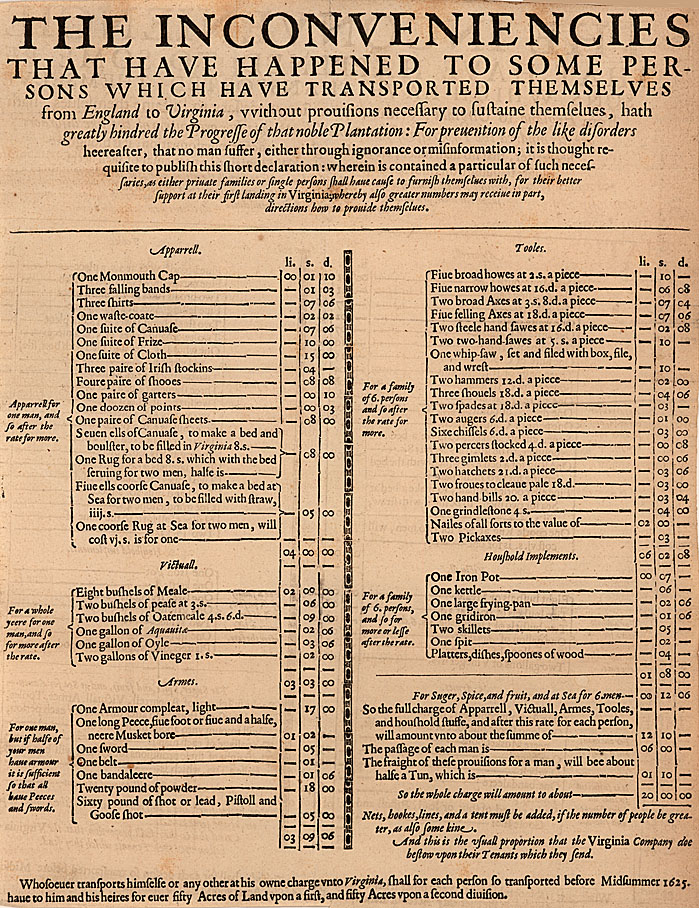
I plan on doing my final project on British Immigration to the Colonies

This is a primary source that details what an immigrant going to America should pack. I found it on the John Carter Brown Library.

The second source that I plan to use is an indentured servitude contract for Richard Lowther. I found it on Virtual Jamestown. You can view it here.

The third source that I plan to use is a first-hand account detailing an immigrant’s journey to America. I found it on Virtual Jamestown. You can view it here.

…read more

Industrialization: Atlantic Systems of Profit and Consequence


Warning: Undefined variable $num in /home/shroutdo/public_html/courses/wp-content/plugins/single-categories/single_categories.php on line 126

Warning: Undefined variable $posts_num in /home/shroutdo/public_html/courses/wp-content/plugins/single-categories/single_categories.php on line 127

The late eighteenth and early to mid nineteenth centuries saw the institution of particular technological advancements that fed the industrial appetite of the Atlantic basin. A growing demand for textiles, not satiated by English production alone, led to industrial outbreak in North America. These revolutionary changes showed how interconnected the economies of the Atlantic really were. For example, Britain’s massive industrial demand for raw cotton helped to sustain a slave based society in the southern United States. (Egerton et al, 429) Additionally, “a series of synergistic technological innovations in Britain and the [U.S.] ultimately resulted in the greatest surge of the importation of captive Africans into the United States.” (Egerton et al, 430) By the nineteenth century, Atlantic economies had become so interwoven that any change in any market would impact all corners of the Atlantic basin.

During the industrial revolution, while profits steadily increased for capitalist merchants, technological change was not always positively progressive. Egerton et al argues, “economic gains and improved living standards in one part of the Atlantic basin were reliant on the expansion and intensification of socially and economically retrogressive trends in another.” (Egerton et al, 429,430) More clearly stated, “for every James Watt who grew rich from technology, there were numerous slaves whose bodies were sold into the newly cleared lands of the U.S. cotton South.” (Egerton et al, 453) Moreover, industrialization spawned a new demand of natural resources providing for a fresh imperialistic competition across the Atlantic. The indigenous population of the Congo felt the wrath, and sadly, they made up only a small percentage of the those negatively effected by industrialization and new imperialism.

Women were another demographic effected by industrial revolution. As I was reading the final paragraph of the chapter, I was reminded of Mary Norton’s article and the role white women played in colonial America. In this chapter, Egerton et al provides a positive outlook for white women in post-Revolution New England, claiming good things were said about the putting-out system. “It enabled wives and daughters to combine domestic labor with the larger market and use their earnings to buy mass-produced goods,” directly contributing economically. (Egerton et al, 453) The woman’s role has been and always will be an integral part of any society. As Alec stated in his post concerning the societies of Potosi and the Yoruba, “women did play quite the roll throughout Atlantic history.”

…read more

Primary Sources


Warning: Undefined variable $num in /home/shroutdo/public_html/courses/wp-content/plugins/single-categories/single_categories.php on line 126

Warning: Undefined variable $posts_num in /home/shroutdo/public_html/courses/wp-content/plugins/single-categories/single_categories.php on line 127

1. Garcés, Francisco Tomás Hermenegildo, On the Trail of a Spanish Pioneer, University of Utah-American West Center.
This source was found at the following website:
http://utah-primoprod.hosted.exlibrisgroup.com/primo_library/libweb/action/dlDisplay.do?vid=MWDL&afterPDS=true&docId=digcoll_uuu_11uaida/9207

2. Keith, George. 1706. A Journal of Travels from New-Hampshire to Caratuck: On the Continent of North-America. by George Keith, A.M. Late Missionary from the Society for the Propagation of the Gospel in Foreign Parts; and Now Rector of Edburton in Sussex. London: printed by Joseph Downing for Brab. Aylmer at the Three-Pigeons over-against the Royal-Exchange in Cornhill.

This source was found at the following website:

http://find.galegroup.com.lib-proxy.fullerton.edu/ecco/retrieve.do?inPS=true&prodId=ECCO&userGroupName=csuf_main&tabID=T001&bookId=0032200600&resultListType=RESULT_LIST&contentSet=ECCOArticles&showLOI=&docId=CW3317443825&docLevel=FASCIMILE&workId=CW117443824&relevancePageBatch=CW117443824&retrieveFormat=MULTIPAGE_DOCUMENT&callistoContentSet=ECLL&docPage=article&hilite=y

3. Humphreys, David, 1689-1740, Missionaries Sent to North Carolina, [New Haven, Conn.?: G.B. Bassett?], 1852.

This source was found at the following website:

http://find.galegroup.com.lib-proxy.fullerton.edu/ecco/retrieve.do?inPS=true&prodId=ECCO&userGroupName=csuf_main&tabID=T001&bookId=0032200600&resultListType=RESULT_LIST&contentSet=ECCOArticles&showLOI=&docId=CW3317443825&docLevel=FASCIMILE&workId=CW117443824&relevancePageBatch=CW117443824&retrieveFormat=MULTIPAGE_DOCUMENT&callistoContentSet=ECLL&docPage=article&hilite=y

…read more

Primary Sources


Warning: Undefined variable $num in /home/shroutdo/public_html/courses/wp-content/plugins/single-categories/single_categories.php on line 126

Warning: Undefined variable $posts_num in /home/shroutdo/public_html/courses/wp-content/plugins/single-categories/single_categories.php on line 127
Turning The Tide: How a Small Band of Allied Sailors Defeated the U-boats and Won the Battle of the Atlantic

For my final project I would like to focus on the Battle of the Atlantic and the impact it had on WWII. This key geographical location played a huge role before, during and after the war. With careful observation and historical evidence, I would like to bring forth the details of one of the greatest naval battles in history. My final project will be posted to https://BattleoftheAtlantic.darhino.com.

  1. Offley, Edward. 2011. Turning the Tide : How a Small Band of Allied Sailors Defeated the U-boats and Won the Battle of the Atlantic. New York: Basic Books.
  • -This source is located in the north basement of the Pollak Library at the CSUF Campus. It is a compilation of interviews of sailors and their experience with U-boats on the Atlantic.

2.

  • “Battle of the Atlantic”, Map, University of Minnesota Libraries, Manuscripts Division, Blake, F. Donald (1908-1997), Created 1944. http://umedia.lib.umn.edu/node/46228
  • This source helps give an understanding to the amount of traffic and action the Atlantic faced and its impact globally.

3. 1591149959-01Y’Blood, William T. 2004. Hunter-killer; U.S. Escort Carriers in the Battle of the Atlantic. Annapolis, Md.: Naval Institute Press.

  • This source explores the experience of the U.S. Escort Carriers and how they played a role against the U-boat attacks.
  • This source can be found in the north basement of the Pollak Library at the CSUF campus.

…read more

Atlantic World Chapter 13


Warning: Undefined variable $num in /home/shroutdo/public_html/courses/wp-content/plugins/single-categories/single_categories.php on line 126

Warning: Undefined variable $posts_num in /home/shroutdo/public_html/courses/wp-content/plugins/single-categories/single_categories.php on line 127

Chapter 13 in Atlantic World explains the large migration throughout the Atlantic during the Industrial Age and many of those Europe who migrated to the United States were Irish immigrants. European migration spread throughout the United States because for many immigrants the United States helped many immigrants creating societies and crops. One example of migration was Irish migrants moving from Ireland to the United States. Irish farmers used potatoes as cash to pay their rents to their Protestant English landlords because it was used to bargain as their form of payment and Irish potatoes had value. Potatoes were one of the crops that Irish Farmers had during the 1840s and become the staple of the Irish diet by this time. (Chapter 13, Page 441-442). The reason Irish migrants chose to move to the United States because of debts in Ireland were high and more opportunities to establish homes, crops, and societies. The majority of Irish migration was in the United States, which received 85 percent of Irish immigrants. (Chapter 13, Page 442). I think Irish immigrants’ move to the United States was important because more opportunities for Irish immigrants to build their society by growing crops on their land that these Irish immigrants would live on their land, and hopefully would bring a better feature for these Irish immigrants and their families. There were several European immigrants that moved to Africa because the British owned parts of Africa and had a lot more resources located in Africa. The series of migration helped create production because with European throughout the Atlantic on various countries, it could help trade through production, plantation, and food to help the economy. This reading reminds me of Danny Alvarez’s reading from Caterina Pizzigoni on local indigenous society in Mexico because just like the Irish, the Mexicans had to make payment to their landlords towards their homes. The maguey plants were used for either food or material fuel in Mexico. The maguey gave the Toluca people an ecological advantages to help pay off for their well-being with low-wage rental housing and unequal debts in Mexico.

…read more

Primary Sources


Warning: Undefined variable $num in /home/shroutdo/public_html/courses/wp-content/plugins/single-categories/single_categories.php on line 126

Warning: Undefined variable $posts_num in /home/shroutdo/public_html/courses/wp-content/plugins/single-categories/single_categories.php on line 127

My final project will explore how Spanish Catholicism affected and justified the exploitation and cruel treatment of Indigenous populations and the forced migration of Africans overseas. Listed below are my primary sources:

The Spanish Requirement of 1513

The Spanish Requirement of 1513 was read to Native Americans in Spanish before a conquest was fully executed. The document declared that the Spanish Monarchy had the divine right to conquer new territories and spread Catholicism.

Christopher Columbus’ Journals

The Journals of Christopher Columbus provide insight behind the economic and religious motivations for explorations and colonization. Columbus’ writings offer explanations for why Native Americans were treated brutally, and the writings expose the racist and superior mindsets of the Spanish, often justified through religion.

King Ferdinand’s Letter to the Taino-Arawak Indians

King Ferdinand’s Letter reveals promises of prosperity and success tot eh Taino-Arawak Indians, but at the price of Catholicism and conquering. Here, King Ferdinand hints at Catholic superiority over Atlantic territories.

…read more