Primary Sources for Pirates


Warning: Undefined variable $num in /home/shroutdo/public_html/courses/wp-content/plugins/single-categories/single_categories.php on line 126

Warning: Undefined variable $posts_num in /home/shroutdo/public_html/courses/wp-content/plugins/single-categories/single_categories.php on line 127

Since I’m doing my report on Pirates in the Atlantic, I have found some pretty interesting primary sources.

Here is a map of the West Indies as a “war plan”. It could have been used for pirates. It was created in 1762 by Emanuel Bowden. It is from the Map Collections from the University of Texas in Arlington as well as the University of Texas at Arlington Library. https://texashistory.unt.edu/ark:/67531/metapth190464/

Next is an image depicting a sea battle between the English and Spanish pirates.

“Attack on Spanish Fleet” was created in 1742 during the Battle of Bloody Marsh. It was a fight against the Spanish and the English over Florida and Georgia. Taken from New Georgia Encyclopedia at the Digital Library of Georgia. http://www.georgiaencyclopedia.org/file/6418. Unknown illustrator.

Primary view of object titled 'West Indies from the latest and best authorities.'.

Here is a map of the West Indies, a good source to use when locating pirate attacks or getting a sense of where pirates conducted most of their activity. Taken from the University of Texas at Arlington Library in the Map Collections from the University of Texas at Arlington and made by N & S.S. Jocelyn in 1825. https://texashistory.unt.edu/ark:/67531/metapth192608/

…read more

Iroquois Encounters with Christianity


Warning: Undefined variable $num in /home/shroutdo/public_html/courses/wp-content/plugins/single-categories/single_categories.php on line 126

Warning: Undefined variable $posts_num in /home/shroutdo/public_html/courses/wp-content/plugins/single-categories/single_categories.php on line 127
iroquois-5

My original topic initially focused on Protestant Christianity among the Iroquois Confederacy during the colonial era. However, due to a slew of primary source material I have come across, I would like to refine this topic to include Iroquois peoples’ encounters with Christianity in general. Below are five primary sources including four works of art and a sacred religious text.

Ernest Smith, “Handsome Lake Preaching His Code at the Longhouse,” 1936, watercolor, Rochester Museum and Science Center.

This is Senecan preacher Handsome Lake granting a sermon. He is known for syncretizing indigenous Senecan beliefs and aspects of Quakerism. His teachings came to encompass an entire religion, Gaiwiio, whose sacred text is visible here. A full citation of the religious text is immediately below.

Parker, Arthur. The Code of Handsome Lake, the Seneca Prophet. Albany: University of the State of New York, 1913.

Handsome Lake’s religious code, the eponymous The Code of Handsome Lake, was compiled by anthropologist Arthur Parker, who vigorously studied Iroquois culture.

Father Chauchetiere, “Saint Kateri Tekakwitha,” c. 1682-1696, oil on canvas, 41 x 37 in., St. Francis Xavier Church, Kanawake Mohawk Reservation, Montreal, Quebec.

Kateri Tekakwitha is depicted in the portrait above. A survivor of smallpox, she converted to Catholicism at the age of 19. She is both beatified and canonized.

Gérard Dicks Pellerin a-1640xl pc065135 10-02-04
F.J. Bressani, “Wendat Family Praying after their Conversion to Christianity by Jesuits,” c. 1657, engraving, 24 cm., in The Huron: Farmers of the North, Bruce G. Trigger (Fort Worth: Harcourt Brace Jovanovich College Publishers, 1990), 14.

The Wendats were an Iroquois-speaking people who inhabited what is now the Canadian province of Ontario. They were the target of Jesuit missionary activity during the 17th century.

iroquois

Joseph-Francois Lafitau, “Moeurs des Sauvages Americains Comparees aux Moeurs des Premier Temps,” 1724, detail, The Library Company of Philadelphia.

This is a depiction of a Jesuit missionary observing an Iroquois burial ceremony in the early 18th century.

…read more

Thomas Jefferson’s Letter to Lafayette


Warning: Undefined variable $num in /home/shroutdo/public_html/courses/wp-content/plugins/single-categories/single_categories.php on line 126

Warning: Undefined variable $posts_num in /home/shroutdo/public_html/courses/wp-content/plugins/single-categories/single_categories.php on line 127

In his letter to the Marquis de Lafayette in 1792, Thomas Jefferson explains his perspective on the direction in which the United States was headed, as well as his perception of his newly formed nation. Expressing his concerns about the uneasiness of America during the 18th century, Jefferson writes about the importance of maintaining American independence and stability after British emancipation. In his letter, Jefferson voices his concerns about British supporters, but reassures Lafayette that they are “preachers without followers, and that [American] people are firm & constant in their republican purity.”

In his post, Hunter Loya explains that Jefferson’s language signifies that he is deeply concerned about the future of the extremely young United States of America. Loya states that “Jefferson’s concerns over the political issues that were starting to sprout inside of the government were growing, unaware of the factions that would persist years after.” I agree with this point and would like to add that Jefferson’s concerns display the divide in ideology over American government beginning with American independence. Jefferson’s desire to states rights and minimal federal power are expressed in his letters, and his concerns as shown represent his disagreements with British government, as well as his fear that American government will be heavily centralized and eventually replicate the monarchy colonists revolted against.

The Declaration of Independence lists the acts of the Monarch of England that American colonists disagreed with, from refusal of Assent of Laws, to refusal to pass laws of immediate importance, to the quartering of troops in homes. In Jefferson’s letter to Lafayette, not only does he express concerns for maintaining American independence from Britain, but he also continues the debate as to whether the United States should have a strong centralized government or strong state administrations.

…read more

Propaganda: Paul Revere’s Boston Massacre


Warning: Undefined variable $num in /home/shroutdo/public_html/courses/wp-content/plugins/single-categories/single_categories.php on line 126

Warning: Undefined variable $posts_num in /home/shroutdo/public_html/courses/wp-content/plugins/single-categories/single_categories.php on line 127

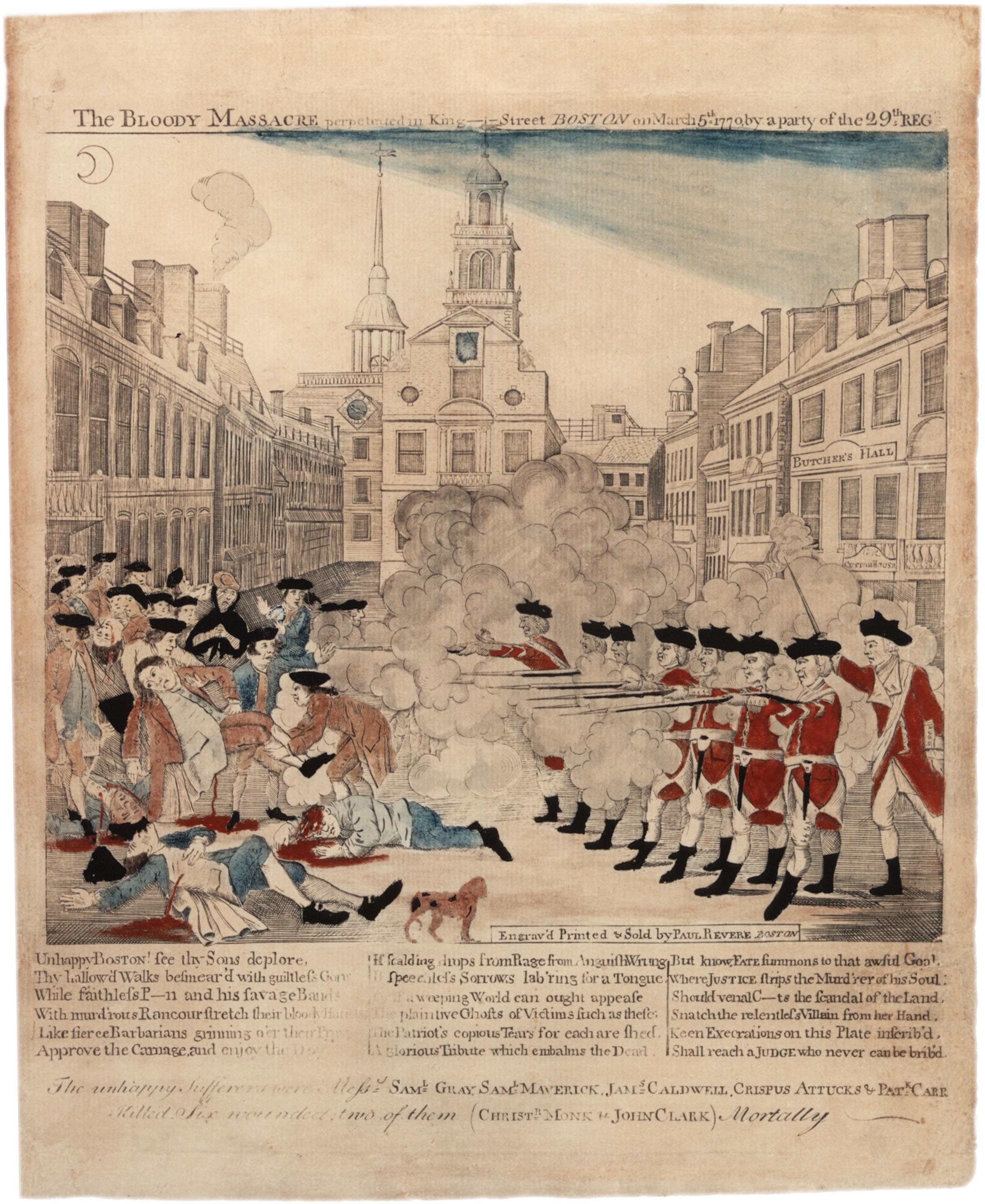
As the Revolution dawned and the colonies needed to drum up support for their cause, propaganda began to be released about the British. Paul Revere’s painting of the Boston Massacre helps to convey the colonies’ message that the British were the enemy. It is an excellent example of propaganda, as it distorts the truth and uses great symbolism to accomplish its goal, which is convincing the colonists that the war was just. Even though the American Revolution was mostly driven by wealthy individuals, they relied on the support of the lower classes.

The iconography that is used in the painting is clear and conveys the intended message. This can be seen through the use of red throughout the painting; the deep red color is only used two times, one for the blood of the “massacred” citizens and the other for the coats of the British. This conveys the message that the British are evil and equates the blood that is spilled with the British themselves. Likewise, the colonists are wearing normal, muted clothes, which distinguishes them from the British. This distorts the truth for several reasons, namely the name “massacre.” As the painting itself notes, relatively few people were killed however, the painting makes it seems like more individuals were killed. Similarly, the painting does not show any conflicts prior to the event, and simply shows what the aftermath was.

As Matt Everett noted, this represents an important cultural distinction between the British and the colonists. This cultural distinction was important because although they were similar in culture, there was a difference in laws in regards to trade. As previously discussed in weeks prior by the authors of The Atlantic World, most aspects of the Atlantic world as a whole were driven by the importance of trade and wealth. Because the laws complained about by the wealthier colonists did not affect the whole of society, propaganda was necessary to change their opinions of a group that was so culturally similar to themselves.

Source

The Boston Massacre by Paul Revere

…read more

The Exacerbation of Colonial American Tensions


Warning: Undefined variable $num in /home/shroutdo/public_html/courses/wp-content/plugins/single-categories/single_categories.php on line 126

Warning: Undefined variable $posts_num in /home/shroutdo/public_html/courses/wp-content/plugins/single-categories/single_categories.php on line 127

During class on Monday, we learned about the Proclamation of 1763 and its explicit prohibition of colonial settlement past the Appalachian Mountains. Today’s assigned readings (a series of primary source documents) underline the rationale behind this prohibition. Interfering with American Indian affairs and allowing non-consensual appropriation of their land was simply not conducive to trade. Colonists migrating westward beyond the ‘backcountry’ (a spatial term explored in James Merrell’s Second Thoughts) created administrative problems for the British. The British government preferred to conduct formal diplomatic proceedings with Native American assemblies to ‘legitimize’ the seizure of their land (although the British themselves acknowledged the treaties they produced were largely unfair and lopsided). This is a consistent theme in Atlantic history and reminiscent of the Spanish treatment of Indians: they, too, made token efforts to express concern over Native well-being with ineffectual legal documents and vapid declarations (Egerton et al., 152).

Naturally, the Proclamation of 1763 translated to the tumultuous revolutionary milieu of 1770s colonial America. Colonists were upset at being forbidden to settle the lucrative Ohio River Valley, and the added burden of taxation to finance the cost of maintaining an army further exacerbated tensions. As my classmate Andre Escalante states in his own blog post, “leading up to the American Revolution, cultural distinctions between the British and colonists deepened.” As colonists endured more and more tax burdens, they naturally began to foster a collective identity and ferment revolutionary ideals (many of these ideals being explored in Jefferson’s letter to Lafayette). These developments culminated in the Boston Massacre, depicted in a print by Paul Revere. His print purposefully portrays the British soldiers who fired upon a Bostonian crowd as aggressors, although the truth is, the colonists attacked first. As the Gilder Lehrman Institute of American History states, Paul Revere’s print “was probably the most effective piece of propaganda in American history.” Atlantic history is rife with exploitation and injustices, so it is quite ironic how a rallying point behind “the first big breakaway from an imperial power” in the Atlantic is a propagandist spin of a provocation by revolutionaries.

…read more

Thomas Jefferson’s Letter to Lafayette


Warning: Undefined variable $num in /home/shroutdo/public_html/courses/wp-content/plugins/single-categories/single_categories.php on line 126

Warning: Undefined variable $posts_num in /home/shroutdo/public_html/courses/wp-content/plugins/single-categories/single_categories.php on line 127

This letter from Thomas Jefferson to Marquis de Lafayette shows us the direction that Jefferson believed his country was headed and reveals his perception of the newly formed United States of America. Jefferson wrote to Lafayette in a time when early America was in a very uneasy position. After gaining independence from Great Britain, the United States needed to maintain the power it had gained. Jefferson announces his fears of those who oppose the fledgeling country in the first page of his letter, but reassures Lafayette (and himself) that these men are “preachers without followers.”

Viktoriya responded to this letter, calling it an ordinary letter between Jefferson and Lafayette and to some extent I agree that without any context this letter would seem very innocuous. However, given Jefferson’s ambitions for the United States and the country’s short lifetime, the language that Jefferson uses are indicative of a much more concerned man. Jefferson’s concerns over the political issues that were starting to sprout inside of the government were growing, unaware of the factions that would persist years after.

…read more

Hero of Two Worlds


Warning: Undefined variable $num in /home/shroutdo/public_html/courses/wp-content/plugins/single-categories/single_categories.php on line 126

Warning: Undefined variable $posts_num in /home/shroutdo/public_html/courses/wp-content/plugins/single-categories/single_categories.php on line 127

This title speaks volumes. I will revisit this thought later. At the time of Jefferson’s letter, France was deep in the throws of revolution, both in the metropole and in its Haitian colony. Not being too far removed from revolution himself, Jefferson touched on the ideals of a constitutional republic, referring to the extermination of the “monster aristocracy” and the torturous dental work for “it’s associate monarchy.” (Jefferson, 1) The letter finds the Marquis de LaFayette on the Austrian front, fighting for a country undergoing a massive renovation. Ironically, the French commoners continued to demand the rights spelled out in, The Declaration of the Rights of Man and of the Citizen, while their counterparts simultaneously subjugated African American slaves on the sugar plantations of Saint Domingue. Jefferson, a collaborator of the French declaration for human rights and composer of the Declaration of Independence, advises the Marquis that the “blacks” will continue their revolt against enslavement (as in Jamaica in the 1760’s) and there exists no real solution but to “compound with them.”

As for the title of my blog post, the Marquis may truly be the “Hero of Two Worlds.” Adopting the revolutionary cause, LaFayette led troops in rebellion against the English crown and lobbied for much needed French support on the behalf of colonial Americans. Crossing the Atlantic, he championed a similar cause in his home nation, mediating the growing controversy between the crown and its people. He fought selflessly on two Atlantic continents for the establishment of a government for the people and by people, in order to preserve the inalienable rights of mankind. I disagree with Viktoriya’s assumption that Jefferson’s letter does not address any large concerns. Two thoughts: First, the Marquis is in the fight of his life, both domestically and internationally. He is teetering on a fine line; on one side are his revolutionary ideals, and on the other, his nationalistic pride as the protector of the French Crown. Reassurances from a fellow revolutionary and collaborator reinforced the Marquis’ ideology and motivated him to continue his mission. Secondly, the “black” issue raised by Jefferson called into question the integrity of both The Declaration of the Rights of Man and of the Citizen, and the Declaration of Independence, two documents both men had a hand in creating. These men were both extremely influential in their respective nations. The French abolished slavery two years after this letter was written. The Americans wouldn’t follow suit for another sixty some odd years.

…read more

Week 11: Early Startings – “Thomas Jefferson’s Letter to Marquis de Lafayette”


Warning: Undefined variable $num in /home/shroutdo/public_html/courses/wp-content/plugins/single-categories/single_categories.php on line 126

Warning: Undefined variable $posts_num in /home/shroutdo/public_html/courses/wp-content/plugins/single-categories/single_categories.php on line 127

In Thomas Jefferson’s letter to France’s Marquis de Lafayette in June 1792, it explains about the current state of government in the United States Congress. Jefferson makes the point that British monarchy loyalists have found themselves elected (in the United States House of Representatives) or appointed (in the United States Senate; senators were not directly elected until the ratification of the 17th Amendment) to further their respective agenda. While the letter does find that Jefferson is annoyed by this factor, he does not worry about it too much because the American public would eventually remove these individuals out of power. Once Jefferson finishes his statement, he wishes his friend well in his battles that are happening in France.

When Thomas Jefferson mentioned that those that are holding office in the US House of Representatives and US Senate are British monarchy loyalists, Allison Roberts makes a point that I could not code out when I read this. The individuals that Jefferson was mentioning are those who would prefer to be “commons, kings, and lords.” This letter has shown that the United States still had a long way in finding their own identity in the representation of their government. Those improvements that Jefferson mentioned are the following: improving the understanding of philosophies that government representatives have, evolution of government, and formation of alliances that will last the test of time.

…read more

Pri-Mary Keep on Burning (cliche historical narratives)


Warning: Undefined variable $num in /home/shroutdo/public_html/courses/wp-content/plugins/single-categories/single_categories.php on line 126

Warning: Undefined variable $posts_num in /home/shroutdo/public_html/courses/wp-content/plugins/single-categories/single_categories.php on line 127

Primary sources display nuances and complexities in history that are taken for granted when studying the past. Historical actors often take on narratives and become pigeonholed by researchers looking to confirm their own biases. The late 18th century is a good example of these dynamic modes of thought due to the revolutionary nature of prominent states. France, America, and Haiti all underwent revolutions during that time that presented the challenge of balancing new ideas of democratic representation and a tyranny of the majority.

Thomas Jefferson specifically is a historical agent who is commonly seen as a genocidal sociopath. Jefferson telling Marquis de Lafayette that he “sincerely” wishes for the restoration of “the Blacks,” could pose a problem for a person who already has their mind made up on Americas 3rd president. Was Jefferson simply playing the hand he was dealt? Did he have a sympathetic side that he could not show for political reasons? Or was he simply part of an emerging aristocratic class whose dependence relied on rhetoric concerned with liberty and human rights in congruence with the extinction of Indian populations and free black labor.

As God fearing Americans how can we possibly accept the idea of Paul Revere being anything other than the hero on the horse who warned people of an impending British presence? The idea of his publications being simply war propaganda seems blasphemous. The Beastie Boys did not write their iconic song, named after Revere himself, for the man to be slandered by modern day “intellectuals” and “academics.” Sometimes, however, you have to call a spade a spade (intentionally ironic and possibly problematic? You be the judge,) and acknowledge that primary historical sources, placed in context with credible modern research, can illuminate history’s deafening silences.

Kyle Kelsay is right when he says, “Americans wanted to create their own identity because they did not want to be like the British sibling in North America which resulted in unity within Americans in communities, religion, and economics.” Sometimes they did it like this, sometimes they did it like that, and sometimes they did it with a wiffle ball bat. Individual motives behind specific actions throughout history rely on an objective combination of first hand accounts and fact based arguments.

-Vince

…read more