How to Hyperlink (updated)


Warning: Undefined variable $num in /home/shroutdo/public_html/courses/wp-content/plugins/single-categories/single_categories.php on line 126

Warning: Undefined variable $posts_num in /home/shroutdo/public_html/courses/wp-content/plugins/single-categories/single_categories.php on line 127

When you reference your colleagues’ posts, you should link to them.  In order to create a link:

First, get a URL for the post you want to reference.  The easiest way to do this is to right-click on the title of the post you want to cite, and then select “copy link” or “copy link location” or “copy url”

screen-shot-2016-09-21-at-7-35-38-am

Then, within your own post, highlight the text that you want made into a hyperlink:

screen-shot-2016-09-14-at-7-05-41-am

Then, click on the link icon:

screen-shot-2016-09-14-at-7-05-41-am

Then, enter the URL of the website you want to link to in the box, and hit enter

screen-shot-2016-09-14-at-7-06-04-am

You now have a hyperlink!

Hello world!


Warning: Undefined variable $num in /home/shroutdo/public_html/courses/wp-content/plugins/single-categories/single_categories.php on line 126

Warning: Undefined variable $posts_num in /home/shroutdo/public_html/courses/wp-content/plugins/single-categories/single_categories.php on line 127

Welcome to WordPress. This is your first post. Edit or delete it, then start blogging!

…read more

Guardians of the Atlantic Slave Trade


Warning: Undefined variable $num in /home/shroutdo/public_html/courses/wp-content/plugins/single-categories/single_categories.php on line 126

Warning: Undefined variable $posts_num in /home/shroutdo/public_html/courses/wp-content/plugins/single-categories/single_categories.php on line 127

Revolts were a serious threat on board of slave ships sailing in the Atlantic. Oftentimes, the crews were outnumbered by the ship’s slaves eight to one. Yet Smallwood points out many historical examples where captives on slave ships were called on to assist their captors, whether it be in defending against an enemy ship, preparing food, or keeping their fellow captives in line.Every chance and and opportunity to rebel were not always taken advantage of by the captives. Smallwood examines how slave ships were able to maintain control. Not only did the captives of slave ships face physical restraints, armed oppressors, but also other captives empowered and granted privileges by the captors. These were know as guardians. Guardians were captives who received their position as a result of social dominance on the ships. The guardians that came from the Gold Coast were from separate communities other than those of the rest of the slaves. Guardians could be male or female. One reason the use of guardians came about may be the result of an agreement between the Royal African Company and the slave traders. Slave ship captains understood the hazards of utilizing guardians. It was imperative for ships’ crews to rely on maintaining social control because they knew they did not have sufficinet manpower, weapons, tools, etc. in the event of a revolt. While guardians had the power to ignite revolts, they did not dare bite the hand that feeds them. Many believed their position of power and privilege would continue on after the voyage. It is for these reasons that Smallwood argues the use of guardians enabled slave ships to maintain order and control effectively despite guardians being captives themselves.

Classmate Matt Everett points out that the Iberians’ contact with the civilizations of the new world was similar to Europeans contact with the African coasts. Initially trade was the motivation, but in both cases this changed and would lead to European exploitation of the land indigenous people. This is a repetitive trend in Atlantic history.

…read more

Spaces, Ships and Slavery


Warning: Undefined variable $num in /home/shroutdo/public_html/courses/wp-content/plugins/single-categories/single_categories.php on line 126

Warning: Undefined variable $posts_num in /home/shroutdo/public_html/courses/wp-content/plugins/single-categories/single_categories.php on line 127

Stephanie Smallwood’s work “African Guardians, European Slave ships and the Changing Dynamics of Power in the early Modern Atlantic” exists to educate people on the dynamics of power, aboard Slave carrying vessels that once sailed the Atlantic. It is commonly taught in American schools that the hierarchy of power aboard slave ships crossing the Atlantic was rigid and only existed as follows, Crew > Slaves. Smallwood challenges that assumption with the introduction of a third group in that hierarchy that awkwardly takes its place between the European crew members and the slaves aboard the ship.

This group was the African born “Guardians “that watched over the rest of the slaves on board the vessel, looking for signs of insurrection. Guardians were often members of a different ethnicity so that familial ties did not compromise their loyalty to the crew. Guardians loyalty to the crew was acquired in various ways including, the promise of freedom, the feeling of superiority acquired from holding the position and better food/boarding available to them. While freedom was sometimes promised to Guardians that promise was rarely kept and they often met the same fate as those they guarded.

Since their fate was the same as those they guarded, their position was largely an empty one but, it’s still provides us with a more diverse hierarchy than the one we are often taught. The fact that some slaves were given elevated status despite still being viewed as “property” shows just how illogical the race based institution of slave was.

…read more

hello world


Warning: Undefined variable $num in /home/shroutdo/public_html/courses/wp-content/plugins/single-categories/single_categories.php on line 126

Warning: Undefined variable $posts_num in /home/shroutdo/public_html/courses/wp-content/plugins/single-categories/single_categories.php on line 127

In the late 15th and 16th centuries Spain and Portugal ventured west towards the Americas on a dangerous, but potentially lucrative exploration. Motives for the journey included gold, evangelism and cheap labor. Viewing indigenous populations as possible capital, Columbus captured Taino people and put them on a ship back to Spain. Columbus was met with aggression from the Taino as he began to abandon a trade based occupation in favor of a “town-based pattern of colonization.” (Egerton 87) Nicolas de Ovando would replace Columbus as Governor of the Indies in 1502, but patterns of extreme aggression and rebellion continued. Southern expansion meant ongoing exploitation of native populations. Spanish attempts at cultural integration led to the disappearance of any semblance of native culture.

Portugal was slower to adopt the Spanish patterns of colonization in the Americas, instead looking to the East for resource acquisition. The trade centered economy that Portugal chose to keep was more benevolent than Spain’s slave based model, but still far from desirable for indigenous people. The Portuguese took trips back to Brazil intermittently where they would trade goods for brazilwood, and until the mid-sixteenth century. Demand for production and France’s claim to Brazil led the Portuguese crown to begin an aggressive colonization of the country, and by 1570 the French were replaced by Portuguese colonists and African slaves to be used for dangerous and labor intensive sugar cultivation.

It would be easy to follow the common narrative that the Spanish were exceptionally cruel. In reality they were what would be commonly known today as “entrepreneurs.” Driven by the prospect of wealth and a cloak of piety the Spanish sought to expand their empire by any means necessary. The Portuguese realized they were competing with other growing European nations and made the economically pragmatic decision to capitalize on the burgeoning sugar trade using free Black labor. Slaves became logistics for boats full of merchandise. Nations were shaped by colonialism and histories were lost because of it. All for gold. Which is not even used to back currency anymore.

“For a colonized people the most essential value, because the most concrete, is first and foremost the land: the land which will bring them bread and, above all, dignity.”

― Frantz Fanon, The Wretched of the Earth

…read more

Week 4: Guardians, Slaves, and Changing Dynamics – Reading


Warning: Undefined variable $num in /home/shroutdo/public_html/courses/wp-content/plugins/single-categories/single_categories.php on line 126

Warning: Undefined variable $posts_num in /home/shroutdo/public_html/courses/wp-content/plugins/single-categories/single_categories.php on line 127

In Stephanie Smallwood’s article “African Guardians, European Slave Ships and the Changing Dynamics,” she makes her argument clear that supremacy of the sea and the slave trade was not going to be easy to maintain over a long time period. After reading and analyzing her article, I found that the control of slaves and of the Atlantic Ocean are the two most important pillars in order to claim supremacy.

First, she states that supremacy of the Atlantic Ocean was not going to last because slaves forced to the slave trade will find ways to rebel against the trade. Slaves will find their chance to rebel before their capture and their eventual capture. The slaves would find ways to cause chaos on the ship, so individuals responsible for the trade had to make sure that they had chains and weaponry to prevent “an actual outbreak of [slave] revolt” (Smallwood, 679). And secondly, she mentions that supremacy of the Atlantic Ocean will not last if a group or company cannot keep complete control of the sea, in a form of a monopoly. Three different nations were able to hold control of the sea during the 15th till the 18th century; the Portuguese had complete control of the Atlantic Ocean during the 15th and 16th centuries while the English and the Dutch were able to take away the Portuguese’s control of the ocean during the 17th and 18th centuries.

While I agree with Smallwood’s argument that supremacy of the sea and of the slave trade was not going to be easy in the long term, I do believe that there are many more pillars that can be made in order to maintain supremacy. While I believe that her argument lacks in-depth explanations, she does make a good solid argument point.

Smallwood, Stephanie. “African Guardians, European Slave Ships and the Changing Dynamics of Power in the Early Modern Atlantic,” The William and Mary Quarterly, 64, No. 4, (Oct. 2007): 679-716.

…read more

The Struggle for Power on Slave Ships


Warning: Undefined variable $num in /home/shroutdo/public_html/courses/wp-content/plugins/single-categories/single_categories.php on line 126

Warning: Undefined variable $posts_num in /home/shroutdo/public_html/courses/wp-content/plugins/single-categories/single_categories.php on line 127

The kidnapping and selling of slaves was only one of many treacherous acts by European seamen. Men and women were ripped apart from their families and their homes. Unwilling and afraid, they were often forced onto crowded ships. Smallwood wrote about the power that the Europeans had held against the “cargoes” on the slave ships. (Smallwood, 679). The captives would often try to shift the balance of power by seizing any objects that could used as weapons. Smallwood reminded her readers that slaves were not always confined. They were often called on for help by the captains and his crews. There were many instances where the unwilling travelers helped sail their ship to safety. (Smallwood, 682).

One of the many things that intrigued me in this article was the use of African guardians. These guardians were slaves who were appointed to police the rest of cargoes. They helped discipline and control the rest of the captives. Many of the documentations and records of these slave guardians were produced by those of the Royal African Company. These slave guardians were often bought and sold just the same as the rest, yet they hold more power than them.

This article was very interesting to read and also well written. However, compared to many other articles and documentaries that I have seen about slavery, I believe that Smallwood definitely looks to the less gruesome side of slave trade. There are many things that she had brushed aside or sugarcoated. Smallwood had focused a lot more on their use and worth on the slave ships. She mentioned that it was important for captains and their crew to “minimize their need to ever put such force to direct use against their human cargoes.” (Smallwood, 681). This was true for many ships that want to maximize their profit. Unfortunately, there were other slave ships who packed on as much captives as they could. This often caused a shortage of food and supplies for everyone. Slave traders would then lessen the mouths to feed by brutally torturing and killing the captives.

Stephanie Smallwood. “African Guardians, European Slave Ships and the Changing Dynamics of Power in the Early Modern Atlantic” in The William and Mary Quarterly. Volume 64, Number 4, October 2007

…read more

Spaces, Ships, and Slavery Reading Response


Warning: Undefined variable $num in /home/shroutdo/public_html/courses/wp-content/plugins/single-categories/single_categories.php on line 126

Warning: Undefined variable $posts_num in /home/shroutdo/public_html/courses/wp-content/plugins/single-categories/single_categories.php on line 127

In order to analyze the way that slaves were transported across the Atlantic and how they dealt with the situations they were placed in, we need to look at the relationships they had with each other and the English sailors who captured and took them across. Smallwood dives into the different ways that slaves were treated during the long voyage across the Atlantic, suggesting that some slaves were chosen to be “guardians.(Smallwood, 683).” This sheds some light on the types of relationships that these English sailors had to develop in order to maintain control.

Matthew talks about this in his response of the reading where he states: “the camaraderie between guardians and slaves can be the must powerful weapon because it brings people together and forms bonds.” One would think that with the trust that is placed in these slave guardians that there was often struggles on the voyages, but according to Smallwood there is not much evidence to suggest that. Smallwood suggests that these guardians worked to help their captors rather than those they were enslaved with(Smallwood, 685). This sort of social control seems opposite to the type of “naked physical force” that Smallwood talks about in the early parts of the article.

This opens up different ways of looking at how slaves interacted with their captors and how they handled being given power themselves in new situations. It reinforces the idea that human relationships are complex and more complicated than the binaries we tend to confine them to be when thinking historically.

…read more

Slides for 4.2


Warning: Undefined variable $num in /home/shroutdo/public_html/courses/wp-content/plugins/single-categories/single_categories.php on line 126

Warning: Undefined variable $posts_num in /home/shroutdo/public_html/courses/wp-content/plugins/single-categories/single_categories.php on line 127

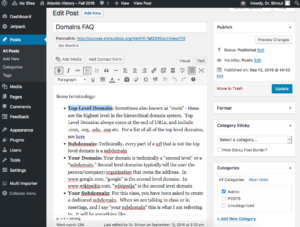
Domains FAQ


Warning: Undefined variable $num in /home/shroutdo/public_html/courses/wp-content/plugins/single-categories/single_categories.php on line 126

Warning: Undefined variable $posts_num in /home/shroutdo/public_html/courses/wp-content/plugins/single-categories/single_categories.php on line 127

Some terminology:

  • Top Level Domain: Sometimes also known as “roots” – these are the highest level in the hierarchical domain system.  Top Level Domains always come at the end of URLs, and include .com, .org, .edu, .usa etc.  For a list of all of the top level domains, see here
  • Subdomain: Technically, every part of a url that is not the top level domain is a subdomain
  • Your Domain: Your domain is technically a “second level” or a “subdomain.” Second level domains typically tell the user the person/company/organisation that owns the address.  In www.google.com, “google” is the second level domain.  In www.wikipedia.com, “wikipedia” is the second level domain
  • Your Subdomain: For this class, you have been asked to create a dedicated subdomain.  When we are talking in class or in meetings, and I say “your subdomain” this is what I am referring to.  It will be something like www.atlantichistory.yourdomain.com.
  • Applications: You can install applications on your domains and subdomains.  However, you can only install one application per subdomain.  Each individual application installed on a subdomain is called an “instance.”  For example, “I see you have a wordpress instance at wwww.courses.shroutdocs.org”
  • WordPress: WordPress is a blogging application.  Like any application, it can be installed.  During the installation, you will be asked to select a user name and password.  That username and password is only for that instance of wordpress.  You will have to set up individual user names and passwords at each wordpress instance (though they can be the same). Once installed, you can work within the application without having to fiddle with the installer.  This is similar to applications you have on your computer or phone – once they are installed via the app store, you don’t need to use the app store to access them.