Chapter 13 of the Atlantic world


Warning: Undefined variable $num in /home/shroutdo/public_html/courses/wp-content/plugins/single-categories/single_categories.php on line 126

Warning: Undefined variable $posts_num in /home/shroutdo/public_html/courses/wp-content/plugins/single-categories/single_categories.php on line 127

The main focus of Chapter 13 of the Atlantic world is the rise of industrialization. The chapter opens by discussing the population boom that England experienced during the mid 18th century to early 19th century, due to advances in technology. The authors then go on to discuss that thanks to this large growth in population and new technologies, this would also lead to a growing working population and demand for textiles. Thanks to these changes there was a need for change in regards to labor, and so this would lead into the growth of the textiles industry.

In this reading, it is noted that the rise of Industrialization meant a shift in slave labor and how it was used. This was also noted by warm turtle tank (Name not given), they note the same thing in regards to industrialization and slavery. Expanding on this, I find it interesting that the rise of industrialization did not eliminate slavery but rather shifted what the emphasis of it was. Instead of slave plantations focusing on tobacco or sugar, as noted in the sugar islands readings, they instead were able to adapt.

Overall I enjoyed this reading, as it talked about a topic which I am interested in. I did however at times get sidetracked as the textbook can be at times a bit “dry” or dull.
…read more

Primary Sources


Warning: Undefined variable $num in /home/shroutdo/public_html/courses/wp-content/plugins/single-categories/single_categories.php on line 126

Warning: Undefined variable $posts_num in /home/shroutdo/public_html/courses/wp-content/plugins/single-categories/single_categories.php on line 127

I plan on doing my final project on British Immigration to the Colonies

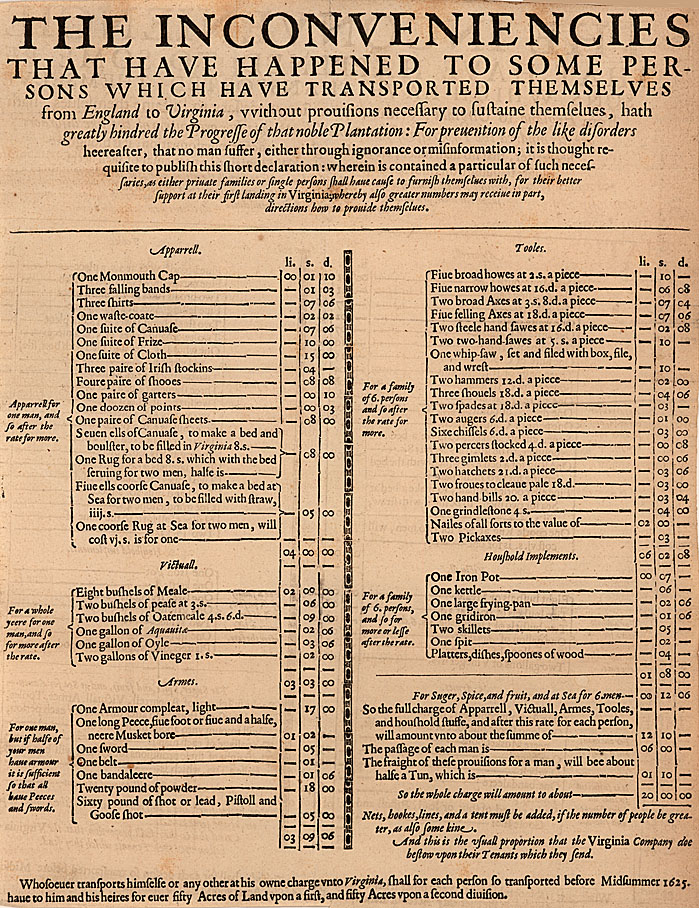
This is a primary source that details what an immigrant going to America should pack. I found it on the John Carter Brown Library.

The second source that I plan to use is an indentured servitude contract for Richard Lowther. I found it on Virtual Jamestown. You can view it here.

The third source that I plan to use is a first-hand account detailing an immigrant’s journey to America. I found it on Virtual Jamestown. You can view it here.

…read more

Industrialization: Atlantic Systems of Profit and Consequence


Warning: Undefined variable $num in /home/shroutdo/public_html/courses/wp-content/plugins/single-categories/single_categories.php on line 126

Warning: Undefined variable $posts_num in /home/shroutdo/public_html/courses/wp-content/plugins/single-categories/single_categories.php on line 127

The late eighteenth and early to mid nineteenth centuries saw the institution of particular technological advancements that fed the industrial appetite of the Atlantic basin. A growing demand for textiles, not satiated by English production alone, led to industrial outbreak in North America. These revolutionary changes showed how interconnected the economies of the Atlantic really were. For example, Britain’s massive industrial demand for raw cotton helped to sustain a slave based society in the southern United States. (Egerton et al, 429) Additionally, “a series of synergistic technological innovations in Britain and the [U.S.] ultimately resulted in the greatest surge of the importation of captive Africans into the United States.” (Egerton et al, 430) By the nineteenth century, Atlantic economies had become so interwoven that any change in any market would impact all corners of the Atlantic basin.

During the industrial revolution, while profits steadily increased for capitalist merchants, technological change was not always positively progressive. Egerton et al argues, “economic gains and improved living standards in one part of the Atlantic basin were reliant on the expansion and intensification of socially and economically retrogressive trends in another.” (Egerton et al, 429,430) More clearly stated, “for every James Watt who grew rich from technology, there were numerous slaves whose bodies were sold into the newly cleared lands of the U.S. cotton South.” (Egerton et al, 453) Moreover, industrialization spawned a new demand of natural resources providing for a fresh imperialistic competition across the Atlantic. The indigenous population of the Congo felt the wrath, and sadly, they made up only a small percentage of the those negatively effected by industrialization and new imperialism.

Women were another demographic effected by industrial revolution. As I was reading the final paragraph of the chapter, I was reminded of Mary Norton’s article and the role white women played in colonial America. In this chapter, Egerton et al provides a positive outlook for white women in post-Revolution New England, claiming good things were said about the putting-out system. “It enabled wives and daughters to combine domestic labor with the larger market and use their earnings to buy mass-produced goods,” directly contributing economically. (Egerton et al, 453) The woman’s role has been and always will be an integral part of any society. As Alec stated in his post concerning the societies of Potosi and the Yoruba, “women did play quite the roll throughout Atlantic history.”

…read more

Primary Sources


Warning: Undefined variable $num in /home/shroutdo/public_html/courses/wp-content/plugins/single-categories/single_categories.php on line 126

Warning: Undefined variable $posts_num in /home/shroutdo/public_html/courses/wp-content/plugins/single-categories/single_categories.php on line 127

1. Garcés, Francisco Tomás Hermenegildo, On the Trail of a Spanish Pioneer, University of Utah-American West Center.
This source was found at the following website:
http://utah-primoprod.hosted.exlibrisgroup.com/primo_library/libweb/action/dlDisplay.do?vid=MWDL&afterPDS=true&docId=digcoll_uuu_11uaida/9207

2. Keith, George. 1706. A Journal of Travels from New-Hampshire to Caratuck: On the Continent of North-America. by George Keith, A.M. Late Missionary from the Society for the Propagation of the Gospel in Foreign Parts; and Now Rector of Edburton in Sussex. London: printed by Joseph Downing for Brab. Aylmer at the Three-Pigeons over-against the Royal-Exchange in Cornhill.

This source was found at the following website:

http://find.galegroup.com.lib-proxy.fullerton.edu/ecco/retrieve.do?inPS=true&prodId=ECCO&userGroupName=csuf_main&tabID=T001&bookId=0032200600&resultListType=RESULT_LIST&contentSet=ECCOArticles&showLOI=&docId=CW3317443825&docLevel=FASCIMILE&workId=CW117443824&relevancePageBatch=CW117443824&retrieveFormat=MULTIPAGE_DOCUMENT&callistoContentSet=ECLL&docPage=article&hilite=y

3. Humphreys, David, 1689-1740, Missionaries Sent to North Carolina, [New Haven, Conn.?: G.B. Bassett?], 1852.

This source was found at the following website:

http://find.galegroup.com.lib-proxy.fullerton.edu/ecco/retrieve.do?inPS=true&prodId=ECCO&userGroupName=csuf_main&tabID=T001&bookId=0032200600&resultListType=RESULT_LIST&contentSet=ECCOArticles&showLOI=&docId=CW3317443825&docLevel=FASCIMILE&workId=CW117443824&relevancePageBatch=CW117443824&retrieveFormat=MULTIPAGE_DOCUMENT&callistoContentSet=ECLL&docPage=article&hilite=y

…read more

Primary Sources


Warning: Undefined variable $num in /home/shroutdo/public_html/courses/wp-content/plugins/single-categories/single_categories.php on line 126

Warning: Undefined variable $posts_num in /home/shroutdo/public_html/courses/wp-content/plugins/single-categories/single_categories.php on line 127
Turning The Tide: How a Small Band of Allied Sailors Defeated the U-boats and Won the Battle of the Atlantic

For my final project I would like to focus on the Battle of the Atlantic and the impact it had on WWII. This key geographical location played a huge role before, during and after the war. With careful observation and historical evidence, I would like to bring forth the details of one of the greatest naval battles in history. My final project will be posted to https://BattleoftheAtlantic.darhino.com.

  1. Offley, Edward. 2011. Turning the Tide : How a Small Band of Allied Sailors Defeated the U-boats and Won the Battle of the Atlantic. New York: Basic Books.
  • -This source is located in the north basement of the Pollak Library at the CSUF Campus. It is a compilation of interviews of sailors and their experience with U-boats on the Atlantic.

2.

  • “Battle of the Atlantic”, Map, University of Minnesota Libraries, Manuscripts Division, Blake, F. Donald (1908-1997), Created 1944. http://umedia.lib.umn.edu/node/46228
  • This source helps give an understanding to the amount of traffic and action the Atlantic faced and its impact globally.

3. 1591149959-01Y’Blood, William T. 2004. Hunter-killer; U.S. Escort Carriers in the Battle of the Atlantic. Annapolis, Md.: Naval Institute Press.

  • This source explores the experience of the U.S. Escort Carriers and how they played a role against the U-boat attacks.
  • This source can be found in the north basement of the Pollak Library at the CSUF campus.

…read more

Atlantic World Chapter 13


Warning: Undefined variable $num in /home/shroutdo/public_html/courses/wp-content/plugins/single-categories/single_categories.php on line 126

Warning: Undefined variable $posts_num in /home/shroutdo/public_html/courses/wp-content/plugins/single-categories/single_categories.php on line 127

Chapter 13 in Atlantic World explains the large migration throughout the Atlantic during the Industrial Age and many of those Europe who migrated to the United States were Irish immigrants. European migration spread throughout the United States because for many immigrants the United States helped many immigrants creating societies and crops. One example of migration was Irish migrants moving from Ireland to the United States. Irish farmers used potatoes as cash to pay their rents to their Protestant English landlords because it was used to bargain as their form of payment and Irish potatoes had value. Potatoes were one of the crops that Irish Farmers had during the 1840s and become the staple of the Irish diet by this time. (Chapter 13, Page 441-442). The reason Irish migrants chose to move to the United States because of debts in Ireland were high and more opportunities to establish homes, crops, and societies. The majority of Irish migration was in the United States, which received 85 percent of Irish immigrants. (Chapter 13, Page 442). I think Irish immigrants’ move to the United States was important because more opportunities for Irish immigrants to build their society by growing crops on their land that these Irish immigrants would live on their land, and hopefully would bring a better feature for these Irish immigrants and their families. There were several European immigrants that moved to Africa because the British owned parts of Africa and had a lot more resources located in Africa. The series of migration helped create production because with European throughout the Atlantic on various countries, it could help trade through production, plantation, and food to help the economy. This reading reminds me of Danny Alvarez’s reading from Caterina Pizzigoni on local indigenous society in Mexico because just like the Irish, the Mexicans had to make payment to their landlords towards their homes. The maguey plants were used for either food or material fuel in Mexico. The maguey gave the Toluca people an ecological advantages to help pay off for their well-being with low-wage rental housing and unequal debts in Mexico.

…read more

Primary Sources


Warning: Undefined variable $num in /home/shroutdo/public_html/courses/wp-content/plugins/single-categories/single_categories.php on line 126

Warning: Undefined variable $posts_num in /home/shroutdo/public_html/courses/wp-content/plugins/single-categories/single_categories.php on line 127

My final project will explore how Spanish Catholicism affected and justified the exploitation and cruel treatment of Indigenous populations and the forced migration of Africans overseas. Listed below are my primary sources:

The Spanish Requirement of 1513

The Spanish Requirement of 1513 was read to Native Americans in Spanish before a conquest was fully executed. The document declared that the Spanish Monarchy had the divine right to conquer new territories and spread Catholicism.

Christopher Columbus’ Journals

The Journals of Christopher Columbus provide insight behind the economic and religious motivations for explorations and colonization. Columbus’ writings offer explanations for why Native Americans were treated brutally, and the writings expose the racist and superior mindsets of the Spanish, often justified through religion.

King Ferdinand’s Letter to the Taino-Arawak Indians

King Ferdinand’s Letter reveals promises of prosperity and success tot eh Taino-Arawak Indians, but at the price of Catholicism and conquering. Here, King Ferdinand hints at Catholic superiority over Atlantic territories.

…read more

Primary Sources


Warning: Undefined variable $num in /home/shroutdo/public_html/courses/wp-content/plugins/single-categories/single_categories.php on line 126

Warning: Undefined variable $posts_num in /home/shroutdo/public_html/courses/wp-content/plugins/single-categories/single_categories.php on line 127
  1. Horne, Charles Francis, and Walter Forward Austin. 1923. Source Records of the Great War: A Comprehensive and Readable Source Record of the World’s Great War, Emphasizing the More Important Events, and Presenting These as Complete Narratives in the Actual Words of the Chief Officials and Most Eminent Leaders Presenting Documents from Government Archives and Other Authoritative Sources, with Outline Narratives, Indices, Chronologies, and Courses of Reading on Sociological Movements and Individual National Activities. [n. p.]: National Alumni. This compilation of sources is found in the Pollack Library north basement.
  2. Purdom, C. B. 1930. Everyman at War: sixty personal narratives of the war. London: J.M. Dent. This source is found in the WorldCat Database.
  3. The Times (London) Digital Archive 1785-1985 (Gale). Artemis Primary Sources. This source is found via the Pollack library primary source tab.

…read more

Primary Sources


Warning: Undefined variable $num in /home/shroutdo/public_html/courses/wp-content/plugins/single-categories/single_categories.php on line 126

Warning: Undefined variable $posts_num in /home/shroutdo/public_html/courses/wp-content/plugins/single-categories/single_categories.php on line 127

Primary Sources

This collection focuses on Cuban sugar production and trade beginning in the late 19th century under Fidel Castro. The Braga Brothers collection, “provides descriptions of the social, political, and economic environment in which Cuban sugar was manufactured.” The archive will give greater context to the later part of sugar culture in the Atlantic.

  • Maps of Sugar Production in Cuba, Hispaniola, and the Madeira Islands.
  • Figures detailing slave production and mortality, Atlantic land prices, and price differences in Mexico, Brazil and Morelos.

The maps and figures listed are located in the text “Tropical Babylons: Sugar and the Making of the Atlantic World, 1450-1680”

…read more

Primary Sources: Plymouth Colony


Warning: Undefined variable $num in /home/shroutdo/public_html/courses/wp-content/plugins/single-categories/single_categories.php on line 126

Warning: Undefined variable $posts_num in /home/shroutdo/public_html/courses/wp-content/plugins/single-categories/single_categories.php on line 127

My final research topic covers the relations between the Pilgrims and the Native Americans in the Plymouth Colony and the surrounding New England area.

Primary Source #1: A Mapp of New England (1676)

Original in the John Carter Brown Library at Brown University

This primary source is a map of Plymouth Colony and the rest of the New England area in 1676. The map shows landmarks like trees and rivers, settlements throughout New England, and colonists and natives engaging in war.

Source

Primary Source #2: William Bradford and the “First Encounter”

published in London, 1622: Pilgrim Hall Museum

This source is a letter written by William Bradford, early explorer of Plymouth and his first encounter with the native population. He writes that in December, 1620, him and a few others were attacked as they heard a horrible shout from the natives. Bradford and the other men sent the arrows left behind to England and called the place where both sides met the “First Encounter.”

Source

Primary Source #3: Edward Randolph’s report of King Philip’s War in New England, 1675.

Smithsonian Source: Smithsonian Center for Education and Museum Studies.

This source briefly discusses reasons for the aggression coming from the Native Americans. Randolph blamed the spread of Christianity to the natives and also blamed Massachusetts for teaching the natives how to use firearms.

Source

…read more