Primary Sources


Warning: Undefined variable $num in /home/shroutdo/public_html/courses/wp-content/plugins/single-categories/single_categories.php on line 126

Warning: Undefined variable $posts_num in /home/shroutdo/public_html/courses/wp-content/plugins/single-categories/single_categories.php on line 127
s1

“Washer-women” The image depicts a scene of slave women domestic labor.

Source: Digital Public Library of America (DPLA)

“Ladies Whipping Girls” The image depicts a slave woman being punished by her female owner.

Source: DPLA

s4

“Branding Slaves” The image depicts black slaves women being branded by their white owners.

Source: DPLA

s5“A Brazilian Family” The image depicts an upper class, slave-holder family.

Source: Getty Image

…read more

Primary Sources: Spanish-American War


Warning: Undefined variable $num in /home/shroutdo/public_html/courses/wp-content/plugins/single-categories/single_categories.php on line 126

Warning: Undefined variable $posts_num in /home/shroutdo/public_html/courses/wp-content/plugins/single-categories/single_categories.php on line 127
Ickringills, Steve J.S. and Hilton, Syliva L. European Perceptions of the Spanish-American War of 1898. Berlin: Peter Lang AG 1999. World Affairs Institute. “An Anglo-American Alliance,” The Advocate of Peace (1894-1920). 60. No. 6. 1898. World Affairs Institute. “A Conflict of two Civilizations,” The Advocate of Peace (1894-1920). 61. No. 3. 1899.
  • Ickringills, Steve J.S. and Hilton, Syliva L. European Perceptions of the Spanish-American War of 1898. Berlin: Peter Lang AG 1999.
  • World Affairs Institute. “An Anglo-American Alliance,” The Advocate of Peace (1894-1920). 60. No. 6. 1898.
  • World Affairs Institute. “A Conflict of two Civilizations,” The Advocate of Peace (1894-1920). 61. No. 3. 1899.

…read more

Primary Sources – The Slave Trade in the Early Americas


Warning: Undefined variable $num in /home/shroutdo/public_html/courses/wp-content/plugins/single-categories/single_categories.php on line 126

Warning: Undefined variable $posts_num in /home/shroutdo/public_html/courses/wp-content/plugins/single-categories/single_categories.php on line 127
atlanta-ship-l

For my topic, I want to go into depth how the United States handled the Slave Trade during the time which this practice was legal. By going back into letters and additional contents in the National Archives, I will try to pinpoint how the Slave Trade was handled by our Founding Fathers and our early American citizens.

Primary Source 1: The Court Case, U.S. v. Schooners

This primary source tells the story about “the illegal importation of slaves.” The following primary source lists the transaction of slave and is used as evidence in a court case. I will use this primary source to see how much slaves were priced at and determine who were the individuals that purchased these slaves.

Provided by the National Archives | Source Link

Primary Source 2: The Five Pages of The Amistad Africans

This primary source, page one of the five-page series shows how the evil of slavery (and the extent of the slave trade) had come to be exposed. I will use this primary source to see how much damage that slavery caused to a population unable to fight back. I will also use these primary source series to see how the slave trade harmed these individuals.

Provided by the National Archives | Source Link

Primary Source 3: Bills of Sale, 1864

slave-receipts-1-mThis primary source gives an insight about slave sales that occurred during the Civil War in 1864. Even though this sale occurred when the United States Slave Trade was abolished in 1808 under legislation signed by President Thomas Jefferson, the slave trade continued even when the American Civil War was going on. I will use this primary source to gain knowledge on how the slave trade continued even though it was considered unlawful due to passed legislation.

Provided by the National Archives | Source Link

*These sources are subjected to change due to more primary sources being found in the near future.*

…read more

Primary Sources for my Final Project about the Trans-Atlantic Trade of Cotton during the American Civil War


Warning: Undefined variable $num in /home/shroutdo/public_html/courses/wp-content/plugins/single-categories/single_categories.php on line 126

Warning: Undefined variable $posts_num in /home/shroutdo/public_html/courses/wp-content/plugins/single-categories/single_categories.php on line 127
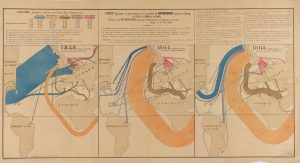
Figurative and approximate map of the quantities of raw cotton imported into Europe in 1858, 1864 and 1865

The following is a list of primary sources I will be using for my final project.

  1. union_blockade

Proclamation of Blockade against Southern Ports

This document is Abraham Lincoln’s proclamation to seal off the Southern Ports from international trade. This blockade severely limited the transportation of raw cotton to Europe

Source

2.

Carte figurative et approximative des quantités de coton brut importées en Europe en 1858, en 1864 et en 1865. (Translated : Figurative and approximate map of the quantities of raw cotton imported into Europe in 1858, 1864 and 1865.)

This map was made by French civil engineer Charles Joseph Minard. The map shows flow of raw cotton prior, during, and after the war are depicted as colored bands. The width of the bands represents the amount of raw cotton imported, with one millimeter representing 5000 barrels. Prior to the U.S. Civil War, most of Europe relied exclusively on the U.S. South as the sole source of this indispensable raw material (blue band). Export blockades during the war changed global trade patterns, instigating a fierce competition between the U.S. (blue band), India and (orange band), and Egypt (brown band)

Source

3.johnbul_cotton-and-wool

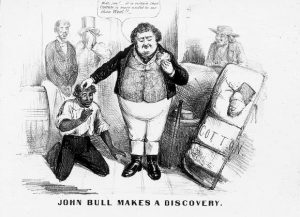
John Bull Makes a Discovery

This source is an anti-British cartoon the print probably appeared in late 1862 or early 1863, when a cotton shortage caused by the Union blockade started to cripple the English textile industry. Diplomatic efforts were then under way by the South to win support for the Confederacy from Britain. Here the artist predicts that the British would abandon its humanitarian antislavery stance in favor of economic self-interest.

Source

4. cotton_burners

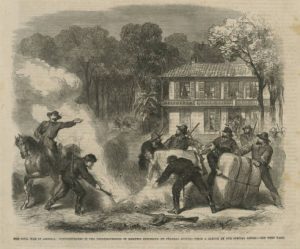
Cotton burners in the Neighborhood of Memphis Surprised by Federal Scouts.

Confederate leaders believed an embargo and shortage of cotton would lead Great Britain and France would intervene in the Civil War as well as recognize the Confederacy as an independent country. In order to create a shortage, around 2.5 million bales of cotton were burned. This reduced the amount of cotton bales exported to Europe from 3 million bales in 1860 to mere thousands a year later. Known as King Cotton diplomacy, this venture would severely backfire on the South.

Source

…read more

Primary Sources


Warning: Undefined variable $num in /home/shroutdo/public_html/courses/wp-content/plugins/single-categories/single_categories.php on line 126

Warning: Undefined variable $posts_num in /home/shroutdo/public_html/courses/wp-content/plugins/single-categories/single_categories.php on line 127
03618-1

1678 Untitled

Collection: JCB Archive of Early American Images
Original in the John Carter Brown Library at Brown University

Scenes from the life of a pirate. Six vignettes show scenes of torture, cannibalism, naval battle, and warfare. Two pirates stand on either side of title; one pirate steps on a native American in feathered headdress who clutches riches, the other steps on a European gentleman who begs for mercy.

1700 Untitled

Collection: JCB Archive of Early American Images
Original in the John Carter Brown Library at Brown University

Two pirates flank the title. One draws his sword at a man lying at his feet who offers up money. The other stands above a black [slave] who lies on an ingot of gold [?] and coins. In the background are a town buring and a scene of warfare.

02724002

Brief van den Spaenschen Generael Don Alonzo del Campo Spinoce, aen Morgan Admirael van de Rovers

Collection: JCB Archive of Early American Images
Original in the John Carter Brown Library at Brown University

Scene of naval warfare and an attack by pirates on a town. Built environment includes ships, boats, and fortifications.

05014008

Naval attack on seaport

Collection: JCB Archive of Early American Images
Original in the John Carter Brown Library at Brown University

Ships attack fortifications and town. Includes scene of naval warfare, cannons firing, churches, and dwellings.

…read more

Primary Sources: Pocahontas and European Worldviews


Warning: Undefined variable $num in /home/shroutdo/public_html/courses/wp-content/plugins/single-categories/single_categories.php on line 126

Warning: Undefined variable $posts_num in /home/shroutdo/public_html/courses/wp-content/plugins/single-categories/single_categories.php on line 127

John Smith’s Letter to Queen Anne of Britain, 1616. Digital History.

In his letter to Queen Anne, John Smith mentions his capture by the Powhatans and Pocahontas’ attempt to save him. He also notes her assimilation in European society, as well as mentioning her rejection of indigenous dress and tradition.

Source

John Smith’s General Historie of Virginia, 1624. Digital Public Library of America.

The following account is an excerpt from John Smith’s journals of his voyages. He discusses his capture by the Powhatans and how Pocahontas prevented them from killing him.

Source

John Rolfe’s Letter to Thomas Dale, 1624. Virtual Jamestown.

John Rolfe asks Thomas Dale to bless his marriage to Pocahontas, and he believes their relationship would be beneficial to the colonies. He goes into detail about his affection for Pocahontas, and how their Christian beliefs would inspire them to serve God through any means.

Source

…read more

The Difference in Roles of Enslaved African-American Women and African Women


Warning: Undefined variable $num in /home/shroutdo/public_html/courses/wp-content/plugins/single-categories/single_categories.php on line 126

Warning: Undefined variable $posts_num in /home/shroutdo/public_html/courses/wp-content/plugins/single-categories/single_categories.php on line 127

For this topic, I wrote on the difference in roles between African women and African-American women who were enslaved. It was much more difficult to find sources for the African women, however, it was fairly easy to find sources for African-American women. There are many depictions of slave women in the form of images, and a few in text form.

“Slave Woman,” Antebellum South, Photograph, University of Georgia Libraries through New Georgia Encyclopedia

This depicts a slave woman doing a traditionally female role, which is washing the clothing. It shows female slaves did a multitude of roles, including more traditional gender roles.

Source

“Slave Women Cultivating A Village Garden,” Central Africa, Print, University of Virginia Library

This depicts women working in Africa doing similar roles to those they did in the Americas. It also only depicts women, and it depicts them in their more traditional African attire.

Source

“Inspection Roll of Negroes Book No. 1,” 4/23/17939/1793, National Archives Catalog

This depicts an inspection roll of Africans who were forced into slavery. It discusses men as well as women, however, it makes notes of each woman’s physical attributes. It shows how female slaves were valued, and why they were valued that way.

Source

Pierre Havens, “Slave Family,” 1850’s, Photograph, New York Historical Society through New Georgia Encyclopedia

This depicts a slave family picking cotton outside of Savannah. It includes the whole family, and shows both young girls and their mother working alongside men.

Source

Henry Byam Martin, “Slave Market,” 1833, Pen and Ink Drawing, Library and Archives Canada through New Georgia Encyclopedia

This depicts a slave market in Charleston South Carolina in 1833. The text depicts “‘The land of the free & home of the brave.”

Source

“Slave Women in a Cotton Field,” Antebellum South, Print, Digital Library of Georgia through New Georgia Encyclopedia

This depicts slave women working in a field, without the overwhelming presence of men. It also shows young girls working as well alongside older women.

Source

Harriet Jacobs, “Incidents in the Life of a Slave Girl,” 1861

This is a memoir written by Harriet Jacobs, herself a slave, about her experiences with slavery. It explores the struggles that she, as well as other female slaves, had to deal with as female slaves on plantations. It is one of the only written memoirs by a female slave about her experiences.

Source

…read more

The Difference in Roles of Enslaved African-American Women and African Women


Warning: Undefined variable $num in /home/shroutdo/public_html/courses/wp-content/plugins/single-categories/single_categories.php on line 126

Warning: Undefined variable $posts_num in /home/shroutdo/public_html/courses/wp-content/plugins/single-categories/single_categories.php on line 127

For this topic, I wish to write on the difference in roles between African women and African-American women who were enslaved. It was much more difficult to find sources for the African women, however, it was fairly easy to find sources for African-American women. There are many depictions of slave women in the form of images, and a few in text form.

“Slave Woman,” Antebellum South, Photograph, University of Georgia Libraries through New Georgia Encyclopedia

This depicts a slave woman doing a traditionally female role, which is washing the clothing. It shows female slaves did a multitude of roles, including more traditional gender roles.

Source

“Slave Women Cultivating A Village Garden,” Central Africa, Print, University of Virginia Library

This depicts women working in Africa doing similar roles to those they did in the Americas. It also only depicts women, and it depicts them in their more traditional African attire.

Source

“Inspection Roll of Negroes Book No. 1,” 4/23/17939/1793, National Archives Catalog

This depicts an inspection roll of Africans who were forced into slavery. It discusses men as well as women, however, it makes notes of each woman’s physical attributes. It shows how female slaves were valued, and why they were valued that way.

Source

Pierre Havens, “Slave Family,” 1850’s, Photograph, New York Historical Society through New Georgia Encyclopedia

This depicts a slave family picking cotton outside of Savannah. It includes the whole family, and shows both young girls and their mother working alongside men.

Source

Henry Byam Martin, “Slave Market,” 1833, Pen and Ink Drawing, Library and Archives Canada through New Georgia Encyclopedia

This depicts a slave market in Charleston South Carolina in 1833. The text depicts “‘The land of the free & home of the brave.”

Source

“Slave Women in a Cotton Field,” Antebellum South, Print, Digital Library of Georgia through New Georgia Encyclopedia

This depicts slave women working in a field, without the overwhelming presence of men. It also shows young girls working as well alongside older women.

Source

Harriet Jacobs, “Incidents in the Life of a Slave Girl,” 1861

This is a memoir written by Harriet Jacobs, herself a slave, about her experiences with slavery. It explores the struggles that she, as well as other female slaves, had to deal with as female slaves on plantations. It is one of the only written memoirs by a female slave about her experiences.

Source

…read more

Week 12 The Life Within


Warning: Undefined variable $num in /home/shroutdo/public_html/courses/wp-content/plugins/single-categories/single_categories.php on line 126

Warning: Undefined variable $posts_num in /home/shroutdo/public_html/courses/wp-content/plugins/single-categories/single_categories.php on line 127

In Caterina Pizzigoni’s work The Life Within: Local Indigenous Society in Mexico’s Toluca Valley, 1650-1800 the social structure and customs of the Toluca valley residents are described. The first pages of Ch. 5 set out to illustrate the importance of agriculture in this community. In the first few pages we are introduced to examples of maguey (this is apparently some type of agave) being willed away like property would be today, there are also examples of this involving livestock like pigs and oxen. I agree with my peer Diana that oxen seemed important to the people of the valley because they were used for food, agriculture and rarely collateral for loans. While some indications of egalitarianism are found in the culture of the valley, it seems to be drowned out by the influence of Spanish culture and the desire for monetary wealth.

The emphasis this book puts on the economy of a specific region has a lot of similarities with previous works we have read this semester. Some examples include Mangan’s work on Potosi and how the city existed solely for the purpose of economic gain. A better example may be the Murder on the saltwater frontier article which kinda describes how imperialistic ideas changed how people of different regions traded and operated.

…read more

chaper 5 wubalubadubub


Warning: Undefined variable $num in /home/shroutdo/public_html/courses/wp-content/plugins/single-categories/single_categories.php on line 126

Warning: Undefined variable $posts_num in /home/shroutdo/public_html/courses/wp-content/plugins/single-categories/single_categories.php on line 127

Chapter 5 of Caterina Pizzigoni’s, “The Life Within,” highlights the important details and semantics related to indigenous Mexican society and practices that separate those populations from normative European colonial traditions. Maguey was a plant that presented new opportunities for an indigenous group who previously relied on maize for sustenance. The fact that Maguey was a symbol of equal representation between genders demonstrates an objective look at intercommunal working in central Mexico in the early 18th century. Pizzigoni’s work demonstrates how colonial intervention affected the consumption and production of Maguey based liquor consumption. Those reactions not only sahped steroty[e pf indigenous people, but constructed legislation and oppression of a minority voice. Individual accounts of women capable of capitalizing on the labor andproductivity are shown in the readings nad demonstrate lentjs officials would go through to maintain hegemonic control. Maguey presented new elements of economic representation that posed problems for a sydtematically controlled economy with a Eurocentric empshasis . Taxation is theft. Don’t tread on me. Free Mumia. Free all political prisoners. Salute all comrades involved in the October revolution. Diana was correct when she said, “Their day usually consists of maguey cultivation and exploitation, raising livestock and domestic animals, trading in land, hocking and moneylending.”

…read more