Hero of Two Worlds


Warning: Undefined variable $num in /home/shroutdo/public_html/courses/wp-content/plugins/single-categories/single_categories.php on line 126

Warning: Undefined variable $posts_num in /home/shroutdo/public_html/courses/wp-content/plugins/single-categories/single_categories.php on line 127

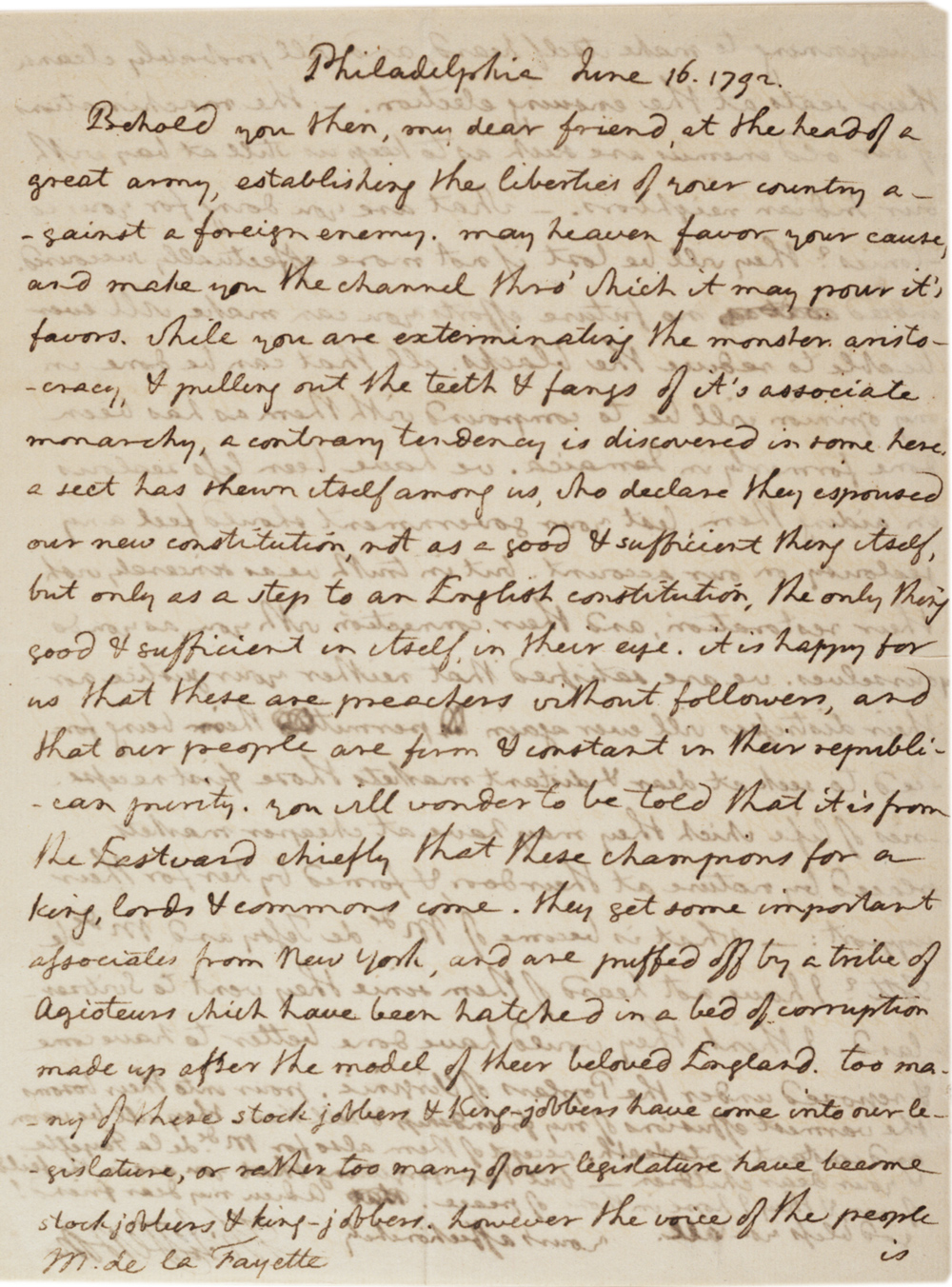
This title speaks volumes. I will revisit this thought later. At the time of Jefferson’s letter, France was deep in the throws of revolution, both in the metropole and in its Haitian colony. Not being too far removed from revolution himself, Jefferson touched on the ideals of a constitutional republic, referring to the extermination of the “monster aristocracy” and the torturous dental work for “it’s associate monarchy.” (Jefferson, 1) The letter finds the Marquis de LaFayette on the Austrian front, fighting for a country undergoing a massive renovation. Ironically, the French commoners continued to demand the rights spelled out in, The Declaration of the Rights of Man and of the Citizen, while their counterparts simultaneously subjugated African American slaves on the sugar plantations of Saint Domingue. Jefferson, a collaborator of the French declaration for human rights and composer of the Declaration of Independence, advises the Marquis that the “blacks” will continue their revolt against enslavement (as in Jamaica in the 1760’s) and there exists no real solution but to “compound with them.”

As for the title of my blog post, the Marquis may truly be the “Hero of Two Worlds.” Adopting the revolutionary cause, LaFayette led troops in rebellion against the English crown and lobbied for much needed French support on the behalf of colonial Americans. Crossing the Atlantic, he championed a similar cause in his home nation, mediating the growing controversy between the crown and its people. He fought selflessly on two Atlantic continents for the establishment of a government for the people and by people, in order to preserve the inalienable rights of mankind. I disagree with Viktoriya’s assumption that Jefferson’s letter does not address any large concerns. Two thoughts: First, the Marquis is in the fight of his life, both domestically and internationally. He is teetering on a fine line; on one side are his revolutionary ideals, and on the other, his nationalistic pride as the protector of the French Crown. Reassurances from a fellow revolutionary and collaborator reinforced the Marquis’ ideology and motivated him to continue his mission. Secondly, the “black” issue raised by Jefferson called into question the integrity of both The Declaration of the Rights of Man and of the Citizen, and the Declaration of Independence, two documents both men had a hand in creating. These men were both extremely influential in their respective nations. The French abolished slavery two years after this letter was written. The Americans wouldn’t follow suit for another sixty some odd years.
…read more

Week 11: Early Startings – “Thomas Jefferson’s Letter to Marquis de Lafayette”


Warning: Undefined variable $num in /home/shroutdo/public_html/courses/wp-content/plugins/single-categories/single_categories.php on line 126

Warning: Undefined variable $posts_num in /home/shroutdo/public_html/courses/wp-content/plugins/single-categories/single_categories.php on line 127

In Thomas Jefferson’s letter to France’s Marquis de Lafayette in June 1792, it explains about the current state of government in the United States Congress. Jefferson makes the point that British monarchy loyalists have found themselves elected (in the United States House of Representatives) or appointed (in the United States Senate; senators were not directly elected until the ratification of the 17th Amendment) to further their respective agenda. While the letter does find that Jefferson is annoyed by this factor, he does not worry about it too much because the American public would eventually remove these individuals out of power. Once Jefferson finishes his statement, he wishes his friend well in his battles that are happening in France.

When Thomas Jefferson mentioned that those that are holding office in the US House of Representatives and US Senate are British monarchy loyalists, Allison Roberts makes a point that I could not code out when I read this. The individuals that Jefferson was mentioning are those who would prefer to be “commons, kings, and lords.” This letter has shown that the United States still had a long way in finding their own identity in the representation of their government. Those improvements that Jefferson mentioned are the following: improving the understanding of philosophies that government representatives have, evolution of government, and formation of alliances that will last the test of time.

…read more

Pri-Mary Keep on Burning (cliche historical narratives)


Warning: Undefined variable $num in /home/shroutdo/public_html/courses/wp-content/plugins/single-categories/single_categories.php on line 126

Warning: Undefined variable $posts_num in /home/shroutdo/public_html/courses/wp-content/plugins/single-categories/single_categories.php on line 127

Primary sources display nuances and complexities in history that are taken for granted when studying the past. Historical actors often take on narratives and become pigeonholed by researchers looking to confirm their own biases. The late 18th century is a good example of these dynamic modes of thought due to the revolutionary nature of prominent states. France, America, and Haiti all underwent revolutions during that time that presented the challenge of balancing new ideas of democratic representation and a tyranny of the majority.

Thomas Jefferson specifically is a historical agent who is commonly seen as a genocidal sociopath. Jefferson telling Marquis de Lafayette that he “sincerely” wishes for the restoration of “the Blacks,” could pose a problem for a person who already has their mind made up on Americas 3rd president. Was Jefferson simply playing the hand he was dealt? Did he have a sympathetic side that he could not show for political reasons? Or was he simply part of an emerging aristocratic class whose dependence relied on rhetoric concerned with liberty and human rights in congruence with the extinction of Indian populations and free black labor.

As God fearing Americans how can we possibly accept the idea of Paul Revere being anything other than the hero on the horse who warned people of an impending British presence? The idea of his publications being simply war propaganda seems blasphemous. The Beastie Boys did not write their iconic song, named after Revere himself, for the man to be slandered by modern day “intellectuals” and “academics.” Sometimes, however, you have to call a spade a spade (intentionally ironic and possibly problematic? You be the judge,) and acknowledge that primary historical sources, placed in context with credible modern research, can illuminate history’s deafening silences.

Kyle Kelsay is right when he says, “Americans wanted to create their own identity because they did not want to be like the British sibling in North America which resulted in unity within Americans in communities, religion, and economics.” Sometimes they did it like this, sometimes they did it like that, and sometimes they did it with a wiffle ball bat. Individual motives behind specific actions throughout history rely on an objective combination of first hand accounts and fact based arguments.

-Vince

…read more

“Friendly Insight”-Jefferson to Lafayette Letter: Week 11


Warning: Undefined variable $num in /home/shroutdo/public_html/courses/wp-content/plugins/single-categories/single_categories.php on line 126

Warning: Undefined variable $posts_num in /home/shroutdo/public_html/courses/wp-content/plugins/single-categories/single_categories.php on line 127
Thomas Jefferson Letter to Marquis de Lafayette

Reviewing Thomas Jefferson’s Letter to Marquis de Lafayette was very intriguing. Being able to see this primary source, especially by one of our great founding fathers was from a historical aspect very enlightening. The content within this letter consisted as an update regarding the colonies to Lafayette was off at war. Jefferson takes notice to the English supporters still trying to infiltrate the newly formed American legislature. His fear is that while the people are still trying to find their voice that they will lose the seats within the legislature to those who still pledge to England and not their revolution. It was however also those who originally supporting the revolution also turning to back to English idealism and wanting to make America in the likes of England.

In the later part of his letter, Jefferson addresses the topic of African slaves within the colonies and what he believes America should do with them. As Viktoriya stated, I to believe that Jefferson realized that there was no way to rid america of the blacks and that it would be a process of learning to accept their presence.

Thomas Jefferson Letter to Marquis de Lafayette

This primary source offers an insight into not only politics but also slavery, foreign relations of the day. Without letters such as Jefferson’s to Lafayette, it would not be as easy to historical piece together the context of the 18th century and all that transpired on the Atlantic coast.

…read more

Paul Revere’s Boston Massacre Print


Warning: Undefined variable $num in /home/shroutdo/public_html/courses/wp-content/plugins/single-categories/single_categories.php on line 126

Warning: Undefined variable $posts_num in /home/shroutdo/public_html/courses/wp-content/plugins/single-categories/single_categories.php on line 127

When thinking about the Boston Massacre, this print definitely comes to mind. This iconic print by Paul Revere helped push more of an anti-British public opinion among the colonists who were already fed up with the constant bombardment of taxes being issued from Great Britain. On a cold evening on March 5, 1770, sailors began to throw rocks and snowballs at British soldiers. Many British soldiers were in Boston in 1770 due to high tension between the Great Britain and the colonists. Shots were fired resulting in five sailor deaths, including Crispus Attucks, an African American who would be remembered for his bravery.

Paul Revere’s print is an example of American propaganda, trying to persuade colonists that it was time to stand up to the suffocating British. By looking at his print, one thing that I noticed was that I could not find Crispus Attucks. While he was in the print, he was not painted African-American. Another interesting aspect of Revere’s print was that he had the British soldiers in a line pointing their guns at the defenseless colonists. History says that the British were not the aggressors, rather it was the snowball-throwing colonists. Adding to that point, there is no snow on the ground for the colonists to pick up in Revere’s print.

The Boston Massacre played a huge role that led to the American Revolution. Paul Revere took a chance and it added fuel to the Patriot cause. While war did not start right after, revolt was in the Boston air. The Boston Massacre showed that British and colonist cooperation could no longer exist. I agree with my classmate Andre Escalante that cultural distinctions between the British and the colonists continued to grow. I believe there was an evident growing difference on how to run the colonies. Lastly, I found it interesting that this event was labeled as a massacre when only five men died. I believe that by using the term massacre, it was more propaganda to show how horrible the British treated colonists and it was finally time to kick them out of Boston and the rest of the colonies.

…read more

Thomas Jefferson to the Marquis de Lafayette


Warning: Undefined variable $num in /home/shroutdo/public_html/courses/wp-content/plugins/single-categories/single_categories.php on line 126

Warning: Undefined variable $posts_num in /home/shroutdo/public_html/courses/wp-content/plugins/single-categories/single_categories.php on line 127

Thomas Jefferson seemed to be writing the concerns he had for the future of American to his friend. He states his annoyance at those trying to bring unwanted aspects of England into America. Such as commons, kings, and lords. He considers them to be puffed up and have no place in American politics. He seems to have a lot of faith in the American people and their ability to choose what they want saying these people will be cleansed from their seats in the next election. So while he is concerned it also seems like he has a lot of hope for the future of America. This is similar to Viktoriya’s post in which she discusses similar things about this primary source. I agree that Jefferson seems to be updating an old friend on America’s current status and is also annoyed with the idea of resorting back to British ways but is also optimistic about an American future.

…read more

Thomas Jefferson to the Marquis de Lafayette


Warning: Undefined variable $num in /home/shroutdo/public_html/courses/wp-content/plugins/single-categories/single_categories.php on line 126

Warning: Undefined variable $posts_num in /home/shroutdo/public_html/courses/wp-content/plugins/single-categories/single_categories.php on line 127

In Jefferson’s letter to Lafayette, Jefferson speaks about the current conflicts in the United States. He discusses that the loyalists to the king of England have infiltrated their legislature. Although he is unhappy about this infiltration, he is not extremely worried about it because he explains that the voices of the people are being heard. Soon the people will cleanse these seats that have been taken by people who do not have America’s best interest at hand, and they will be given to revolutionaries. Lafayette was a French general who fought in the revolution of the United States. Jefferson called him a friend and wished him well on the battlefield. Jefferson held him in very high esteem addressing him first by saying that he is the head of a great army and may good keep him in his favor.

In Robert Deleon’s post on Hamilton’s America he states, Hamilton’s tale is essential in understanding how difficult it was to establish and maintain an American nation during and after the revolutionary war. I think this letter from Jefferson to Lafayette expresses some of the difficulties that Jefferson also faced in attempting to establish and maintain an American nation. Jefferson discusses the Africans and what can be done with them in the colonies. He says that it is not possible to rid America of them so they will have to accept their presence and continue living side by side with them. The letter does not address any large concerns though, it seems more like a letter to send an update to Lafayette, like their correspondence was a common occurrence.

…read more

Blood in the Street: The Boston Massacre Painting


Warning: Undefined variable $num in /home/shroutdo/public_html/courses/wp-content/plugins/single-categories/single_categories.php on line 126

Warning: Undefined variable $posts_num in /home/shroutdo/public_html/courses/wp-content/plugins/single-categories/single_categories.php on line 127

The Boston Massacre was a knife to the gut for colonists and a tipping point in the course of American History. In 1770, Boston was occupied by the British Royal Navy and its people were hit hard by taxes on stamps, tea and molasses for rum. Tensions between the colonists and Great Britain were already, but then on the cold night of March 5, 1770 it reached a fever pitch when several angry colonists pelted the redcoats with snowballs. Outraged, the redcoats grabbed their muskets and fired upon the crowd of protestors. This painting, illustrated by Paul Revere, a silversmith and Son of liberty, used it as propaganda to end the bloody mess and tension between the colonies and England.

This painting is crucial to understanding what times were like in the colonies, especially with England`s grasp on foreign territory. As you can see, it was anything but a mutual relationship because people fled England due to high taxes and taxation without representation. Much to the dismay of the colonists, Great Britain followed the rebels to New England in order to suck every penny out of them to pay off war debt from the French and Indian War of 1756-1763. This was more of an imperialist approach because Great Britain wanted to conquer the globe, even if it moved a little bit too fast. On the other hand, this massacre could have been a scare tactic on the Americans because Kyle Kelsay’s Post says it might have been used to demonstrate Great Britain’s power over the colonies. It definitely worked, for America, because civilians were killed and angered them into declaring war.

It is considered by many to be the driving force behind America’s fight for freedom because it was a small nation against the mighty British Empire. It was a call to arms like none other before. So much so, the Boston Massacre is as the straw that broke the camels back and brought Americans together to fight off this dastardly empire from pushing them further and further under the tight grip of imperialism and King George’s thumb.

…read more

Paul Revere Boston Massacre Print in 1770


Warning: Undefined variable $num in /home/shroutdo/public_html/courses/wp-content/plugins/single-categories/single_categories.php on line 126

Warning: Undefined variable $posts_num in /home/shroutdo/public_html/courses/wp-content/plugins/single-categories/single_categories.php on line 127

Paul Revere’s print explains the brutal shooting of the British Soldiers towards the American citizen who were living in Boston under British Rule during the Boston Massacre. Paul Revere explains how violent the British Soldiers were by shooting unarmed American citizens creating one of most famous events in American History known as the Boston Massacre. One of the American civilians started the shooting because he threw an object towards the British Soldiers and hitting one of them which resulted in the massive shooting in Boston. I think the British might have bated the American civilians into fighting them because once own or several objects were thrown towards them, with one object hitting a British Soldier then the shooting started. One of the examples in the image shows the British Soldiers firing their guns straight towards the American civilians and men being shot and laying on the ground while others trying to get away from the shots being fired towards them. I think the Americans wanted to separate from the British because of the high taxes, loss of jobs, and British owning most of their land. In the image, the American civilians charged together as one because this showed a sign of unity of American trying to be united as one. This printed image by Paul Revere gives an American prospective as British Soldiers shooting at unarmed Americans causing one the most brutal and tragic events in Massachusetts and American History. I agree with Matthew Liivoja relating to North America’s Eastern Seaboard being fed up with British rule because they were trying to have a virtual monopoly within the Northeast through production, trade, and communities. Matt brings good points of how the American wanted to be united and start their own identity pulling away from the British. Americans wanted to create their own identity because they did not want to be like the British sibling in North America which resulted in unity within Americans in communities, religion, and economics. By 1776, the United States eventually became an independent nation and creating their own identity through commercial, economics, and colonies.

…read more

Paul Revere’s Boston Massacre: Propaganda for Unification


Warning: Undefined variable $num in /home/shroutdo/public_html/courses/wp-content/plugins/single-categories/single_categories.php on line 126

Warning: Undefined variable $posts_num in /home/shroutdo/public_html/courses/wp-content/plugins/single-categories/single_categories.php on line 127

Paul Revere’s 1770 engraving of the Boston Massacre played a role in uniting colonists against British forces on their land. This piece of propaganda emphasized British soldiers as the enemy, since they are pictured holding a firm stance and smiling upon the colonists as they fire upon them. The colonists are portrayed as victims, looking helpless as chaos and death unfolds before their very eyes. People are packed together as men die among them, with many looking at the situation with horror. The idea of ordinary citizens not reacting against British forces in this artwork frustrated colonists. They were angry at the notion that Britain would eventually take over their country, with no one taking direct action against an oncoming force. In reality, there was already resistance against British soldiers since colonists assaulted them before the shooting began. It can be said that Paul Revere’s engraving was successful in uniting colonists against the British, even when it meant fabricating events of the Boston Massacre.

I agree with Matthew Liivoja that the Boston Massacre led to further conflict between colonists and the British. The majority of colonists were already upset at the British government’s excessive taxation of goods, and civilian deaths at British hands pushed colonists to the breaking point. They realized they had to unite in order to resist British control, fighting for their rights to become an independent country. Ordinary people no longer wanted to be tied to Britain’s legislature or social structure. Whether by force or petition, citizens of the future United States came together to eliminate every trace of British authority from their lands.

…read more